Gastric-Emptying Tachyphylaxis and Exposure Pattern
Sustained GLP-1 receptor stimulation slows gastric emptying less over time, while intermittent stimulation keeps its effect. The model is repeated as settled. The human evidence under it is a handful of small studies.
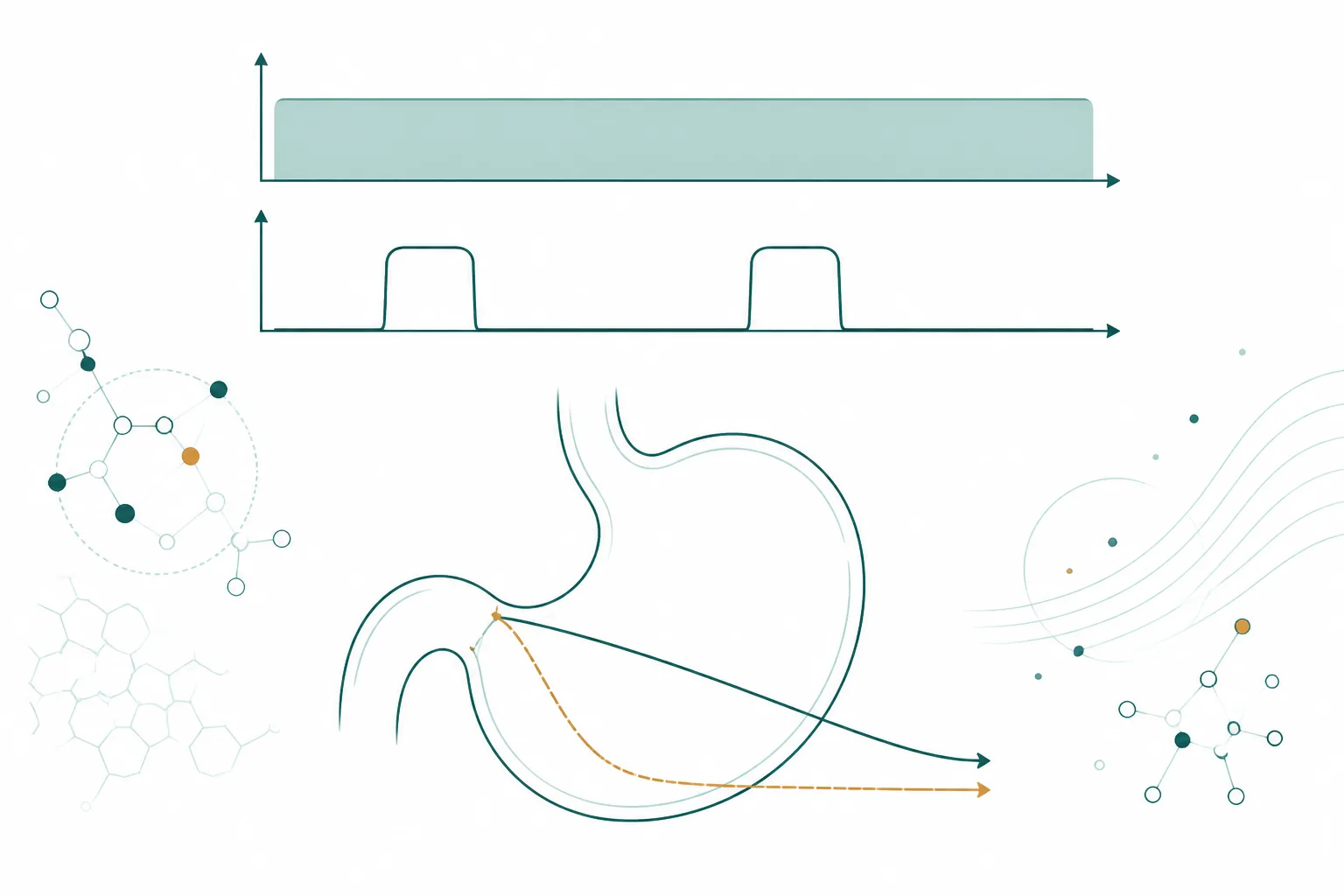
Because gastric emptying is controlled through a nerve pathway that adapts to sustained stimulation, and the adaptation does not occur when the stimulus stops between exposures. In a crossover study of ten healthy men, the slowing of gastric emptying by GLP-1 was marked after a single acute infusion, attenuated with a continuous 24-hour infusion, and maintained with two separated infusions 1. That is the strongest human evidence for the model, and it is a study of ten people receiving an infused native hormone. Evidence tier is stated for each section below, because it varies from human crossover to rodent.
Diabetes-therapy reviews routinely present the tachyphylaxis model as settled and extend it to every long-acting drug in the class. The sources reviewed here support a narrower statement: attenuation is demonstrable, its location is only partly resolved, and the longer-acting drug trials show attenuation rather than disappearance.
Gastric emptying as a pharmacodynamic endpoint
Evidence tier for this section: human methodological review. Scintigraphy, which follows a radiolabelled meal through the stomach, remains the reference method, but the technique is not standardised, and the test meal best suited to assess symptoms may differ from the one best suited to assess glycaemic control 7. The stable isotope breath test is an alternative that can be performed in an office-based setting. Several of the studies below use cheaper surrogates, such as the absorption of paracetamol, which infers emptying from the rate at which an ingested marker appears in blood 56.
The endpoint matters because the same word, "slowed", can describe different quantities. A change in the half-emptying time of a solid meal, a change in the area under a marker curve in the first hour, and a change in liquid emptying are not interchangeable, and they respond differently to the same agonist. A claim about tachyphylaxis should name the meal, the measurement and the timepoint.
The crossover infusion study
Evidence tier for this section: human randomised, double-blind crossover, ten healthy men, infused native GLP-1. Each participant received saline, a continuous 24-hour infusion called prolonged, two 4.5-hour infusions separated by 20 hours called intermittent, and a single 4.5-hour infusion called acute. Emptying of a radiolabelled meal was measured by scintigraphy 1. The design isolates exposure pattern as the variable: it is the same ligand and the same receptor, given in different temporal shapes.
An earlier study examined the effect within a single day. Nine healthy volunteers received an 8.5-hour infusion with two liquid meals four hours apart. The deceleration of emptying was significantly greater after the first meal than after the second 2. Together the two studies establish that attenuation can appear within hours and that a gap in exposure prevents it. Both are small, both enrolled healthy volunteers without obesity or diabetes, and neither tested a drug designed for therapeutic use.
What attenuated and what was preserved
Evidence tier for this section: human crossover, same two studies. In the 24-hour comparison, acute GLP-1 markedly slowed gastric emptying, the magnitude of slowing was attenuated with prolonged infusion and maintained with intermittent infusion, and postprandial glycaemia was potently diminished during acute and intermittent regimens 1. The authors drew the practical inference that short-acting agonists may be superior to long-acting agonists when the aim is specifically to reduce postprandial glycaemic excursions.
In the within-day study, glucose concentrations declined after the first meal but rose after the second, and insulin and glucagon responses also differed between meals 2. The attenuation therefore did not affect emptying alone. What was preserved is less well described than what was lost, and the studies do not report whether other actions of the receptor, such as those on insulin secretion, were equally sensitive.
| Study | Evidence tier | Participants or animals | Exposure | Gastric-emptying finding |
|---|---|---|---|---|
| Umapathysivam et al., 2014 | Human crossover | 10 healthy men | Acute, intermittent and 24-hour prolonged GLP-1 infusion | Slowing attenuated with prolonged, maintained with intermittent |
| Nauck et al., 2011 | Human crossover | 9 healthy volunteers | 8.5-hour infusion, two meals 4 hours apart | Greater slowing after first meal than second |
| Jelsing et al., 2012 | Rat | Rats given two agonists for 14 days | Full 24-hour exposure against shorter exposure | Effect diminished with the full-exposure drug, retained with the other |
| Halawi et al., 2017 | Human randomised trial | 40 adults with obesity | Long-acting agonist or placebo, 16 weeks | Delay present at week 5 and week 16, smaller at week 16 |
Where the desensitisation sits: receptor, neuron or circuit
Evidence tier for this section: human, indirect biomarker; the rest is inference. In the within-day study, the reduction in pancreatic polypeptide levels, a marker of vagal activation, appeared after the first meal but not the second. The authors concluded that the tachyphylaxis occurs at the level of vagal nervous activation 2. That is a measurement of an indirect marker in nine volunteers. It places the adaptation on the neural pathway between the stimulus and the stomach, and it does not distinguish receptor internalisation from a change in neuronal responsiveness or in downstream circuit gain.
The distinction is not pedantic. Receptor desensitisation, receptor downregulation and circuit-level adaptation have different time courses and different reversibility, as the general framework of receptor pharmacology sets out. A model that locates the effect at the level of the receptor predicts one pattern of recovery after a gap in exposure, a circuit adaptation another. The infusion studies measured the first hours and the first day. They did not measure recovery.
Short-acting against long-acting agonists: the inference and its limits
Evidence tier for this section: rat study, plus mechanistic extrapolation. In rats dosed twice daily for 14 days, two agonists with different pharmacokinetics both produced robust acute reductions in gastric emptying. After 14 days the effect was markedly diminished with the agonist that gave full 24-hour exposure, whereas the shorter-acting one retained a profound reduction. Both had similar effects on body weight 5. The authors concluded that the gastric receptors are subject to desensitisation, that the effect depends on full 24-hour exposure, and that appetite signalling in the brain, not emptying, is the main mechanism of the weight effect.
This is the origin of the short-acting versus long-acting framing, and it has two limits. It is a rat study with doses chosen for similar acute effects. And an infusion regimen is not a drug: the 24-hour infusion in the human crossover reproduces continuous exposure, but it does not reproduce the peaks and troughs of a once-daily or once-weekly injection. Applying the model to a specific marketed molecule is an inference from the exposure pattern, not a finding about that molecule.
Conflicting results in the longer-acting literature
Evidence tier for this section: human randomised trials of long-acting agonists. In a single-centre randomised pilot trial of 40 adults with obesity, a long-acting agonist delayed gastric emptying of solids at 5 weeks (median 70 minutes against 4 minutes with placebo) and at 16 weeks (30.5 minutes against −1 minute) 3. The delay at week 16 was less than half the delay at week 5. It was also still present and statistically significant. A later 16-week trial of 136 adults reported that the half-emptying time of solids was slowed at both 5 and 16 weeks, each with P below 0.001 4.
A crossover trial of a once-weekly agonist in 30 adults with obesity found that first-hour gastric emptying was delayed after 12 weeks, with an estimated treatment ratio of 0.73, but that overall emptying across five hours was not statistically different from placebo 6. These results fit attenuation with a retained component. They do not fit complete loss of effect, and they do not fit a picture in which sustained exposure leaves emptying unchanged.
Baseline motility as an effect modifier
Evidence tier for this section: human review of observational and trial data. The review of clinical consequences lists, among points to consider, the limited effect on gastric emptying in individuals with slow emptying before treatment 8. The earlier methodological review states that the effect of GLP-1 agonists on postprandial glycaemia depends on the baseline rate of emptying as well as the magnitude of slowing, and that the appropriate use of different agents is likely to vary with baseline emptying and glycaemic profile 7.
This means a group mean at week 16 can conceal two populations: participants whose delay has attenuated, and participants who started slow and had little room to slow further. A reported mean half-emptying time cannot tell these apart. Distributional data, or analysis stratified by baseline, would.
What the evidence supports, and what is extrapolation
Evidence tier for this section: synthesis. Supported in humans: exposure-dependent attenuation of GLP-1-induced slowing of gastric emptying, demonstrated in two small crossover studies of healthy volunteers 12; a persistent but reduced delay in randomised trials of a long-acting agonist over 16 weeks 34. Supported in rodents: drug-specific loss of the gastric effect over 14 days, dependent on the duration of daily receptor exposure 5.
Extrapolation: that the vagal adaptation explains the long-term findings, that short-acting drugs preserve emptying effects over months, and that the pattern generalises to every agonist and to dual or triple agonists acting at additional receptors. None of these is tested by the studies cited here. The model is a reasonable hypothesis with a small human foundation, and the key human evidence is a single crossover infusion study in ten healthy men.
A researcher reading the literature should check the exposure pattern, the population, the meal and the timepoint before treating any statement about tachyphylaxis as a finding. The word describes a time course of response, and the time course differs by drug, by measurement and by individual.
References
- Comparative effects of prolonged and intermittent stimulation of the glucagon-like peptide 1 receptor on gastric emptying and glycemia
- Rapid tachyphylaxis of the glucagon-like peptide 1-induced deceleration of gastric emptying in humans
- Effects of liraglutide on weight, satiation, and gastric functions in obesity: a randomised, placebo-controlled pilot trial
- Effects of liraglutide on gastrointestinal functions and weight in obesity: A randomized clinical and pharmacogenomic trial
- Liraglutide: short-lived effect on gastric emptying -- long lasting effects on body weight
- Semaglutide improves postprandial glucose and lipid metabolism, and delays first-hour gastric emptying in subjects with obesity
- Measurement of gastric emptying in diabetes
- Clinical Consequences of Delayed Gastric Emptying With GLP-1 Receptor Agonists and Tirzepatide