receptor pharmacology fundamentals
Desensitisation, Internalisation and Downregulation: Three Things That Get Called "Tolerance"
A falling response to a repeated stimulus has at least four possible causes operating on different timescales. They are routinely reported under one word, and the word chosen usually reveals nothing about which process was measured.
A response that shrinks under repeated stimulation is one of the most commonly reported observations in receptor pharmacology, and one of the most loosely explained. Desensitisation, internalisation, downregulation, tachyphylaxis and tolerance are used interchangeably in secondary sources. They are not synonyms. They name processes that occur at different molecular locations, over timescales separated by orders of magnitude, and with different consequences for whether responsiveness returns 1.
This article is the general framework rather than a case study. The growth hormone secretagogue hexarelin is treated separately on this site as the compound whose potency made these effects conspicuous in one specific axis; what follows deliberately avoids that compound and that axis, and sets out the processes as they apply across G-protein-coupled receptors — how each is defined, how each is distinguished experimentally, and why the pattern of exposure matters as much as the total amount of agonist present.
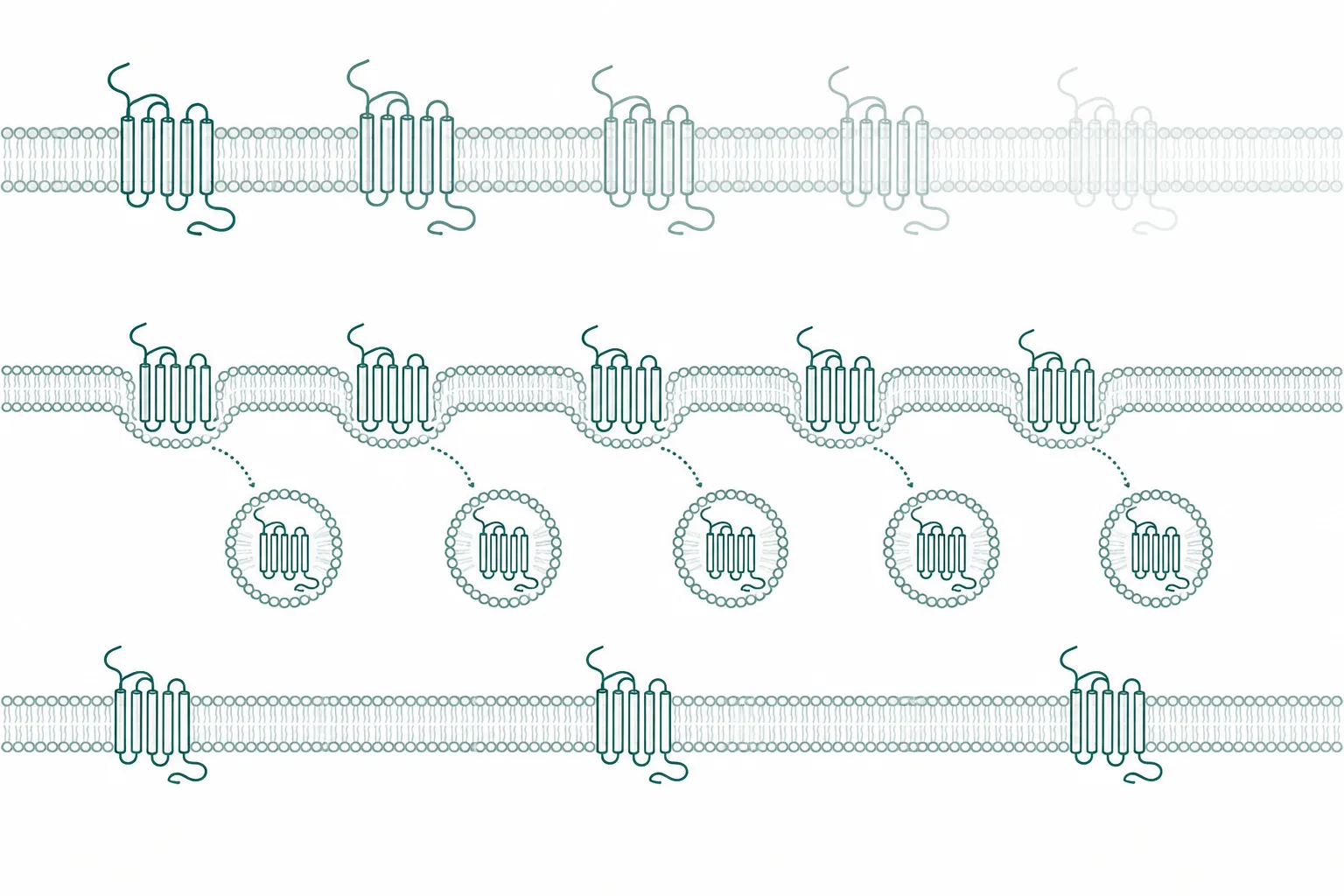
Three processes, three timescales
The acute phase begins within seconds of activation. Receptor kinases phosphorylate the receptor's intracellular regions, β-arrestin binds the phosphorylated receptor, and that binding sterically prevents further coupling to the G protein. The receptor is still present at the surface and still capable of binding agonist. What it has lost is the ability to pass the signal on. This is desensitisation used precisely 13.
The second process follows from the first. Arrestin recruits the endocytic machinery, and the receptor is drawn into the cell in a vesicle. Now agonist in the extracellular space cannot reach it at all, which removes the receptor from the responding population for as long as it remains inside 2. Internalisation is therefore a different kind of loss from uncoupling, and it is separately measurable, because surface receptor density can be quantified directly.
The third process operates over hours to days. Internalised receptors sorted for destruction are degraded in lysosomes, and with prolonged stimulation the cell may also reduce transcription of new receptor. The result is fewer receptors in total, not merely fewer at the surface, which lowers the ceiling on any future response. That is downregulation, and it is the phase that takes longest to reverse because it requires synthesis of new protein 1.
| Process | What changes | Approximate timescale | Recovery requires |
|---|---|---|---|
| Uncoupling (desensitisation) | Receptor can no longer engage its transducer | Seconds to minutes | Dephosphorylation and arrestin release |
| Internalisation | Receptor is removed from the cell surface | Minutes | Trafficking back to the membrane |
| Degradation | Internalised receptor is destroyed | Minutes to hours | Synthesis of new receptor protein |
| Downregulation | Total receptor population falls | Hours to days | Restored transcription and translation |
The fork in the road: recycling or destruction
An internalised receptor has two fates, and which one it meets determines whether responsiveness returns in minutes or in days. It can be dephosphorylated in an endosomal compartment and returned to the surface, ready to signal again, or it can be sorted into the degradative pathway. Sorting is not random. It is controlled by identifiable molecular features, including covalent tagging of the receptor with ubiquitin, which routes it towards lysosomal destruction 5.
One determinant of that fate is how persistently arrestin stays attached. A comparative study of arrestin binding across many receptors found that receptors fall into two broad classes: one that binds β-arrestin transiently and dissociates from it early in the endocytic process, and one that binds both non-visual arrestins with similarly high affinity and remains associated with arrestin into the endosome. Exchanging the receptors' carboxyl-terminal tails reversed the behaviour, identifying that region as the structural determinant 4.
The functional consequence is that two receptors subjected to identical stimulation can recover on completely different schedules, for reasons that have nothing to do with the agonist. This is one reason a desensitisation result obtained for one receptor cannot be transferred to another by analogy, even within the same superfamily.
Words that describe observations, not mechanisms
Tachyphylaxis means a rapid decline in response on repeated stimulation. Tolerance usually means a slower decline over days to weeks. Refractoriness is used for both. None of these terms identifies a mechanism: each can be produced by uncoupling, by internalisation, by downregulation, or by processes that are not receptor events at all 1.
- Depletion of a releasable store. In secretory systems, a stimulus can exhaust the pool of hormone available for release while every receptor remains fully functional.
- Counter-regulation. Feedback from a downstream product, or rising inhibitory tone in an opposing pathway, reduces the observable response without touching the receptor.
- Transducer limitation. Depletion or modification of a G protein or second-messenger enzyme reduces the response to every agonist acting through it.
- Pharmacokinetic change. Accelerated clearance or altered distribution reduces the concentration reaching the receptor, which looks like a receptor change and is not.
- Antibody formation. For peptide agents given repeatedly, an immune response can neutralise the agonist before it arrives.
A paper that reports a diminishing response and attributes it to downregulation without measuring receptor number has not demonstrated downregulation. It has demonstrated a diminishing response. This is the single most frequent overreach in this part of the literature, and it is easy to check for: the mechanism named in the discussion should correspond to something the methods section actually measured 3.
How the processes are separated experimentally
| Question | Measurement | What a positive result shows |
|---|---|---|
| Has coupling efficiency fallen? | Transducer activation per occupied receptor | Uncoupling, independent of receptor number |
| Have receptors left the surface? | Surface receptor density versus total cellular receptor | Internalisation without loss of total receptor |
| Has the total population fallen? | Total receptor protein, and receptor transcript levels | Degradation, and reduced synthesis |
| Is the defect upstream or downstream? | Stimulation of the pathway below the receptor | A preserved response localises the defect to the receptor |
| How fast does it reverse? | Response after graded agonist-free intervals | Recycling kinetics, and whether new synthesis is needed |
The fourth row deserves emphasis because it is the cheapest discriminating experiment available. If a stimulus applied below the receptor still produces a full response after the receptor-mediated response has faded, the cell's capacity to respond is intact and the change is at or near the receptor. If the downstream stimulus is also blunted, the limitation lies deeper and no amount of receptor measurement will explain it 2.
Why continuous and pulsatile exposure differ
The most instructive demonstration in this field is nearly fifty years old and concerns the pituitary response to gonadotropin-releasing hormone. In monkeys whose hypothalamic input had been removed, constant infusion of the hormone failed to restore sustained gonadotropin secretion, whereas delivering the same hormone intermittently at roughly the physiological frequency re-established it. The authors noted explicitly that the outcome was attributable to the pattern of delivery rather than to the quantity the pituitary was exposed to, and that switching an animal from intermittent to continuous delivery produced a loss of response they described as desensitisation or downregulation 6.
That result has two consequences worth separating. The first is mechanistic: intervals without agonist allow dephosphorylation, arrestin release and trafficking back to the surface, so a receptor stimulated in pulses spends part of each cycle recovering, while a continuously occupied receptor never does. The second is interpretive: pattern is a variable in its own right, and an experiment that changes only the pattern can produce an opposite outcome from the same total exposure.
A corollary follows for agonists engineered to persist. Extending an agonist's residence in circulation converts an intermittent exposure into a continuous one, which is favourable for convenience and potentially unfavourable for the receptor's recovery cycle. Whether that trade-off matters for a given target depends on the receptor's recycling behaviour and on whether the physiological signal being replaced was itself pulsatile. It is an empirical question per receptor, and the answer is not predictable from the agonist's properties alone 5.
What this framework does not settle
- Whether a receptor characterised in a transfected cell line desensitises the same way in native tissue, where receptor and arrestin abundance differ.
- The timescale over which any of these processes occurs in a living organism for most peptide targets. Almost all quantitative work on recovery kinetics is cellular.
- Whether an exposure pattern that avoids desensitisation exists for a given receptor. This requires long-duration studies that have not been done for most compounds of research interest.
- How much of an observed loss of response is receptor-mediated at all. For secretory axes in particular, store depletion and feedback are strong competing explanations.
The general point
Adaptation to a sustained signal is normal receptor behaviour, not a defect of particular compounds. Cells are built to report change rather than absolute level, and the mechanisms described here are the machinery by which they do it. The reason the vocabulary matters is that each process implies a different recovery time, and recovery time is what determines whether a diminishing response is a transient feature of an experiment or a durable property of the system 1.
For any specific compound, the useful questions are narrow: which process has been demonstrated, in what preparation, on what timescale, and with what evidence that the response returns. Most of the peptide literature answers the first question by assertion and the remaining three not at all. That gap is worth noticing, because a falling response with an unidentified mechanism is compatible with almost any interpretation, including several that contradict each other 3.
References
- GPCR desensitization: acute and prolonged phases
- Evolving concepts in G protein-coupled receptor endocytosis: the role in receptor desensitization and signaling
- Desensitization of G protein-coupled receptors and neuronal functions
- Differential affinities of visual arrestin, beta arrestin1, and beta arrestin2 for G protein-coupled receptors delineate two major classes of receptors
- Regulation of GPCRs by endocytic membrane trafficking and its potential implications
- Hypophysial responses to continuous and intermittent delivery of hypothalamic gonadotropin-releasing hormone