Ipamorelin: Selective Ghrelin Receptor Agonism and the Cortisol Question
Ipamorelin is a pentapeptide agonist at the growth hormone secretagogue receptor. Its defining claim is selectivity — releasing growth hormone without the cortisol and prolactin rise seen with earlier secretagogues. Here is where that claim comes from and how far the evidence carries it.
Ipamorelin is a synthetic pentapeptide that causes the pituitary to release growth hormone. It belongs to a class called growth hormone secretagogues, and it is almost always described with one particular word attached: selective. That word is doing a great deal of work, and it is worth examining what it actually meant to the researchers who first used it.
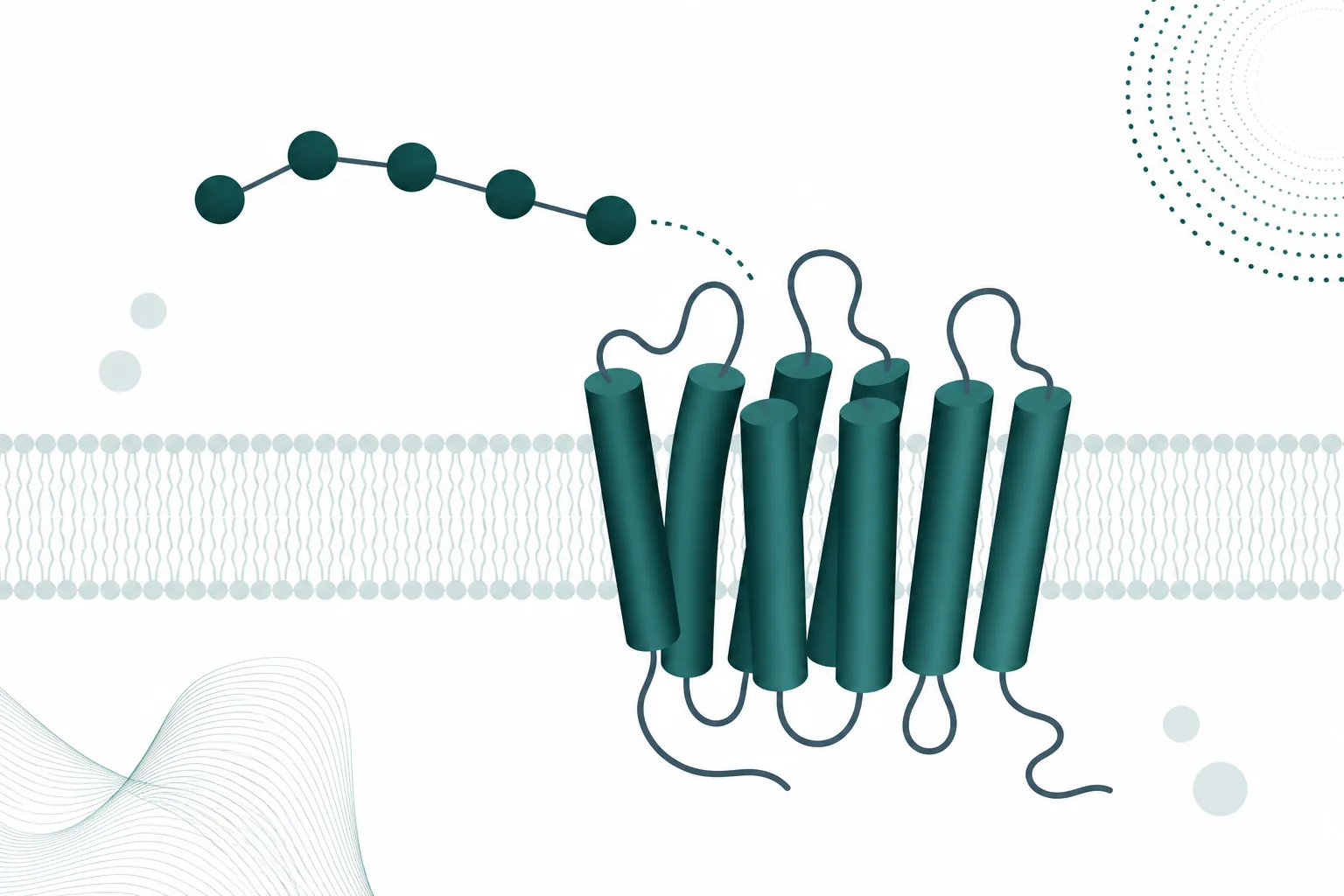
The receptor came before the hormone
The usual order of discovery in endocrinology is that a hormone is found, and then the receptor it acts on is identified. The growth hormone secretagogue story ran backwards. Through the 1980s and early 1990s, researchers were working with small synthetic peptides that released growth hormone but did so through a pathway distinct from growth hormone releasing hormone 5. These compounds clearly bound something. Nobody knew what.
In 1996 that receptor was cloned and characterised, and given the name growth hormone secretagogue receptor, or GHS-R 2. It is a G protein-coupled receptor expressed in the pituitary and the hypothalamus. Its identification created an obvious question: if there is a receptor, there ought to be a natural ligand for it, and it was unlikely to be a synthetic peptide invented in a pharmaceutical laboratory.
That ligand turned out to be ghrelin, isolated from stomach tissue and described in 1999 3. The receptor's name is therefore a historical accident: it is named after the synthetic compounds that led researchers to it rather than after its endogenous ligand. The active splice variant, GHS-R1a, is the one that signals; a second variant, GHS-R1b, is truncated and does not.
What ipamorelin is, structurally
Ipamorelin is a pentapeptide — five amino acid residues. That is very short. For comparison, growth hormone releasing hormone in its full form is forty-four residues, and growth hormone itself is a protein of one hundred and ninety-one. Short peptides are cheap to synthesise and relatively easy to characterise, which is part of why this class was explored so thoroughly.
The compound contains non-standard residues, including D-amino acids and aminoisobutyric acid, which is not one of the twenty amino acids the body uses to build proteins. These substitutions are deliberate. Proteases — the enzymes that cut peptides apart — are stereospecific, meaning they recognise the naturally occurring L-configuration of amino acids. Substituting a D-residue at a cleavage site makes the peptide substantially harder to degrade, extending how long it survives in circulation.
This design approach was general to the class. The earlier growth hormone releasing peptides, from which ipamorelin descends conceptually, were themselves derived from work on enkephalin analogues, and carried similar structural modifications for the same reason 4.
The selectivity claim
The paper that introduced ipamorelin is titled, plainly, as describing the first selective growth hormone secretagogue 1. Understanding what that title claims requires knowing what the problem was with the compounds that came before it.
Earlier secretagogues in this family released growth hormone effectively, but they did not release it cleanly. Along with growth hormone came measurable increases in adrenocorticotropic hormone and consequently cortisol, and in prolactin. For a research tool intended to probe the growth hormone axis specifically, that is a serious confound: any physiological effect observed might be attributable to the cortisol rise rather than to growth hormone. For a potential therapeutic it is worse, because sustained cortisol elevation carries its own consequences.
The ipamorelin work reported that in the models tested, the compound produced growth hormone release comparable to the reference secretagogues while the accompanying corticotropin and prolactin responses remained close to baseline levels 1. That is the selectivity being claimed. It is a comparative statement — ipamorelin against other members of its own class — and it was established primarily in rat and pig models, with supporting observations in a limited human context.
Why the pituitary sets a ceiling
Growth hormone is not secreted continuously. It is released in pulses, with the largest normally occurring during slow-wave sleep, and the pattern of those pulses is governed by two opposing hypothalamic signals: growth hormone releasing hormone, which promotes release, and somatostatin, which inhibits it. A secretagogue acts into this existing system rather than overriding it.
This has a specific consequence that is frequently misunderstood. The pituitary holds a finite pool of stored growth hormone, and somatostatin tone varies through the day. An agonist at GHS-R1a can amplify a pulse, but it cannot produce unlimited release, and its effect depends on the state of the system at the moment it acts. The dose-response relationship therefore flattens: beyond a point, more agonist does not produce proportionally more hormone.
Downstream, growth hormone stimulates hepatic production of insulin-like growth factor 1, and IGF-1 exerts negative feedback on the axis. In studies of this class, IGF-1 is often the more informative measure, because a single growth hormone reading captures one point on a pulsatile curve while IGF-1 integrates the signal over a longer window 4.
How ipamorelin sits against the rest of the class
| Property | Ipamorelin | Earlier GHRPs |
|---|---|---|
| Target receptor | GHS-R1a | GHS-R1a |
| Length | Five residues | Six residues typically |
| Reported cortisol response | Near baseline in the original models | Measurable increase |
| Reported prolactin response | Near baseline in the original models | Measurable increase |
| Appetite signalling | Reported as limited | More pronounced for some members |
The comparison in that table is drawn from the original characterisation work and the reviews of the class that preceded it 14. It should be read as a summary of reported findings in specific experimental models, not as a general ranking. Different studies used different species, different measurement windows and different reference compounds, and those choices affect what gets reported.
The state of the human evidence
This is where an honest account has to become uncomfortable. Ipamorelin is discussed at very high volume relative to the size of its human literature. The foundational pharmacology is solid and was carefully done, but it was largely done in animals 1. Human investigation of the compound has been limited, and the clinical development programme that would have generated a substantial trial record did not produce an approved product.
The practical consequence is that statements about what ipamorelin does in humans over any extended period are extrapolations. The receptor is the same receptor, and the acute growth hormone response has been observed. What has not been established in a large human dataset is what sustained receptor agonism produces over months, whether the selectivity observed acutely holds with repeated exposure, and whether receptor desensitisation becomes significant — a phenomenon documented for other members of this class.
Anyone reading secondary sources on this compound will encounter confident claims about outcomes. Those claims are not supported by the primary literature at the level of confidence with which they are usually stated. The primary literature supports a narrower conclusion: ipamorelin is a selective agonist at GHS-R1a that releases growth hormone in the models in which it has been studied, with a hormonal profile cleaner than that of the compounds it was designed to improve upon.
What would strengthen the picture
- Human studies with repeated exposure over a period long enough to detect receptor desensitisation, using IGF-1 rather than single growth hormone measurements as the primary endpoint.
- Direct head-to-head comparison against other secretagogues in the same human protocol, since almost all existing comparisons are between separate studies with different designs.
- Characterisation of whether the acute selectivity for growth hormone over cortisol and prolactin persists with continued receptor stimulation.
- Independent replication of the original pharmacology by groups unconnected to the compound's development.
None of these is an unreasonable ask, and the absence of them is not evidence that the compound does nothing. It is simply the current state of the record. The distinction between an unproven claim and a disproven one matters, and in this case the accurate description is that most of the interesting questions about ipamorelin in humans remain open.
References
- Ipamorelin, the first selective growth hormone secretagogue
- A receptor in pituitary and hypothalamus that functions in growth hormone release
- Ghrelin is a growth-hormone-releasing acylated peptide from stomach
- Peptidomimetic regulation of growth hormone secretion
- Growth hormone-releasing peptides: clinical and basic aspects