Tesamorelin: A Stabilised GHRH Analogue and the Visceral Fat Endpoint
Tesamorelin is a growth hormone releasing hormone analogue carrying a single chemical modification that protects it from enzymatic cleavage. It is the one compound in this family with a substantial randomised trial record — in a specific patient population, on a specific endpoint.
Tesamorelin occupies an unusual position among the compounds discussed on this site. Most of them have thin human evidence and a great deal of secondary commentary. Tesamorelin has the opposite profile: a genuine randomised controlled trial programme published in major journals, conducted in a defined patient population, measuring a defined endpoint. What it does not have is evidence that generalises easily beyond that population.
Where GHRH came from
The existence of a hypothalamic factor that triggers growth hormone release was suspected for decades before anyone isolated it. The quantities present in hypothalamic tissue were tiny, and the purification problem was severe. The breakthrough came from an unexpected direction: a pancreatic tumour in a patient with acromegaly was producing the factor in bulk, and that tumour tissue provided enough material to isolate and sequence it 1.
The isolated hormone was named growth hormone releasing factor, later growth hormone releasing hormone. In its full human form it is forty-four residues long. Subsequent work established that the biological activity resides in the first twenty-nine residues — a finding that matters a great deal for this family of compounds, and which is covered separately in the article on sermorelin.
The problem the modification solves
Native GHRH has a serious practical limitation as a research tool or a therapeutic: it does not last. Its circulating half-life is measured in minutes. The principal reason is an enzyme called dipeptidyl peptidase 4, usually written DPP-4, which cleaves two residues from the N-terminus of susceptible peptides and in doing so destroys their receptor activity.
DPP-4 is not specific to GHRH. It acts on a family of regulatory peptides that share a particular pattern near their N-terminus, including the incretin hormones GLP-1 and GIP 2. This is the same enzymatic problem that shaped the design of the incretin analogues, and the solutions adopted across those programmes are conceptually related: modify the peptide near the cleavage site so the enzyme can no longer act on it.
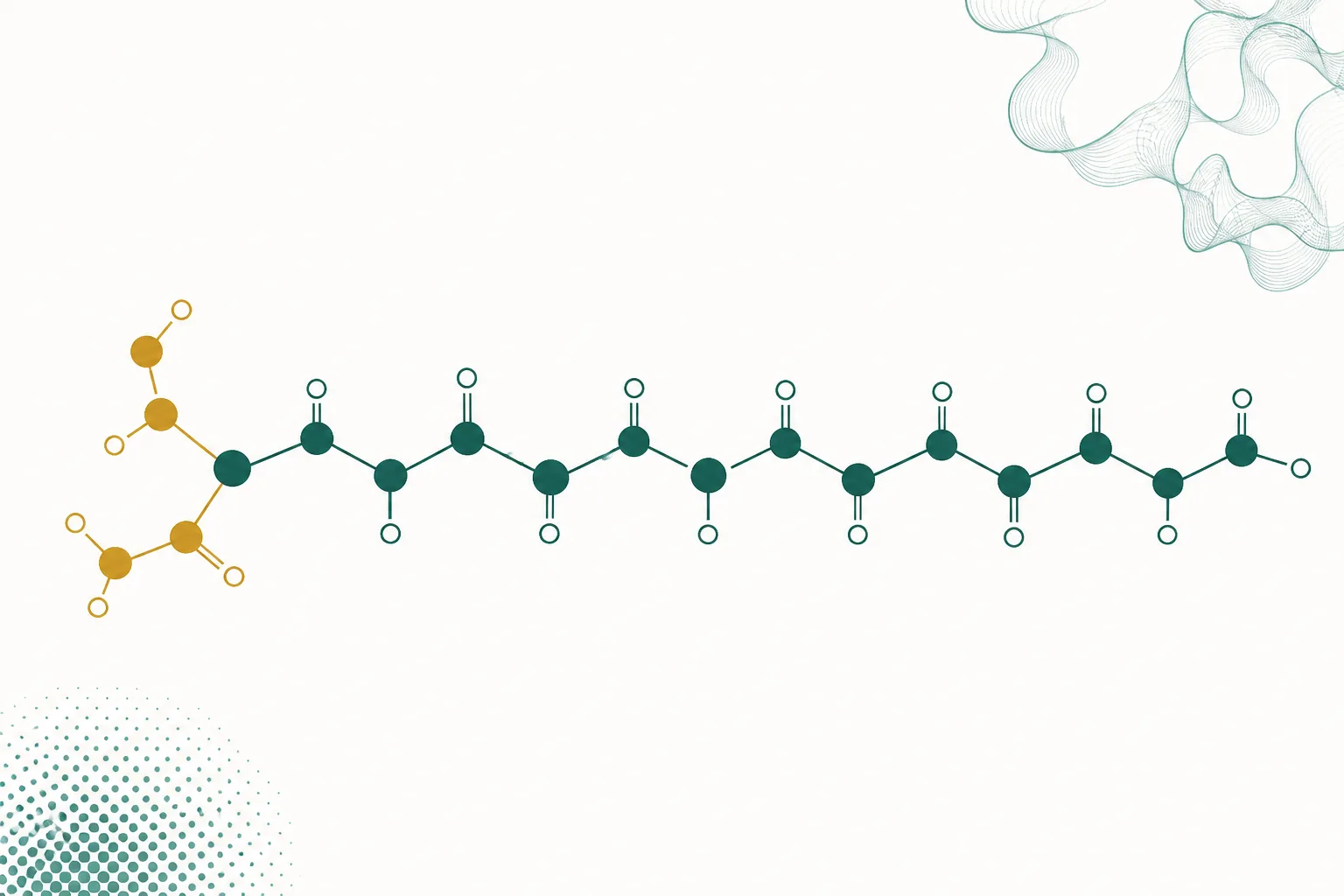
Tesamorelin's solution is to attach a trans-3-hexenoyl group to the N-terminal residue of GHRH(1–44). The group is a short unsaturated fatty acid chain. It is not there to change how the peptide binds its receptor; it is there to obstruct the enzyme. The peptide sequence itself is unchanged from the human hormone.
What the trials measured
The clinical programme addressed a specific problem. People living with HIV on long-term antiretroviral therapy can develop a characteristic redistribution of body fat, including accumulation of visceral adipose tissue — the fat surrounding the abdominal organs, as distinct from subcutaneous fat. Visceral adiposity is associated with metabolic consequences, and at the time there was no approved treatment for it in this population.
The first large randomised trial reported in 2007 tested the GHRH analogue against placebo in this population, with visceral adipose tissue measured by computed tomography as the primary endpoint 3. A second phase 3 trial with a similar design followed, reporting in 2010 4. Both found reductions in visceral adipose tissue relative to placebo, alongside increases in IGF-1 consistent with the intended pharmacology.
A later study extended the question to hepatic fat, using magnetic resonance spectroscopy to measure liver fat fraction in the same broad population 5. This mattered because visceral adiposity and hepatic steatosis often occur together, and reducing one does not automatically address the other.
| Study | Population | Primary measure |
|---|---|---|
| 2007 randomised trial | Adults with HIV and abdominal fat accumulation | Visceral adipose tissue by CT |
| 2010 phase 3 trial | Adults with HIV and excess abdominal fat | Visceral adipose tissue by CT |
| 2014 randomised trial | Adults with HIV and abdominal fat accumulation | Liver fat fraction by MR spectroscopy |
The consistent design feature across these studies is the population. Every one of them enrolled people with HIV who had a specific pattern of fat distribution associated with their treatment. That is the group in whom tesamorelin's effects have been demonstrated, and it is the group for which regulatory approval was granted.
Why the population constraint matters
It is tempting to read a trial result as a statement about a drug and forget that it is a statement about a drug in a population. The distinction is not pedantic. HIV-associated fat redistribution has particular underlying physiology, and the participants in these trials were, by design, people in whom visceral adiposity had developed through that route.
Whether the same intervention produces the same magnitude of effect in someone whose visceral adiposity arose differently is a question the trials were not designed to answer. It may. It may not. The honest position is that the studies establish an effect in the population studied, and that extending the conclusion beyond it is extrapolation rather than evidence.
There is a second constraint worth stating. The effect in the trials was not permanent. Where treatment was discontinued, the accumulated visceral fat tended to return, which is consistent with the mechanism: the compound modulates an endocrine axis while present and stops modulating it when absent 4.
IGF-1 as the pharmacodynamic readout
Across these studies, IGF-1 is the measure that confirms the compound is doing what its mechanism predicts. Growth hormone itself is released in pulses, so a single blood measurement captures an arbitrary point on a fluctuating curve and tells you relatively little. IGF-1 is produced largely by the liver in response to growth hormone exposure and has a much longer circulating half-life, so it integrates the signal over a period of days.
The trials reported IGF-1 increases in treated participants, which establishes that the pharmacological chain — analogue binds GHRH receptor, pituitary releases growth hormone, liver produces IGF-1 — was intact 34. It also provides the safety measure that matters most in this axis, because sustained excessive IGF-1 elevation is the state that defines acromegaly and carries its own risks. Monitoring IGF-1 was part of the trial protocols for that reason.
What is genuinely established
Why visceral fat and not fat generally
One feature of the trial results deserves more attention than it usually receives. The reductions reported were in visceral adipose tissue specifically, with subcutaneous fat much less affected. That selectivity is not an artefact of how the outcome was measured; it reflects something real about the tissue.
Visceral and subcutaneous adipose depots are not simply the same tissue in different locations. They differ in blood supply, in innervation, in the receptors their cells express, and in how readily stored lipid is mobilised. Visceral adipocytes are generally more lipolytically responsive, and growth hormone is among the signals that promotes lipolysis. A pharmacological intervention that raises growth hormone exposure would therefore be expected to act more strongly on the depot that responds more strongly, which is what the imaging showed 3.
This matters for interpretation in a specific way. It means the observed effect is consistent with the proposed mechanism rather than merely coincident with it. The compound raised IGF-1, and the fat compartment that changed was the one growth hormone would be expected to mobilise. Coherence between mechanism and outcome is one of the things that distinguishes a well-supported finding from a statistical association.
The monitoring the axis requires
Any intervention that raises growth hormone exposure carries a defined set of concerns, and they follow directly from what happens when the axis is chronically overactive. Acromegaly is the clinical state produced by sustained growth hormone excess, and its consequences include glucose intolerance, soft tissue changes and cardiovascular strain.
This is why IGF-1 monitoring featured in the trial protocols rather than being an optional extra 4. IGF-1 integrates growth hormone exposure over days, so it functions as the practical safety measure for the axis. Glucose handling is the second concern, because growth hormone opposes insulin action and raising growth hormone exposure can reduce insulin sensitivity.
- The trans-3-hexenoyl modification confers resistance to DPP-4 cleavage without altering the underlying GHRH sequence.
- The compound acts at the GHRH receptor and produces measurable IGF-1 elevation consistent with pituitary growth hormone release.
- In adults with HIV-associated abdominal fat accumulation, it reduced visceral adipose tissue relative to placebo across more than one randomised trial.
- In the same broad population, it reduced hepatic fat fraction relative to placebo.
- The effect depends on continued administration rather than producing a durable change after withdrawal.
That list is short, and every item on it is supported by published randomised evidence. It is a stronger evidential position than almost any other compound in this family occupies. The corresponding discipline is not to stretch it: what is established is established in one population on defined endpoints, and the useful thing about tesamorelin is precisely that the boundary of its evidence is unusually easy to state.
References
- Growth hormone-releasing factor from a human pancreatic tumor that caused acromegaly
- Dipeptidyl-peptidase IV hydrolyses gastric inhibitory polypeptide, glucagon-like peptide-1(7-36)amide, peptide histidine methionine and is responsible for their degradation in human serum
- Metabolic effects of a growth hormone-releasing factor in patients with HIV
- Effects of tesamorelin (TH9507), a growth hormone-releasing factor analog, in human immunodeficiency virus-infected patients with excess abdominal fat
- Effect of tesamorelin on visceral fat and liver fat in HIV-infected patients with abdominal fat accumulation