Hexarelin and Receptor Desensitisation
Hexarelin is the most potent of the classical growth hormone releasing peptides, and it is also the one that made the limits of sustained receptor agonism visible. Its second story — a binding site in cardiac tissue — turned out to be the more interesting one.
Hexarelin is usually introduced as the most potent member of the classical growth hormone releasing peptide family. That is accurate but not the most interesting thing about it. The compound is pharmacologically useful mainly because it made two things visible that apply well beyond itself: what happens when you stimulate a G protein-coupled receptor continuously, and what happens when a peptide turns out to bind something other than its intended target.
Position in the series
The growth hormone releasing peptides emerged from structure-activity work that began with enkephalin analogues and produced its first well-characterised hexapeptide in 1984 5. That programme continued, and hexarelin was among the compounds that came out of the later rounds of optimisation, reported as achieving greater potency than its predecessors 1.
Its mechanism at the pituitary is the class mechanism. It is an agonist at the growth hormone secretagogue receptor, the target cloned in 1996 3, and like the rest of the family it acts synergistically with growth hormone releasing hormone rather than additively, indicating engagement with a different point in the same regulatory circuit 2.
Higher potency is often assumed to be straightforwardly better. In pharmacology it is neither good nor bad in itself — it describes the concentration at which an effect appears, not the size or quality of that effect. A compound can be more potent and less selective, or more potent and more prone to the desensitisation described below.
What desensitisation actually is
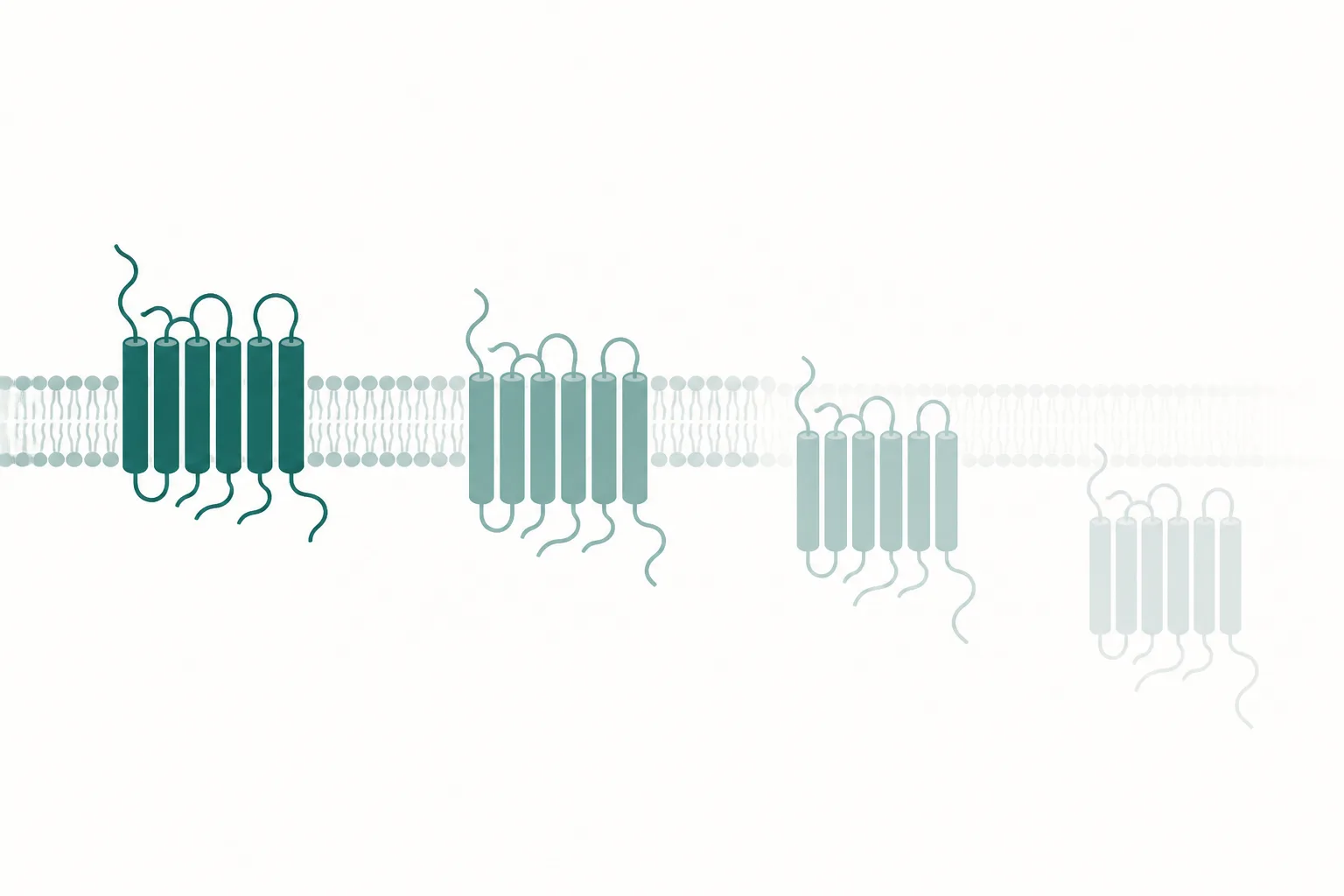
A cell exposed continuously to a strong signal does not keep responding at full strength. For G protein-coupled receptors, which is the family GHS-R1a belongs to, the machinery that reduces the response is well characterised and proceeds in stages.
- Phosphorylation. Specialised kinases modify the receptor's intracellular regions shortly after activation, which reduces its ability to couple to its G protein.
- Arrestin binding. Arrestin proteins bind the phosphorylated receptor and physically block further G protein coupling.
- Internalisation. The arrestin-bound receptor is drawn into the cell in a vesicle, removing it from the surface where it could be reached by more agonist.
- Recycling or degradation. The internalised receptor is either dephosphorylated and returned to the surface, or routed for destruction. Which happens determines how quickly responsiveness recovers.
- Downregulation. With prolonged stimulation, the cell may also reduce production of new receptor, lowering the ceiling on any future response.
The practical consequence is that the same stimulus produces a smaller response than it did before. In the growth hormone axis this is compounded by a second mechanism entirely: the pituitary holds a finite reserve of stored hormone, and repeated release depletes it faster than it is replenished. Diminishing response can therefore arise from receptor changes, from depletion, or from both, and distinguishing them requires deliberate experimental design.
Why this matters for interpreting claims
Nearly all the human data on secretagogues in this family comes from acute studies: a single administration, measurements over the following hours, a clear growth hormone pulse. Those studies are real and their results are not in doubt. The difficulty is what happens when their findings are used to support claims about repeated administration over months.
Desensitisation is precisely the reason that extrapolation is unsafe. A receptor that internalises under sustained agonism will not deliver the acute response indefinitely, and the magnitude of the falloff, the timescale over which it happens, and whether any intermittent pattern of exposure avoids it are all empirical questions requiring long-duration studies to answer.
For this class those studies are largely absent. That is not a claim that the compounds stop working — it is a claim that the shape of the response over time has not been well characterised in humans, and that acute data cannot substitute for it.
The cardiac binding site
The more unexpected part of the hexarelin story is that the compound has a second target. Work on the cardiovascular effects of growth hormone releasing peptides found binding in cardiac tissue that could not be accounted for by GHS-R1a, and identified the site as CD36 — a scavenger receptor involved in fatty acid transport and quite unrelated to the growth hormone axis 4.
This finding did two things. It explained cardiovascular observations that had otherwise been puzzling, and it established that this peptide family is not as pharmacologically clean as a single-receptor description implies. A compound characterised as a growth hormone secretagogue was also acting somewhere else entirely, through a receptor with no connection to the pituitary.
A substantial part of the subsequent research literature on hexarelin concerns this cardiac activity rather than growth hormone. That is worth knowing before reading citation counts as evidence of interest in its endocrine properties: a paper on hexarelin is at least as likely to be about the heart.
| GHS-R1a | CD36 | |
|---|---|---|
| Receptor family | G protein-coupled receptor | Scavenger receptor |
| Principal tissue in this context | Pituitary and hypothalamus | Cardiac tissue |
| Downstream effect studied | Growth hormone release | Cardiovascular responses |
| Endogenous ligand | Ghrelin | Fatty acids and other ligands |
| Subject to the desensitisation described above | Yes | Different regulatory behaviour |
The general point
Hexarelin is a useful compound to understand because it complicates two assumptions that make peptide pharmacology look simpler than it is. The first is that an agonist produces a consistent effect for as long as it is present. The second is that a compound characterised against one receptor acts only at that receptor.
How desensitisation is actually measured
Establishing that a response has diminished sounds straightforward and is not, because several distinct mechanisms produce the same observation and separating them requires the experiment to be designed for it.
- Repeated challenge. The same stimulus is given at intervals and the responses compared. A falling response demonstrates that something has changed but does not identify what.
- Receptor quantification. Surface receptor density is measured directly, distinguishing internalisation from other causes.
- Bypass challenge. A different agent acting downstream of the receptor is given. If the response to that is preserved, the change is at the receptor rather than in the capacity of the cell to respond.
- Recovery interval. The stimulus is withheld for varying periods before re-challenge, which shows whether receptors recycle and how quickly.
- Reserve assessment. In this axis specifically, the stored hormone pool of the pituitary can be depleted independently of any receptor change, so a design that cannot separate depletion from desensitisation will confound the two.
The last point is the one most often missed in this literature. A diminishing growth hormone response to repeated secretagogue administration may reflect receptor downregulation, an emptied pituitary reserve, rising somatostatin tone, IGF-1 feedback, or some combination of those. Reporting the falling response alone does not distinguish between them 2.
Continuous against intermittent exposure
One consequence of the internalisation and recycling cycle is that the pattern of exposure matters as much as the total amount. A receptor that is continuously occupied has no interval in which to return to the surface. A receptor stimulated intermittently may recover between stimuli.
This principle is established across G protein-coupled receptor pharmacology generally and is not specific to this compound or this axis. It is also the reason that pharmacokinetic properties interact with desensitisation in ways that are not obvious. A shorter-acting agonist may produce a more sustainable response across repeated administration than a longer-acting one, despite each individual exposure being briefer.
A final observation about the CD36 finding is worth drawing out, because it generalises. The cardiac binding was discovered by investigating an effect that the known receptor could not explain, rather than by screening for off-target activity in advance. That is how most second targets are found: an anomaly in the data is pursued until it resolves. It follows that the absence of a reported second target for a given compound often means nobody has looked, rather than that nobody would find one.
Neither assumption survives contact with this compound. Sustained agonism at GHS-R1a leads the system to adapt, and the peptide binds a structurally unrelated receptor in a completely different tissue. Both findings are ordinary in pharmacology — receptors desensitise routinely, and off-target binding is common enough that screening for it is standard practice — but they are frequently absent from summaries of what these compounds do.
The defensible description of hexarelin is that it is a potent GHS-R1a agonist whose acute growth hormone releasing activity is well documented, whose behaviour under sustained stimulation follows the general pattern for its receptor family, and which has a second characterised binding site in cardiac tissue that accounts for a large portion of its research literature. Anything stated with more confidence than that is running ahead of what has been shown.
References
- Small peptides as potent releasers of growth hormone
- Peptidomimetic regulation of growth hormone secretion
- A receptor in pituitary and hypothalamus that functions in growth hormone release
- CD36 mediates the cardiovascular action of growth hormone-releasing peptides in the heart
- On the in vitro and in vivo activity of a new synthetic hexapeptide that acts on the pituitary to specifically release growth hormone