peptide pharmacokinetics
DPP-4 and Neprilysin: The Enzymes That Switch Peptide Hormones Off
One enzyme removes exactly two residues from the amino terminus and destroys the signal. The other cuts almost anything hydrophobic, almost anywhere. Together they set the lifetime of most peptide hormones, and both have been turned into drug targets.
Peptide hormones are switched off by being cut, and two enzymes do most of that work on the signalling peptides that matter pharmacologically. Dipeptidyl peptidase-4 is an exopeptidase with a single, narrow specificity rule: it removes a dipeptide from the amino terminus of a substrate when the second residue is alanine or proline. Neprilysin is an endopeptidase with almost the opposite character, cutting internally on the amino side of hydrophobic residues across a very large substrate list. One is a precision instrument; the other is a general-purpose one. Between them they explain why so many native peptides last minutes rather than hours 16.
The reason to treat them together is that they define the two ways a chain can be attacked, and therefore the two problems any protease-resistant design must solve separately. Blocking the amino terminus does nothing about internal cleavage; protecting an internal site does nothing about the terminus. Both enzymes are also drug targets in their own right, one inhibited to raise the level of a hormone, the other inhibited to slow the breakdown of a different set of hormones entirely.
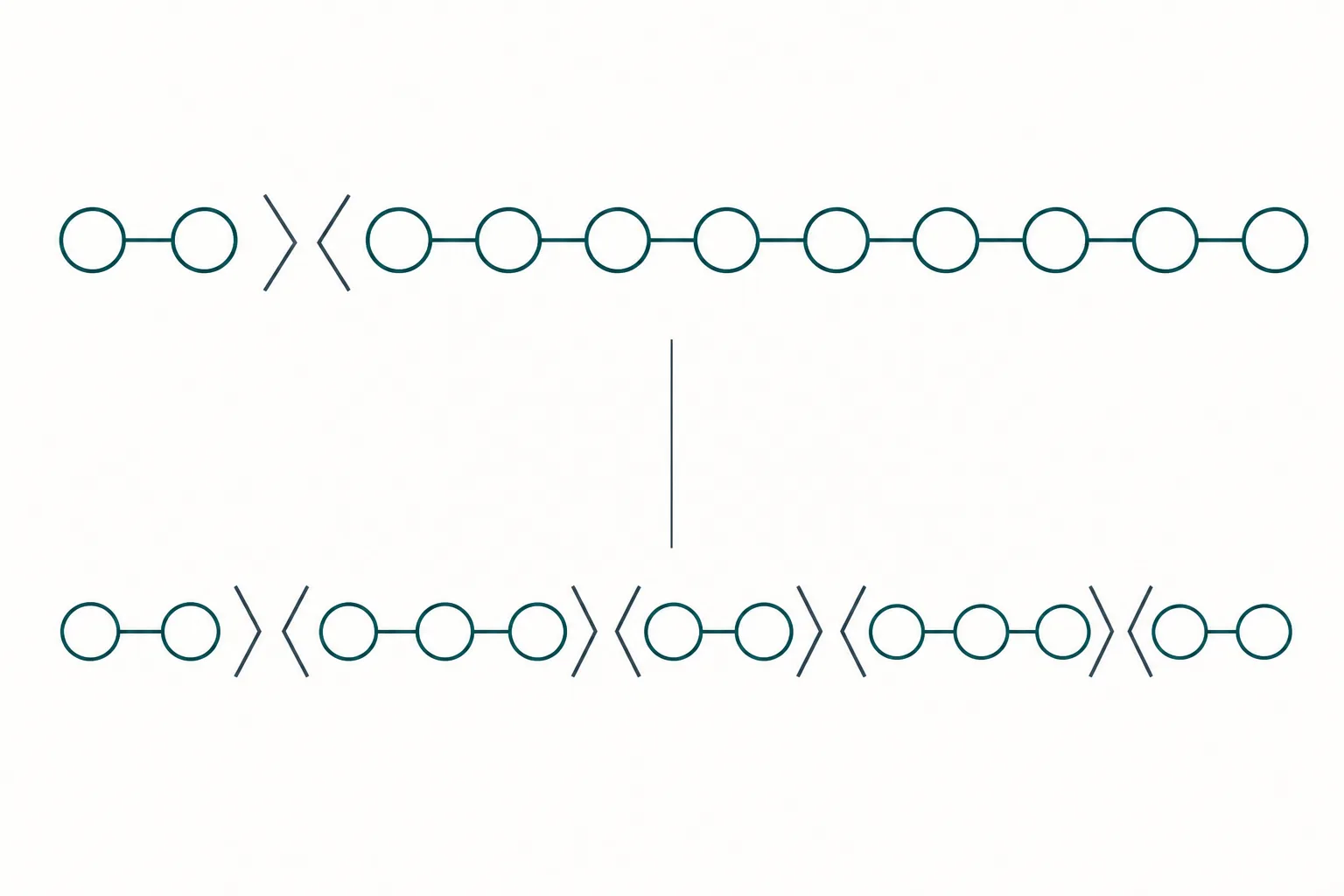
DPP-4: one specificity rule, several casualties
Dipeptidyl peptidase-4 is a serine exopeptidase that exists both as a membrane-anchored ectoenzyme, widely distributed on endothelium and epithelium, and as a catalytically active soluble form in plasma. Its rule is positional: it cleaves after the second residue from the amino terminus, and it requires that second residue to be proline or alanine. A peptide whose sequence happens to satisfy that condition is a substrate; one that does not is untouched. The classic biochemistry established this by showing that the same enzyme hydrolysed a set of otherwise unrelated peptides sharing that motif, and that it accounted for their degradation in human serum 1.
The casualties include the two incretin hormones. Glucagon-like peptide-1 and glucose-dependent insulinotropic polypeptide both present the required residue in position two, and both are inactivated the same way. So are several other regulatory peptides. This is not a system designed to destroy incretins specifically; it is a motif-recognition enzyme, and the incretins happen to display the motif 13.
A note on numbering, because it causes persistent confusion in this literature. The biologically active form of glucagon-like peptide-1 is usually written as the seven-to-thirty-six amide, numbered against the full proglucagon-derived sequence. The alanine that DPP-4 recognises is residue eight in that numbering and the second residue of the circulating peptide. Papers that speak of a substitution at position eight and papers that speak of a substitution at position two are describing the same residue under different conventions 8.
The two-residue truncation, and what the metabolite does
Removing two residues from a thirty-residue peptide sounds trivial and is not. The amino terminus of glucagon-like peptide-1 is the part that engages the receptor's activation machinery, so truncation does not merely weaken the molecule; it produces a fragment with a different pharmacology. Work in the mid-1990s showed that human plasma generates the N-terminally truncated peptide in vitro and, importantly, that this truncated form is a major endogenous metabolite in vivo rather than an artefact of sample handling 2.
Two consequences follow, one biological and one analytical. Biologically, the metabolite has been reported to behave as a weak agonist or antagonist at the receptor depending on the system studied, and has attracted its own literature on possible receptor-independent actions. Analytically, the finding forced a change in how the hormone is measured: an immunoassay directed at the carboxy-terminal region detects intact peptide and metabolite alike, so total concentrations can appear reassuringly high while the active fraction is small. Assays specific for the intact amino terminus were developed for exactly this reason, and older total-hormone figures cannot simply be compared with newer intact-hormone ones 23.
Why analogues change the second residue
If an enzyme requires a particular residue in a particular position, the direct countermeasure is to put something else there. Two approaches dominate. The first substitutes a non-proteinogenic residue with added steric bulk — alpha-aminoisobutyric acid, which is alanine carrying a second methyl group on the alpha carbon — so the enzyme can no longer accommodate the site. The second exploits stereospecificity by installing a D-amino acid, which the enzyme's L-configured active site cannot process. Both remove the recognition event rather than competing with it, and both are used in marketed analogues; semaglutide is the widely cited example of the first 8.
The important qualification is how little this buys on its own. A peptide made completely resistant to DPP-4 is still a few kilodaltons in mass and is still filtered by the kidney at close to the rate plasma water is filtered. Protease resistance converts an enzymatic problem into a purely renal one, which is why every long-acting analogue pairs the substitution with a second, independent modification aimed at filtration 8.
Neprilysin: broad, membrane-bound and almost everywhere
Neprilysin — neutral endopeptidase 24.11, also called enkephalinase and CD10 — is a zinc-dependent membrane metallopeptidase expressed at high density in the kidney and present in lung, vasculature, brain and elsewhere. Its specificity is defined by preference rather than by rule: it hydrolyses on the amino side of hydrophobic residues, with a predilection for phenylalanine or leucine at the position immediately following the cleavage site, and tends to release di- and tripeptides. More than fifty putative substrates have been catalogued, with widely varying strength of evidence for functional relevance 6.
That list includes the natriuretic peptides, angiotensins, endothelins, adrenomedullin, bradykinin, the enkephalins and glucagon-like peptide-1. Direct characterisation of the enzyme against the incretin showed cleavage at several internal positions rather than one, and compared its handling of related glucagon-like peptides 4. The practical significance is that neprilysin does not care whether a peptide has already been truncated: it attacks the interior, so it degrades both the intact hormone and the DPP-4 metabolite.
How much this matters in an intact animal was tested by inhibiting the enzyme selectively. In anaesthetised pigs, blocking neprilysin altered the kinetics of infused glucagon-like peptide-1 measurably, and the study concluded that both enzymes mediate its degradation rather than DPP-4 acting alone 5. The general lesson is that a peptide typically presents multiple liabilities to multiple enzymes, and protecting one site relocates the problem instead of solving it.
| Feature | Dipeptidyl peptidase-4 | Neprilysin |
|---|---|---|
| Class | Serine exopeptidase | Zinc-dependent endopeptidase |
| Where it cuts | After the second residue from the amino terminus | Internally, on the amino side of hydrophobic residues |
| Requirement | Proline or alanine in position two | A hydrophobic residue at the cleavage site, broadly defined |
| Breadth | Narrow and motif-defined | Very broad; more than fifty reported substrates |
| Effect on an already truncated peptide | None; the site is gone | Still cleaves, because the interior remains |
| Countermeasure in analogue design | Substitute position two | Harder; requires removing or shielding internal sites |
| Inhibited therapeutically for | Raising endogenous incretin levels | Raising natriuretic peptide levels in heart failure |
Both enzymes became drug targets, for opposite reasons
The DPP-4 story is the tidier one. If the enzyme destroys an incretin within minutes, inhibiting it should raise the concentration of intact hormone and amplify a physiological response that is already glucose-dependent. That reasoning produced the gliptin class, and the mechanism is well characterised: the effect on glucose handling is largely attributable to preservation of intact incretins rather than to any direct action of the inhibitor on the pancreas 3. Because the amplification depends on endogenous secretion, the effect is self-limiting in a way that direct receptor agonism is not — which also caps how large it can be.
Neprilysin inhibition ran a longer and more instructive course. Blocking the enzyme raises natriuretic peptide levels, which is desirable in heart failure, but it also raises bradykinin and other substrates, and an early dual inhibitor combining neprilysin and angiotensin-converting-enzyme blockade was associated with an unacceptable rate of angioedema. Pairing neprilysin inhibition with angiotensin receptor blockade instead of ACE inhibition sidestepped that overlap, and the resulting combination was superior to an ACE inhibitor comparator for death and heart-failure hospitalisation in a large randomised trial 7. The episode is a clean demonstration of what promiscuity means for a drug target: inhibiting an enzyme with fifty substrates has fifty possible consequences 6.
What the enzymology does not settle
Three limits deserve stating. First, plasma stability measured in vitro is a poor proxy for in vivo lifetime, because both enzymes are largely membrane-bound and much degradation happens at endothelial and renal surfaces that an incubation does not reproduce 5. Second, substrate lists compiled from in vitro cleavage tell you what an enzyme can hydrolyse, not what it does hydrolyse at physiological concentrations; the neprilysin literature is explicit that evidence of functional relevance varies greatly across its catalogue 6. Third, DPP-4 is not only a peptidase — it is also a cell-surface glycoprotein with binding and co-stimulatory roles in immunology, so inferences from a peptidase-inhibition experiment to whole-organism physiology are not automatic 3.
What remains solid is the mechanism. A peptide hormone's working life ends with a cut, the position of that cut is determined by sequence motifs rather than by chance, and the two enzymes described here between them account for a large share of the cutting. Every element of modern peptide design that looks arbitrary — an unnatural residue in second position, a mirror-image amino acid, a cyclised backbone — is a response to one or the other of them.
References
- Dipeptidyl-peptidase IV hydrolyses gastric inhibitory polypeptide, glucagon-like peptide-1(7-36)amide, peptide histidine methionine and is responsible for their degradation in human serum
- Degradation of glucagon-like peptide-1 by human plasma in vitro yields an N-terminally truncated peptide that is a major endogenous metabolite in vivo
- Physiology and Pharmacology of DPP-4 in Glucose Homeostasis and the Treatment of Type 2 Diabetes
- Characterisation of the processing by human neutral endopeptidase 24.11 of GLP-1(7-36) amide and comparison of the substrate specificity of the enzyme for other glucagon-like peptides
- Neutral endopeptidase 24.11 and dipeptidyl peptidase IV are both mediators of the degradation of glucagon-like peptide 1 in the anaesthetised pig
- A Test in Context: Neprilysin: Function, Inhibition, and Biomarker
- Angiotensin-neprilysin inhibition versus enalapril in heart failure
- The Discovery and Development of Liraglutide and Semaglutide