mechanisms
Semaglutide: The GLP-1 Receptor, and Three Modifications That Made a Weekly Drug
Native GLP-1 survives about two minutes in circulation. Semaglutide survives about a week. The engineering that produced that difference is the clearest worked example of peptide drug design in the literature.
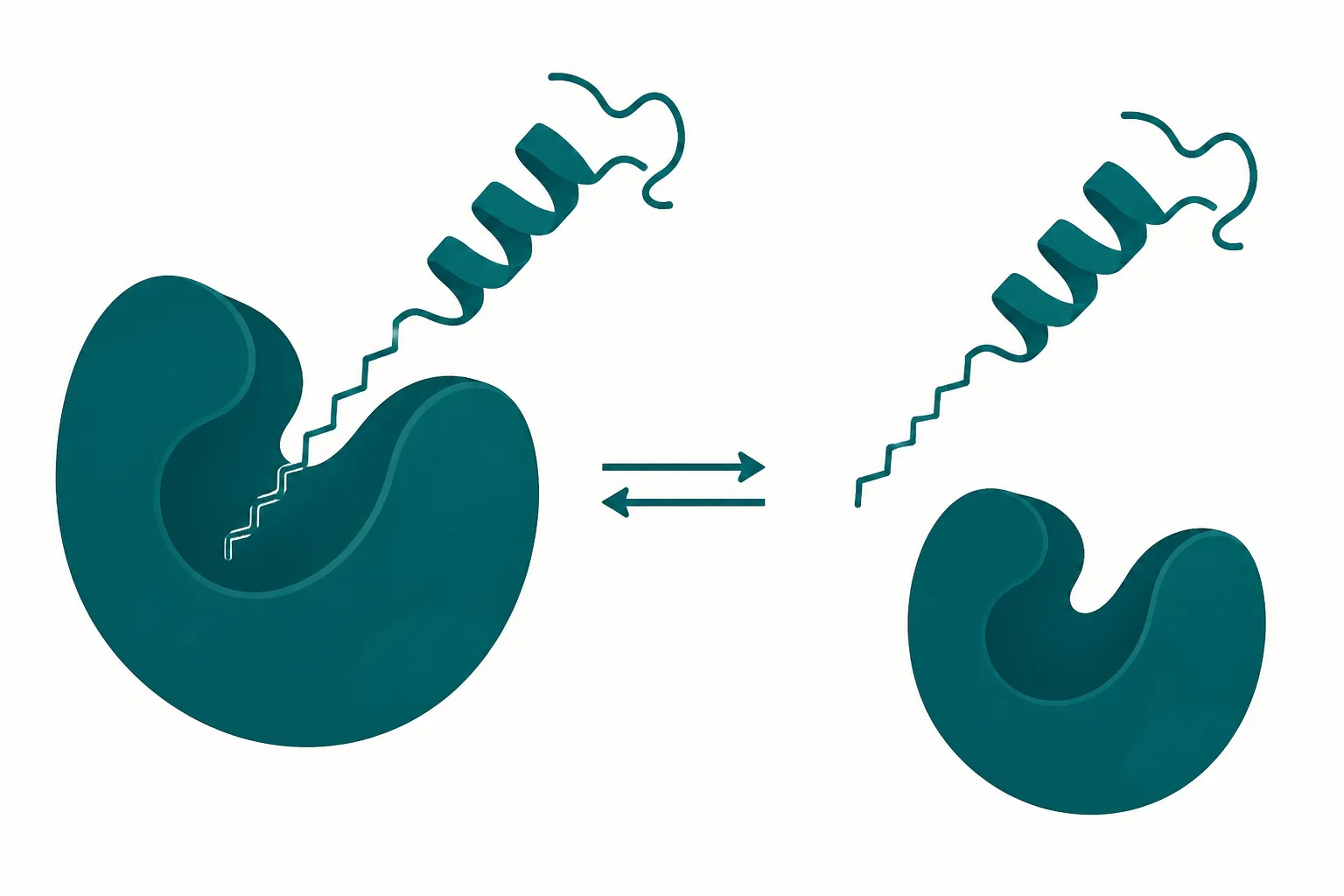
Semaglutide is an analogue of glucagon-like peptide-1, a hormone released from intestinal L-cells after a meal. It works by binding and activating the GLP-1 receptor, a class B G-protein-coupled receptor expressed on pancreatic beta cells and at several sites in the central nervous system 2. Activation there produces three effects that matter clinically: glucose-dependent insulin secretion, suppression of glucagon release, and reduced food intake through central appetite pathways. What distinguishes semaglutide from the hormone it copies is not what it does at the receptor but how long it survives to do it — native GLP-1 has a circulating half-life of roughly one to two minutes, and semaglutide's is approximately 165 hours 1. That difference is the product of three deliberate structural changes, and it is worth understanding in detail because it is the clearest worked example of peptide drug design in the published literature.
The receptor and the signal it carries
The GLP-1 receptor belongs to the secretin-like class B family of G-protein-coupled receptors. It couples primarily to Gs, so agonist binding activates adenylyl cyclase and raises intracellular cyclic AMP. In the pancreatic beta cell, that cAMP signal proceeds through two branches: protein kinase A, and the guanine nucleotide exchange factor Epac2. Both converge on the machinery that moves insulin granules to the membrane and releases them 2.
The physiological role this serves is the incretin effect. An oral glucose load produces substantially more insulin release than the same amount of glucose given intravenously, because eating triggers gut hormone release that primes the beta cell before the glucose arrives. GLP-1 is one of the two principal incretin hormones. In type 2 diabetes the incretin effect is diminished, which is the rationale for replacing the signal pharmacologically.
Why glucose-dependence is the important detail
GLP-1 receptor activation amplifies insulin secretion rather than initiating it. The cAMP signal potentiates a beta cell that is already being depolarised by glucose metabolism; at low glucose there is little to potentiate, and insulin release is not meaningfully stimulated 2. The same dependence applies in reverse to glucagon: suppression occurs at normal and elevated glucose, and the counter-regulatory glucagon response to genuine hypoglycaemia appears to be preserved.
This is a mechanistic property with a direct clinical consequence, and it explains why GLP-1 receptor agonists behave differently from insulin or sulfonylureas, which force insulin release regardless of prevailing glucose. It is a good illustration of why receptor-level detail is worth reading: the safety profile of the class follows from the shape of the signalling, not from dosing convention.
Three modifications, and what each one solves
Native GLP-1 is cleared by two mechanisms working in parallel. Dipeptidyl peptidase-4 cleaves it between residues 8 and 9, destroying activity within minutes, and the remaining fragment is filtered renally. Any therapeutic analogue has to defeat both. The discovery programme that produced semaglutide addressed them with three changes to the parent sequence 1.
| Modification | Position | Problem it solves |
|---|---|---|
| Alanine replaced with α-aminoisobutyric acid (Aib) | 8 | Blocks dipeptidyl peptidase-4 cleavage |
| Lysine replaced with arginine | 34 | Directs acylation to a single intended site |
| C18 diacid attached via a γ-glutamate and two OEG spacers | 26 | Binds albumin; slows renal filtration and degradation |
The first change is the most elegant. α-aminoisobutyric acid is a non-proteinogenic amino acid with two methyl groups on the alpha carbon, and the resulting steric bulk prevents the protease from engaging the bond it would otherwise cut. The enzyme is not inhibited; the substrate is simply no longer recognisable to it.
The third change does the heavy lifting on duration. A long-chain fatty diacid attached through a hydrophilic spacer gives the molecule a reversible binding site for serum albumin. Albumin-bound drug is too large for glomerular filtration and is shielded from degrading enzymes, while a small unbound fraction remains available to reach the receptor. The bound pool behaves as a slowly releasing depot in the bloodstream itself. The second modification exists to serve the third: removing the competing lysine at position 34 ensures the acyl chain attaches only at position 26 1.
Central effects on food intake
The pancreatic actions explain glycaemic effects. They do not explain weight loss, which is mediated centrally. GLP-1 receptors are expressed in hypothalamic nuclei governing energy balance and in the area postrema and other circumventricular organs — brain regions with an incomplete blood-brain barrier, which is how a large, albumin-bound peptide reaches central targets at all 2. Activation there reduces food intake, an effect that appears to combine reduced appetite with altered reward valuation of food.
A second contributor is delayed gastric emptying, which slows nutrient delivery to the small intestine and prolongs fullness after a meal. This effect attenuates with continued exposure, whereas the central appetite effect does not, so the sustained component of weight change is attributed principally to central signalling rather than to gastric slowing. The area postrema is also the brain's emetic trigger zone, which is the mechanistic reason nausea is the characteristic adverse effect of this drug class: the therapeutic target and the side-effect locus are substantially the same tissue.
What the human trials showed
This is where semaglutide separates from every other compound discussed on this site. Most peptides in research supply have no controlled human data at all. Semaglutide has cardiovascular outcome trials enrolling thousands of participants each, with hard clinical endpoints and independent adjudication.
SUSTAIN-6 randomised patients with type 2 diabetes at high cardiovascular risk and reported a significant reduction in the primary composite endpoint of cardiovascular death, non-fatal myocardial infarction and non-fatal stroke, with a hazard ratio of 0.74 3. STEP 1 randomised adults with overweight or obesity and no diabetes, and reported mean body weight change of approximately −14.9% at 68 weeks against −2.4% on placebo 4. SELECT then tested whether that translated into cardiovascular benefit in people with obesity and established cardiovascular disease but without diabetes, and reported a roughly 20% reduction in major adverse cardiovascular events, hazard ratio 0.80 5.
| Trial | Population | Principal reported result |
|---|---|---|
| SUSTAIN-6 (2016) | Type 2 diabetes, high CV risk | HR 0.74 for the primary CV composite |
| STEP 1 (2021) | Overweight or obesity, no diabetes | −14.9% vs −2.4% body weight at 68 weeks |
| SELECT (2023) | Obesity with established CV disease, no diabetes | HR 0.80 for major adverse cardiovascular events |
Limits and open questions
- Weight regain after discontinuation has been observed in extension studies, consistent with a mechanism that suppresses appetite while present rather than resetting a set point.
- A substantial fraction of weight lost is lean mass, and the long-term functional consequence of that is not resolved.
- Gastrointestinal adverse effects are common and are the leading reason for discontinuation.
- Rodent studies found C-cell tumours, prompting a contraindication in medullary thyroid carcinoma. Whether the rodent finding translates to humans remains unresolved — a good example of a species difference being handled by precaution rather than by extrapolation.
- The very long half-life that makes weekly administration possible also means exposure cannot be withdrawn quickly if a problem arises.
Why this compound is worth studying closely
Semaglutide answers a question the peptide field has faced since insulin: how do you make a molecule that the body is designed to destroy in minutes last long enough to be useful? The answer was not a new receptor or a novel pharmacology. It was three targeted changes to a known sequence, each addressing one specific clearance route, validated by a discovery programme that published its structure-activity reasoning in full 1. Every claim made about it has been tested against placebo in populations large enough to detect harm as well as benefit. That is the standard against which the rest of this field should be read, and very little of it comes close.
References
- Discovery of the Once-Weekly Glucagon-Like Peptide-1 (GLP-1) Analogue Semaglutide
- Mechanisms of Action and Therapeutic Application of Glucagon-like Peptide-1
- Semaglutide and Cardiovascular Outcomes in Patients with Type 2 Diabetes
- Once-Weekly Semaglutide in Adults with Overweight or Obesity
- Semaglutide and Cardiovascular Outcomes in Obesity without Diabetes