pharmacology
Peptide Half-Life: Why Clearance Is So Fast, and the Five Ways It Is Slowed
Two independent systems remove peptides from circulation — peptidases cut them and the kidney filters them — and both work quickly. Extending half-life means defeating both, and every method of doing so has a price.
Peptides have short half-lives because two independent clearance systems act on them at once, and both are efficient. Peptidases cut the chain wherever a recognisable motif is exposed, and the kidney filters what remains out of the blood almost as fast as blood arrives. Neither has to be induced, neither saturates at physiological concentrations, and neither waits for the other. A peptide entering the circulation works against a clearance capacity built to remove it quickly, and for most native sequences the result is a plasma half-life measured in minutes 15.
Two routes, running in parallel
The first route is chemical. Peptidases are abundant in plasma, on endothelial surfaces, in gut wall, liver and kidney, and they act continuously. The best-characterised here is dipeptidyl peptidase-4, an exopeptidase that removes a dipeptide from the amino terminus when the residue in position 2 is alanine or proline. That one specificity rule destroys several important signalling molecules. Native glucagon-like peptide-1 carries alanine at position 2; the enzyme clips the first two residues and leaves a fragment that no longer activates the receptor. Degradation begins on entry into the circulation, which is the main reason the native half-life is one to two minutes 4.
It is one enzyme among many, and a peptide usually presents several liabilities rather than one. Exopeptidases work inward from the ends — aminopeptidases from the N-terminus, carboxypeptidases from the C-terminus. Endopeptidases cut internally at recognised motifs and need no terminus at all. Neprilysin, a zinc-dependent membrane endopeptidase concentrated in the kidney, cleaves on the amino side of hydrophobic residues across a broad substrate range. Protecting one cleavage site therefore relocates the problem rather than removing it 12.
The second route is physical. The glomerulus is a size-selective filter with steep but not sharp selectivity. Molecules below roughly 5 kDa pass into the filtrate freely, with no meaningful restriction; between about 5 and 60 kDa passage falls away progressively; above roughly 60–70 kDa it has effectively stopped. Most therapeutic peptides sit far below the lower bound — a 30-residue peptide weighs around 3.3 kDa, a 10-residue peptide around 1.1 kDa. At those masses the filter offers no resistance, so the peptide is removed on essentially the first pass, at close to the glomerular filtration rate of roughly 120 mL of plasma per minute.
The two routes are additive and neither depends on the other. A peptide made fully resistant to dipeptidyl peptidase-4 is still 3 kDa, and is still filtered. A peptide enlarged past the filtration threshold but still displaying an exposed cleavage motif is still cut. This is why single-modification approaches usually fail: they close one exit and leave the other open, and the compound leaves by the route that was not addressed. Long-acting peptides in current use address both, generally with three or more distinct changes 34.
Fast clearance is a feature, not a fault
It is worth stating plainly that the endogenous system is not failing when it clears a peptide in ninety seconds. It is working as specified. Regulatory peptides encode transient information: a meal has arrived, blood volume has risen, a stressor is present. A signal reporting a transient event must itself be transient, because a molecule that persisted would keep asserting a condition that had ceased to be true. Rapid clearance gives the signal an off state, and the off state is what makes the on state informative.
The consequences are practical. Because clearance is fast, incretin, natriuretic and hypothalamic responses can be modulated on a timescale of minutes. Several axes are frankly pulsatile, and a pulse carries meaning only because a trough separates it from the next. Continuous exposure to a molecule the system normally delivers in pulses often produces a different outcome, by receptor desensitisation and downregulation. A long-acting analogue is a different pharmacological object, not the parent given less often 3.
Short half-life is therefore a defect only to someone building a medicine from the molecule. From the standpoint of the system it is a specification that has been met. Holding both framings at once sets the right expectation for half-life extension: a deliberate departure from native pharmacology, not a repair of a flaw in it.
The five strategies, and what each one defeats
The methods used against clearance fall into five groups, better understood as components than as alternatives, since a molecule with a useful profile usually combines several to cover both routes 12.
The first is protease-resistant substitution. Peptidases recognise particular residues in particular positions, so changing the residue removes the recognition. Non-natural residues such as α-aminoisobutyric acid — alanine bearing a second methyl group on the α-carbon — place steric bulk exactly where the enzyme must bind; the one at position 2 of semaglutide is there to remove the dipeptidyl peptidase-4 site 4. D-amino acids exploit stereospecificity instead: proteases evolved to process L-residues and cannot accommodate the mirror image. Neither approach affects renal filtration.
The second is lipidation for albumin binding. A fatty acid or diacid chain is attached to a side chain, usually a lysine, through a short spacer. The chain inserts into one of albumin's fatty-acid binding sites, giving a reversible, non-covalent association. Albumin is roughly 66 kDa and is not filtered, so a peptide bound to it is not filtered either; it has borrowed a carrier large enough to be excluded. Because the association is reversible, a small free fraction stays available to the receptor while the bound pool acts as a circulating depot. Semaglutide is the standard example: a C18 diacid joined through a spacer to lysine 26, with affinity enough to hold the terminal half-life near a week 4.
The third is PEGylation — covalent attachment of polyethylene glycol. PEG chains are heavily hydrated and occupy a hydrodynamic volume far larger than their mass suggests, so a modest chain pushes a small peptide's effective radius past the filtration threshold. The costs are equally direct: the bulk that obstructs the filter also obstructs the receptor, and PEGylated peptides commonly lose potency, sometimes by an order of magnitude. Anti-PEG antibodies have been found in treated populations and in people never exposed to a PEGylated drug, raising immunogenicity concerns that have pushed development elsewhere 15.
The fourth is cyclisation. Joining the ends of the chain — head-to-tail, through a disulfide, or via a lactam bridge — removes the free N- and C-termini exopeptidases require, leaving them nothing to grip. It also constrains conformation, lowering the entropic penalty paid on binding. It does not stop endopeptidases, which cut internally, and does nothing about filtration, since a cyclic peptide is still small. Its appeal is addressing stability and binding together at almost no cost in molecular weight 3.
The fifth is covalent carrier conjugation. Instead of binding albumin reversibly, the peptide is bonded to it permanently, or to a scaffold such as an antibody Fc domain. The conjugate adopts the carrier's pharmacokinetics almost entirely: far above the filtration threshold, and recycled by the neonatal Fc receptor pathway that gives albumin and immunoglobulin their long residence times. The extension is the largest of the five, and so is the loss of control — there is no meaningful free fraction 12.
| Strategy | Mechanism | Example | Principal trade-off |
|---|---|---|---|
| Protease-resistant substitution | Removes the residue the enzyme recognises | α-aminoisobutyric acid at position 2; D-amino acids | No effect on filtration |
| Lipidation | Reversible albumin binding; the carrier is too large to filter | Semaglutide, C18 diacid at lysine 26 | Small, variable free fraction; slow offset |
| PEGylation | Hydrated polymer raises hydrodynamic radius past the threshold | PEGylated peptide conjugates | Reduced potency; anti-PEG immunogenicity |
| Cyclisation | Removes the free termini exopeptidases need | Disulfide and lactam-bridged peptides | No cover against endopeptidases or filtration |
| Covalent carrier conjugation | Permanent bond to albumin or an Fc domain | Fc-fusion and albumin conjugates | Largest potency loss; very slow reversal |
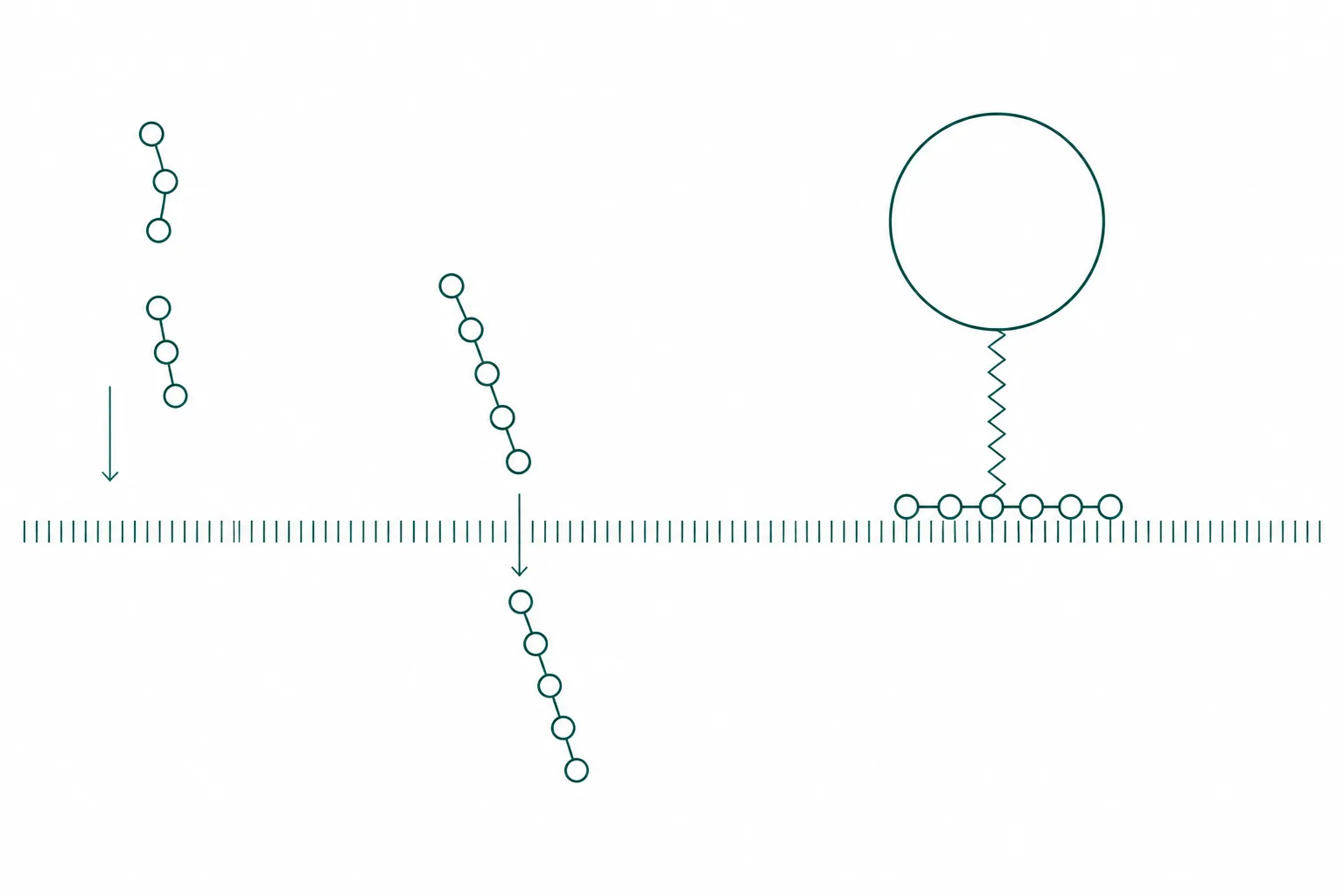
Orders of magnitude: from GLP-1 to semaglutide
The scale of what is achievable is clearest within a single lineage. Native glucagon-like peptide-1 has a plasma half-life of one to two minutes. Semaglutide, built on the same backbone, has a reported terminal half-life of approximately 165 hours 4.
The arithmetic is worth doing explicitly. 165 hours is 9,900 minutes. Against the two-minute end of the native range that is a 4,950-fold extension — call it 5,000-fold; against the one-minute end it approaches 10,000-fold. Either way the change spans three to four orders of magnitude, produced by three modifications: α-aminoisobutyric acid replacing alanine at position 2, removing the dipeptidyl peptidase-4 site; a C18 diacid attached at position 26, providing albumin binding; and a lysine-to-arginine substitution at position 34, directing the acylation to the intended residue 4.
Two observations follow. The changes are not interchangeable — each addresses a different mechanism, and removing any one forfeits a distinct part of the effect. And they contribute unequally: almost all of the extension comes from albumin binding, because for a molecule this size filtration is the larger capacity. Protease resistance alone buys minutes. Defeating filtration is what buys days.
Everything gained is paid for
Half-life extension is not free, and the costs are structural rather than incidental. They arise from the same properties that produce the benefit, so they cannot be engineered away separately.
- Potency. Anything larger, bulkier or tethered tends to be a worse ligand; binding sites are shaped for the native molecule.
- Reversibility. Stopping administration does not stop exposure. It starts a decay curve measured in weeks.
- Free fraction. Strong albumin binding makes the active portion a small share of total drug, and the share is not constant.
- Signal shape. Continuous occupancy is a different stimulus from a pulse, and can produce desensitisation.
The free-fraction problem changes what a measurement means. Only unbound drug engages the receptor. For a strongly albumin-bound peptide the unbound fraction may be well under one percent of total drug, and that percentage is not fixed. It varies with albumin concentration, which falls in inflammation, liver disease, nephrotic syndrome and malnutrition, and with competition from endogenous fatty acids and other albumin-bound compounds. A total-drug assay therefore measures mostly the depot, and the depot is mostly inactive. The relationship between concentration and effect is indirect and unstable 5.
The reversibility problem is the plainest of the set. A molecule with a two-minute half-life is gone once administration stops. A molecule at 165 hours needs roughly five half-lives to clear substantially — on the order of five weeks — during which any unwanted effect continues on its own schedule. There is no antidote for duration. That is the exchange made for convenience, and it is why the five strategies are applied selectively rather than by default.
The general point is that clearance is a system property, not a molecular one. A peptide's half-life is the outcome of an interaction between its chemistry and two large, parallel, unsaturated clearance capacities. A half-life figure read without knowing which route dominated it, in which species, and whether it measured total or free drug, is a number without its units.
References
- Strategies to improve plasma half life time of peptide and protein drugs
- Therapeutic peptides: Historical perspectives, current development trends, and future directions
- Trends in peptide drug discovery
- Discovery of the Once-Weekly Glucagon-Like Peptide-1 (GLP-1) Analogue Semaglutide
- Peptide therapeutics: current status and future directions