fundamentals
Peptide or Protein: Where the Boundary Sits, and Who Decides
Chemically the two are the same class of molecule. The line between them is drawn by convention, by folding behaviour, by how the molecule is manufactured — and, in the United States, at exactly 40 residues by statute.
There is no chemical difference. Peptides and proteins are both polymers of amino acids joined by peptide bonds, built from the same twenty proteinogenic residues by the same linkage, and no reaction distinguishes one class from the other. The distinction is a matter of length, and the threshold is a convention rather than a fact about matter. In common scientific usage the line falls somewhere around 50 residues; in United States drug regulation it falls at exactly 40; and the boundary that does the most practical work — how the molecule folds, and how it is manufactured — falls in roughly the same region for reasons that are not coincidental 12.
The bond they share
A peptide bond forms when the carboxyl group of one amino acid condenses with the amino group of the next, releasing a molecule of water. The result is an amide linkage. Its defining property is that the carbon-nitrogen bond has partial double-bond character from delocalisation of the nitrogen lone pair, which makes the bond planar and restricts rotation around it.
This constraint is why chains of amino acids behave as they do. Rotation is permitted at the two flanking bonds and not at the amide itself, so the backbone is a series of rigid planar units connected by hinges. Every secondary structure element — the alpha helix, the beta sheet — is a consequence of that geometry combined with hydrogen bonding along the backbone. The chemistry is identical whether the chain is three residues long or three hundred.
The boundary is a convention
IUPAC nomenclature governs how residues are named, numbered and symbolised, and establishes the vocabulary for describing modifications and linkages 1. What it does not do is impose a hard residue count separating peptide from protein, because no such count is chemically motivated. Different communities have adopted different thresholds, and each is defensible for its own purposes.
| Context | Boundary used | Basis |
|---|---|---|
| General biochemistry | ~50 residues | Convention and folding behaviour |
| US drug regulation | 40 residues, exactly | Statutory definition |
| Synthetic chemistry | ~50 residues | Practical limit of solid-phase synthesis |
| Oligopeptide | 2–20 residues | Convention |
| Polypeptide | Above ~20 residues | Convention |
| Structural biology | Not size-based | Presence of stable tertiary structure |
The 40-residue line, and why it has consequences
United States regulation contains a definition with real force. A polymer of alpha amino acids with more than 40 residues is a protein and is regulated as a biologic; at 40 or fewer it is a peptide and is regulated as a drug. This is the one place where the boundary is not a matter of usage, and crossing it changes the approval pathway, the manufacturing standards, the naming conventions and the route by which a competitor product can later reach the market.
The distinction is therefore load-bearing in a way that has nothing to do with chemistry. It determines whether a generic version can be approved as a small-molecule copy or must go through the biosimilar route, which is substantially more demanding. A molecule at 39 residues and one at 41 are chemically unremarkable neighbours and regulatorily quite different objects.
The distinction that does real work: folding
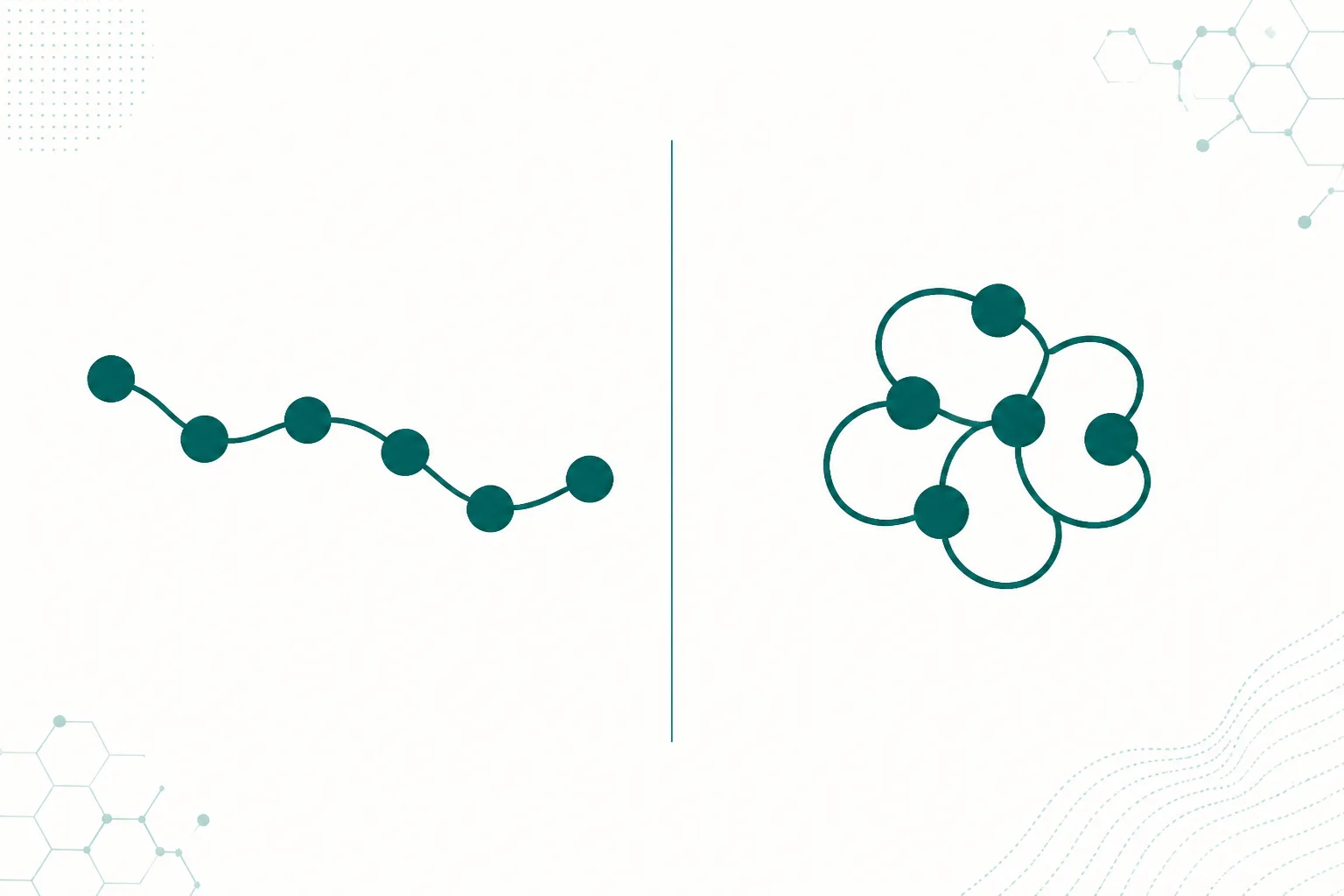
If a chemically meaningful difference exists, it is conformational rather than numerical. A protein folds into a defined three-dimensional structure that is stable under physiological conditions, and its function depends on that structure — denature it and the function is lost. Most short peptides do not fold this way. They are conformationally flexible in solution, sampling many states, and frequently adopt a defined structure only on binding a partner.
Thymosin β4, at 43 residues, is a good illustration: it is unstructured free in solution and takes on defined conformation when it engages actin. This behaviour is characteristic of the length range where the terminology is most contested, and it explains why the boundary sits where it does. Stable tertiary structure requires enough chain to bury a hydrophobic core, and that generally takes more than about 50 residues. The conventional threshold is an empirical observation about folding that later hardened into a naming rule.
The consequence for drug design is direct. A flexible peptide pays a large entropic penalty on binding, which is one reason peptide drugs are often constrained — cyclised, stapled, or built with non-natural residues — to pre-organise them into the bound conformation 3. Proteins arrive pre-organised, which is part of why they bind with the affinities they do.
The manufacturing boundary
There is a practical boundary that tracks the conventional one closely, and it is arguably the reason the convention settled where it did. Solid-phase peptide synthesis, introduced by Merrifield in 1963, builds a chain one residue at a time on an insoluble support, with the growing chain anchored to a resin so excess reagents can simply be washed away 5. It is the basis of essentially all synthetic peptide manufacture.
Its limitation is arithmetic. Each coupling step proceeds at slightly less than complete efficiency, and the errors compound. At 99% per-step efficiency a 20-residue chain finishes at roughly 82% overall yield; a 50-residue chain at about 61%; a 100-residue chain at around 37%, with the remainder a mixture of deletion sequences that must be separated from the target. Beyond roughly 50 residues, synthesis becomes difficult and expensive enough that recombinant expression in a biological host is normally preferred 24.
So the practical taxonomy is: peptides are the things you can reasonably synthesise, proteins are the things you generally have to grow. That framing is not rigorous, but it predicts which molecules are called what more reliably than any residue count, and it explains why the therapeutic peptide field is populated by molecules in the 3-to-50-residue range.
Where the terminology breaks down
Insulin is the standard hard case. It comprises 51 residues across two chains joined by disulfide bridges, sits directly on the conventional boundary, folds into a defined structure, and is produced recombinantly. It is usually called a protein and frequently called a peptide hormone, and both usages appear in current literature without confusion arising.
GLP-1 analogues are another. The active fragment is around 30 residues, comfortably in peptide territory by any threshold, yet semaglutide's engineered albumin-binding chain gives it pharmacokinetics closer to those of a large biologic than to a typical peptide. Length predicts naming; it does not reliably predict behaviour. The useful conclusion is that "peptide" tells you approximately how long a molecule is and very little else — not its stability, not its potency, not its route of administration, and not the quality of the evidence behind it.
Where the taxonomy stops applying: modified peptides
Everything above assumes chains built from the twenty proteinogenic amino acids with an unmodified backbone. Therapeutic peptides routinely violate both assumptions, and once they do, the peptide-protein taxonomy stops describing anything useful 3.
The most common modifications each address a specific liability. Substituting a D-amino acid for its natural L counterpart exploits the stereospecificity of proteases, which cannot process the mirror-image residue — a single substitution at a cleavage site can extend half-life substantially. Non-proteinogenic residues do similar work through steric bulk rather than chirality; the α-aminoisobutyric acid in semaglutide is the standard example. Cyclisation, whether head-to-tail, through a disulfide, or via a lactam bridge, both pre-organises the molecule into its bound conformation and eliminates the free termini that exopeptidases require. N-methylation of backbone amides removes hydrogen-bond donors, which improves membrane permeability and blocks recognition by degrading enzymes.
| Modification | Mechanism | Liability addressed |
|---|---|---|
| D-amino acid substitution | Protease stereospecificity | Enzymatic degradation |
| Non-natural residue (e.g. Aib) | Steric blockade of cleavage site | Enzymatic degradation |
| Cyclisation | Conformational constraint; no free termini | Exopeptidases; binding entropy |
| N-methylation | Removes backbone H-bond donors | Poor membrane permeability |
| Lipidation | Reversible albumin binding | Rapid renal clearance |
| PEGylation | Increases hydrodynamic radius | Rapid renal clearance |
The cumulative effect is that a modern therapeutic peptide is frequently not a molecule any ribosome could produce. It occupies a chemical space between conventional small molecules and biologics, which is precisely the space the field was built to exploit: larger and more selective than a small molecule, smaller and more synthetically tractable than a protein 24.
Why the distinction is worth getting right
The word carries an implication it has not earned. "Peptide" is frequently deployed to suggest that a compound is small, natural, gentle or inherently low-risk, none of which follows from chain length. Some of the most toxic molecules in biology are peptides. Some of the safest drugs in wide use are proteins. Chain length is a structural fact, not a safety claim, and the inference from one to the other is unsupported.
Read the specification instead: how many residues, what sequence, what modifications, what evidence in what species. Those answer questions. The category label does not.
References
- Nomenclature and symbolism for amino acids and peptides
- Therapeutic peptides: Historical perspectives, current development trends, and future directions
- Trends in peptide drug discovery
- Peptide therapeutics: current status and future directions
- Solid Phase Peptide Synthesis. I. The Synthesis of a Tetrapeptide