fundamentals
Why Most Peptides Are Not Orally Bioavailable
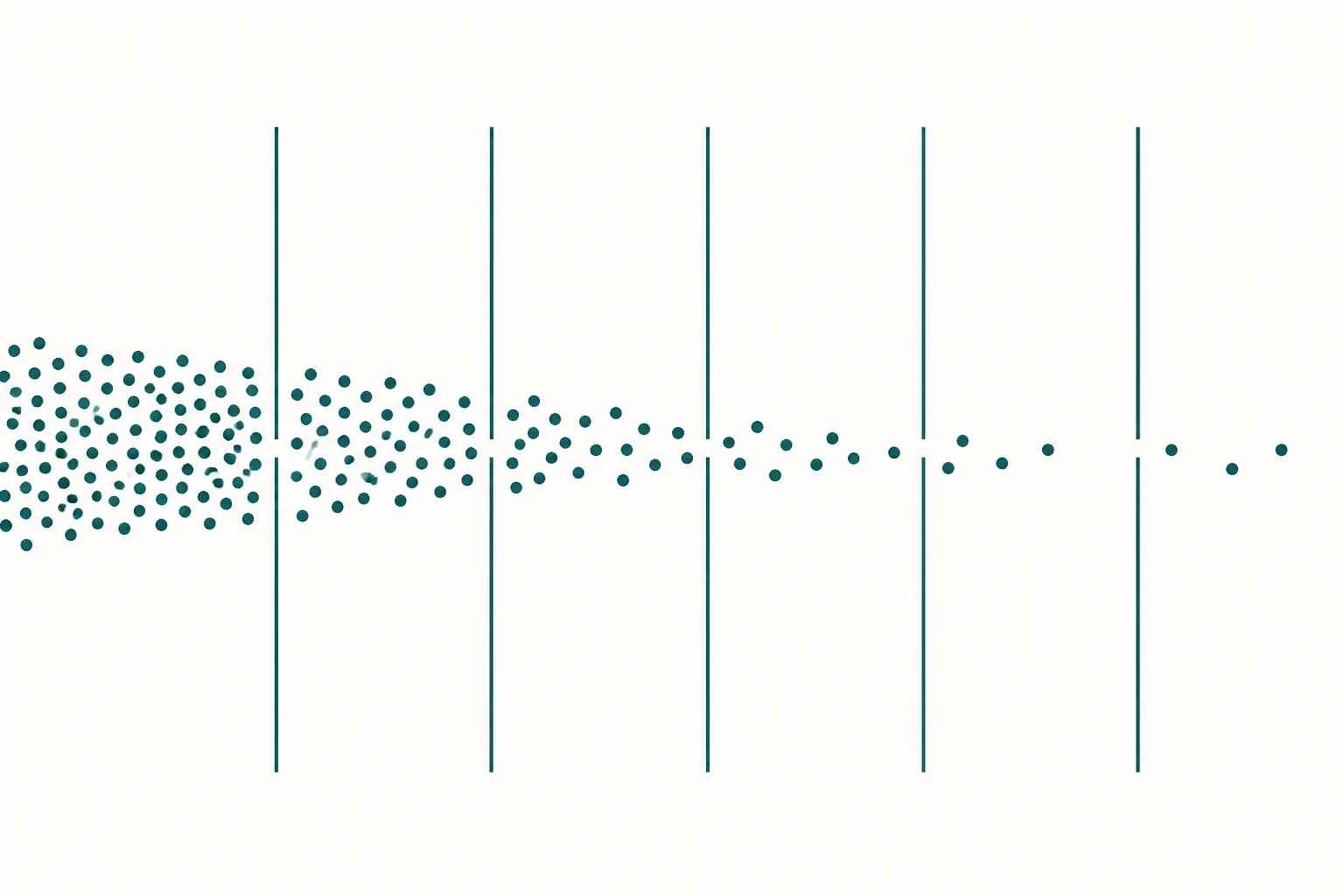
The gastrointestinal tract is a protein-digestion system, and a swallowed peptide is its intended substrate rather than an unlucky bystander. Five barriers stand between the mouth and the circulation, and unmodified peptides clear all five at well under 1%.
Most peptides cannot be taken orally because the gastrointestinal tract is a system built to destroy exactly that class of molecule. A swallowed peptide is not encountering an obstacle. It is being fed into the organ system that evolved to reduce dietary protein to amino acids and very short fragments, and it is chemically indistinguishable from the substrate that system was designed to process. Five barriers stand in sequence between the mouth and the circulation, each removing a share of what reaches it. The losses multiply rather than add, which is why the fraction of an unmodified peptide reaching the bloodstream intact is typically well under 1%, and frequently under 0.1% 15.
A swallowed peptide meets its own dedicated enzyme set
The first two barriers are both in the stomach and work differently. Fasted gastric fluid sits at roughly pH 1.5 to 3.5, and at that acidity the backbone undergoes acid-catalysed hydrolysis — aspartyl-prolyl bonds being particularly labile — while asparagine and glutamine side chains deamidate and disulfide bonds scramble. None of that requires an enzyme. The enzyme arrives anyway. Pepsin is an aspartic endopeptidase with a catalytic optimum near pH 2, one of very few that functions at all under those conditions, and it cleaves preferentially beside bulky hydrophobic and aromatic residues: phenylalanine, tyrosine, tryptophan, leucine.
The third barrier arrives in the duodenum. Pancreatic bicarbonate raises luminal pH into the neutral range, switching off pepsin and switching on the pancreatic proteases: trypsin, cleaving after lysine and arginine; chymotrypsin, after aromatic residues; elastase, after small neutral residues such as alanine and glycine; and carboxypeptidases A and B, trimming from the C-terminus. Between them this set covers essentially every residue type in the proteinogenic alphabet. No sequence of natural amino acids escapes all of them.
The fourth barrier is the intestinal wall, and it is two problems stacked. The brush-border membrane carries its own peptidases — aminopeptidase N, dipeptidyl peptidase 4, several membrane-bound endopeptidases — whose function is to finish the job, delivering free amino acids and di- and tripeptides to the transporters. That specification matters: PepT1, the one efficient peptide transporter in the intestine, carries di- and tripeptides. Nothing carries peptides of therapeutic size.
Then the epithelium itself, where both routes across are closed. The paracellular route is sealed by tight junctions with pore radii on the order of eight angstroms in the jejunum and smaller distally; it passes small hydrophilic solutes and accounts for well under one percent of absorptive surface area. The transcellular route requires partitioning into and out of a lipid bilayer, which demands a molecule that is small, reasonably lipophilic and light on hydrogen-bond donors. A therapeutic peptide is the opposite on every count: large, charged at intestinal pH, dense with backbone donors. Semaglutide's molecular weight exceeds 4,000 daltons against a conventional passive-permeability guideline of 500.
The fifth barrier applies only to what survived the first four. Blood leaving the intestine drains into the portal vein and passes through the peptidase-rich liver before reaching the systemic circulation, and first-pass metabolism removes a further share of an already small quantity.
| Barrier | Location | Mechanism | What defeats it |
|---|---|---|---|
| Gastric acid | Stomach lumen, pH 1.5–3.5 | Hydrolysis, deamidation, disulfide scrambling | Enteric coating; local pH buffering |
| Pepsin | Stomach lumen | Aspartic endopeptidase; aromatic and bulky residues | Local pH above its working range |
| Pancreatic proteases | Duodenum, jejunum | Trypsin, chymotrypsin, elastase, carboxypeptidases | Cyclisation; D-amino acids; protease inhibitors |
| Brush-border peptidases | Enterocyte apical membrane | Aminopeptidases and membrane endopeptidases | Terminal modification; cyclisation |
| The epithelium itself | Gastric or intestinal mucosa | Tight junctions close the paracellular route; bilayer closes the transcellular | Permeation enhancers; N-methylation |
| Hepatic first pass | Portal circulation, liver | Hepatic peptidases before systemic distribution | Non-portal absorption sites; nothing general |
The number, not the adjective
"Poor oral bioavailability" is the phrase the literature reaches for, and it understates the situation badly. For an unmodified peptide the figure is typically below 1% and often below 0.1% 15. Set against oral small molecules, where 50% to 90% is unremarkable, that is not a difference of degree. It is why the great majority of approved peptide drugs are injected, and why route of administration has been the field's defining constraint since insulin 45.
The approved oral peptides sit in the same range, and are instructive precisely because they are the successes. Desmopressin is absorbed at roughly 0.1%, workable only because its potency is extreme. An oral octreotide formulation using a transient permeation enhancer reaches near 0.7%. Oral semaglutide, the most heavily engineered, lands at approximately 1% 12. At those levels a modest absolute change in how much crosses the epithelium is a large proportional change in exposure, which is why variability for oral peptides is consistently high 1.
The misreading worth naming
That conflation is the most common error in secondary writing about research peptides, and it has a recognisable signature. A stability assay is run in simulated gastric fluid — dilute hydrochloric acid with pepsin, at body temperature — and the peptide is recovered largely intact. The result is real and the assay is standard. The conclusion drawn from it, that the compound is therefore "orally active", does not follow. Simulated gastric fluid contains no trypsin, no elastase, no carboxypeptidase, no brush-border membrane, and no epithelium to cross.
A related inference is worth separating out: that an effect observed after oral administration demonstrates absorption. It does not. A peptide can act on the gut lumen or mucosa without entering the circulation at all — linaclotide is approved, works this way, and is essentially unabsorbed. Absorption is a pharmacokinetic claim, and requires a pharmacokinetic measurement.
What it took to make one work: SNAC and oral semaglutide
Semaglutide arrives at the oral problem already engineered for a different one. An α-aminoisobutyric acid substitution at position 8 blocks cleavage by dipeptidyl peptidase 4, and a fatty diacid chain gives reversible albumin binding that extends circulating half-life to about a week 3. Both address what happens once the molecule is in the blood. Neither does anything about getting it there, and the solution to that was not a change to the peptide.
The tablet co-formulates semaglutide with SNAC, sodium N-[8-(2-hydroxybenzoyl)amino] caprylate, an absorption enhancer present in large molar excess. The mechanistic work behind it established something that had not been assumed: absorption occurs in the stomach, not the intestine 2. As the tablet erodes it creates a small, transient microenvironment against the gastric mucosa in which SNAC does two things at once. It buffers local pH upward, protecting the peptide from pepsin — an enzyme that loses activity well before neutrality — and keeping semaglutide in solution. And it promotes transcellular transport across the gastric epithelium.
Three features of that transport are what make the approach tolerable rather than merely effective. It is localised, confined to the mucosa immediately adjacent to the eroding tablet. It is concentration-dependent, operating only where SNAC is present at sufficient local concentration. And it is reversible, the epithelium returning to baseline as SNAC diffuses away 2. An enhancer that opened the gut wall durably and non-selectively would be a far less attractive proposition.
The honest accounting is that this works and is inefficient, and both halves carry weight. Bioavailability remains around 1%, so the quantity of peptide in an oral tablet must be very much larger than the injected quantity for comparable exposure — on the order of a hundredfold more material through the manufacturing chain for the same effect. Absorption is also sensitive to food and to the fluid taken with the tablet, which is why the specified administration conditions are unusually strict. This is what a solved oral peptide looks like: a decade of work, a purpose-built excipient, a demonstrated absorption site, and a yield of one percent.
The other approaches, and where they stand
SNAC is one answer to one barrier. The wider field has worked the problem from several directions, and it is useful to know which barrier each addresses and how far it has got 13.
- Enteric coating. Delays release until the small intestine, clearing barriers one and two — and delivering the peptide straight into the pancreatic proteases. Useful component, never sufficient.
- Permeation enhancers. SNAC and sodium caprate have approved products behind them; many others failed. The objection is selectivity — an epithelium made more permeable is more permeable to everything present.
- Protease inhibitor co-formulation. Soybean trypsin inhibitor, aprotinin and camostat work in animal models. Inhibiting digestive proteases daily is unattractive, and inhibition is necessarily incomplete.
- Cyclisation. Removes the free termini exopeptidases require and pre-organises the molecule — barriers three and four at once, and the most productive single structural strategy.
- N-methylation of backbone amides. Removes hydrogen-bond donors, the property most strongly associated with passive permeability at this size. Applied selectively, since it can also destroy target binding.
- Carrier systems — nanoparticles, lipid formulations, mucoadhesive matrices, ionic liquids. Active preclinical literature; no approved oral peptide product yet rests on them.
The cyclosporine precedent
One naturally occurring peptide crosses the gut well enough to be given orally as a matter of routine, which is why nobody in the field treats the problem as impossible. Cyclosporine is an eleven-residue cyclic peptide of fungal origin. It is cyclised head-to-tail, so it has no termini, and seven of its eleven backbone amides are N-methylated, stripping out most of the hydrogen-bond donors. Its oral bioavailability is on the order of 30%, formulation-dependent — two to three orders of magnitude above an unmodified peptide of comparable size 14.
The mechanism is conformational. In water the molecule presents polar groups outward; on entering a lipid environment it folds so the remaining backbone donors form intramolecular hydrogen bonds, presenting a lipophilic exterior to the membrane. It hides its own polarity for the duration of the crossing. The behaviour is called chameleonic, and designing it in deliberately is what medicinal chemists have spent decades attempting.
The precedent reads in both directions. A peptide can be orally absorbed at a useful rate, so the barriers are not absolute. But the window is narrow: cyclosporine was discovered rather than designed, and general rules for reproducing its behaviour in a new molecule remain incomplete after forty years 34. The problem is not unsolvable. It is extremely constrained, and every solution so far has been specific to its molecule.
How to read a claim of oral activity
Claims that a research peptide is orally active can be sorted quickly by asking a few specific questions. The point is not scepticism for its own sake. It is that the barriers are distinct, so a claim addressing one of them tells you nothing about the other four.
- Which of the five barriers does it address? Acid and pepsin are two of them. A claim stopping there has covered the stomach and nothing beyond it.
- Was absorption measured or inferred? A measurement is a plasma concentration of the intact compound, ideally a pharmacokinetic curve. An observed effect is an inference.
- Against what reference? Absolute bioavailability is a ratio against intravenous administration in the same species. Without an intravenous arm the percentage has no denominator.
- In which species? Rodent gut differs in transit time, luminal pH and peptidase expression, and rodent figures routinely fail to translate.
- Local or systemic? A compound acting on the lumen or mucosa has real effects without being absorbed. Legitimate, but not oral bioavailability.
The underlying discipline is to keep apart two questions that language tends to merge. Stability asks whether the molecule still exists. Bioavailability asks whether it reached the blood. The first is a prerequisite for the second and nowhere near sufficient for it, and the gap between them is where most claims about orally active peptides quietly fail 15.
References
- Advances in oral peptide therapeutics
- Transcellular stomach absorption of a derivatized glucagon-like peptide-1 receptor agonist
- Trends in peptide drug discovery
- Therapeutic peptides: Historical perspectives, current development trends, and future directions
- Peptide therapeutics: current status and future directions