pharmacology
PT-141 (Bremelanotide): Melanocortin Pharmacology and the Development Story
A metabolite of Melanotan II that took the other road: randomised trials, a formulation abandoned over a blood pressure signal, and an approval. The mechanism is central, and the effect size is modest.
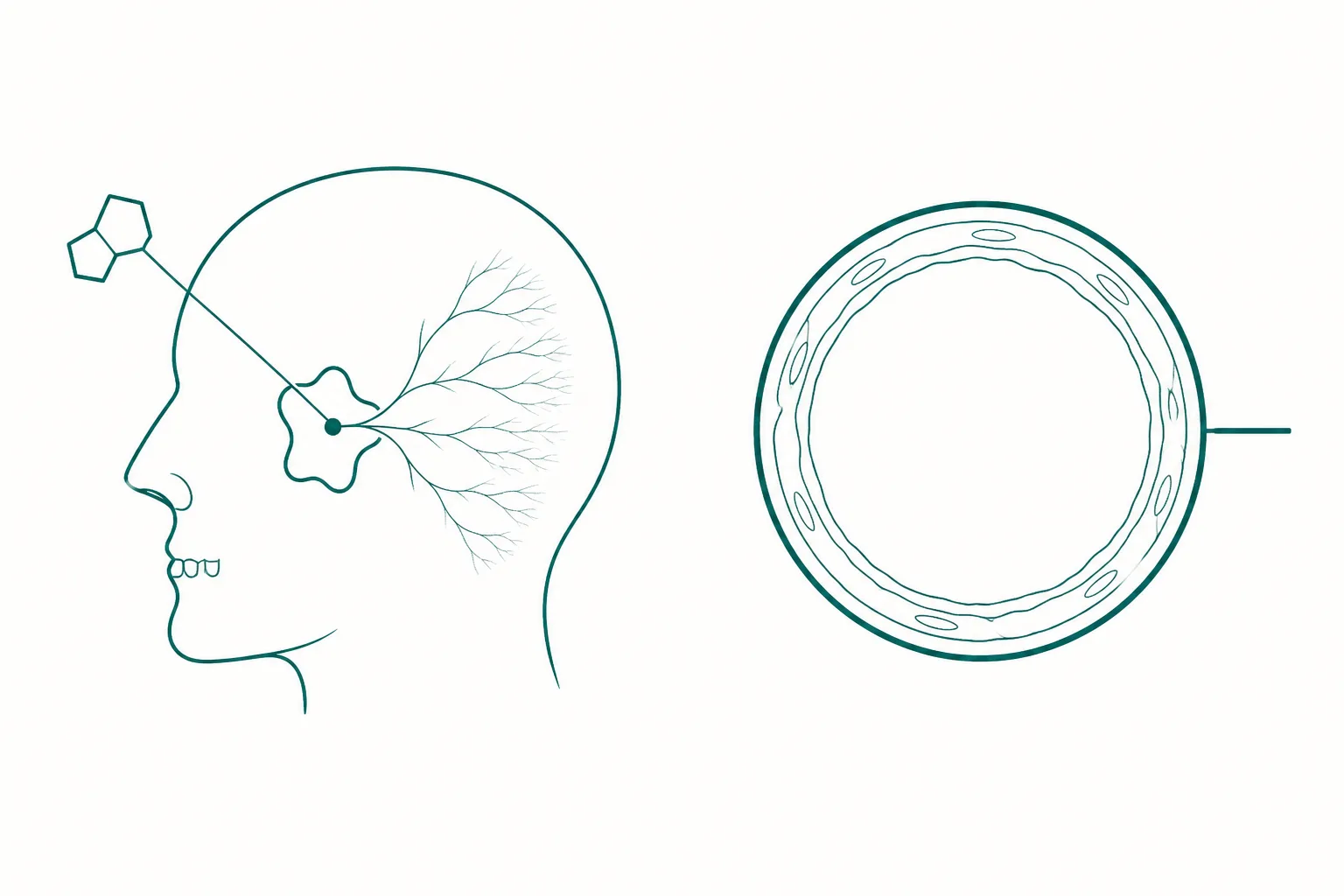
PT-141 (bremelanotide) works in the brain rather than in blood vessels: it is a synthetic melanocortin receptor agonist whose therapeutic effect is attributed to agonism at the melanocortin-4 receptor (MC4R) within central nervous system pathways that generate sexual desire 12. That places it in a different pharmacological category from the phosphodiesterase type 5 inhibitors, which act peripherally on vascular smooth muscle and do nothing to desire. It is also the direct chemical descendant of Melanotan II, differing at a single terminal position — and the two make an unusually clean comparison, because one was developed through randomised trials to approval and the other was never developed at all.
Two molecules, one bond apart
Melanotan II is a cyclic synthetic analogue of alpha-melanocyte-stimulating hormone (alpha-MSH), built around a lactam-bridged heptapeptide core and carrying an amide group at its C-terminus. Bremelanotide is what remains when that amide is hydrolysed to the free acid — in the literal metabolic sense a product of the parent compound, structurally identical everywhere except at that single terminal position 1.
The pharmacological consequence is a shifted balance across the melanocortin receptor family. Both compounds bind more than one subtype, but the pigmentary activity defining Melanotan II is substantially reduced in the metabolite. At the exposures producing the sexual effect, bremelanotide is not a tanning agent and was never developed as one. Reduced is not eliminated, however, and the residual MC1R activity has a visible clinical correlate discussed below.
The historical consequence matters as much. The sexual effects of melanocortin agonism were first noticed as an unwanted finding during early human work on pigmentation — spontaneous erection in male subjects being studied for nothing of the kind. The early PT-141 literature made that observation the target rather than the side effect, proposing a melanocortin agonist for sexual dysfunction and characterising it as acting centrally rather than peripherally 1.
| Melanotan II | Bremelanotide | |
|---|---|---|
| C-terminus | Amide | Hydroxyl (free acid) |
| Pigmentary activity at therapeutic exposure | The defining effect | Minimal; focal hyperpigmentation is an adverse effect |
| Human evidence base | One small pilot study; case reports since | Dose-finding and two randomised phase 3 trials |
| Route developed | Never formally developed | Intranasal, discontinued; then subcutaneous |
| Regulatory status | Not approved in any major jurisdiction | Approved in the United States, 2019, one indication |
Why MC4R agonism affects desire
The melanocortin system comprises five G-protein-coupled receptors. MC1R drives pigmentation; MC2R is the adrenocorticotropic hormone receptor; MC5R is largely exocrine; MC3R and MC4R are distributed through the central nervous system and periphery. MC4R is densely expressed in hypothalamic nuclei and connected structures, where it participates in energy balance and in the neural circuitry of sexual response. Agonism there is not a peripheral event with central consequences. It is a central event.
The clearest preclinical demonstration comes from an animal model built to separate motivation from reflex. In female rats, a melanocortin receptor agonist selectively increased solicitational behaviours — the appetitive actions by which a female rat initiates and invites — without a general increase in locomotor activity or in the reflexive lordosis response 2. The specificity is the finding: the compound did not make the animals more active, it increased the behaviours that index sexual motivation in particular. That is an animal model of desire, with the interpretive caution the phrase requires.
The contrast with phosphodiesterase type 5 inhibitors is worth drawing precisely, because it is routinely blurred. A PDE5 inhibitor blocks the enzyme that degrades cyclic GMP in vascular smooth muscle. Where sexual stimulation has already triggered nitric oxide release, cyclic GMP accumulates rather than being broken down, smooth muscle relaxes, and blood flow into erectile tissue increases. The drug does nothing on its own; it amplifies a peripheral haemodynamic response that desire has already initiated. Bremelanotide acts upstream of that whole sequence. One class addresses whether the plumbing responds; the other, whether the signal is sent at all.
The formulation that was abandoned
Bremelanotide was first developed as an intranasal formulation. The rationale was sound: rapid absorption suited an on-demand indication, and nasal administration avoided injection. Then a cardiovascular signal emerged. Increases in blood pressure were observed, and they were dose-dependent — the relationship distinguishing a genuine pharmacological effect from background noise. The intranasal programme was discontinued in the late 2000s.
What happened next is the instructive part: the compound was not abandoned with the formulation. It was redeveloped for subcutaneous administration, which produces different exposure kinetics — a lower and later peak plasma concentration than rapid nasal absorption delivers, and a correspondingly blunted haemodynamic response. Dose-finding was repeated for the new route in a randomised, placebo-controlled trial in premenopausal women, establishing the range carried into phase 3 3.
The signal did not vanish, and the programme did not pretend it had. With subcutaneous administration, transient increases in systolic and diastolic blood pressure remain measurable in the hours afterwards, accompanied by a compensatory reduction in heart rate, both returning toward baseline. This remained a labelled consideration at approval and drives the contraindications: the product is not for people with uncontrolled hypertension or known cardiovascular disease.
The phase 3 evidence
The pivotal evidence is RECONNECT: two identically designed, randomised, double-blind, placebo-controlled trials run in parallel, enrolling in total more than a thousand premenopausal women with acquired, generalised hypoactive sexual desire disorder, each with a double-blind core phase of roughly six months followed by an open-label extension 4. The population definition is narrow and matters: acquired means the difficulty followed a period of normal function, generalised means it is not confined to a particular partner or situation, and diagnosis required that the distress not be better explained by a co-existing condition, a relationship difficulty, or another medication.
Both trials used co-primary endpoints on validated instruments rather than a single global impression: the desire domain of the Female Sexual Function Index, and the item of the Female Sexual Distress Scale measuring distress specifically about low desire, scored on a short ordinal scale where lower is better. Requiring both to move is a demanding design — a compound must improve the reported experience of desire and reduce the distress attached to its absence. Both endpoints were met in both trials, with the differences from placebo reaching statistical significance 4.
| Instrument | What it measures | Result |
|---|---|---|
| Female Sexual Function Index — desire domain | Self-reported frequency and intensity of desire | Co-primary; met, small increase over placebo |
| Female Sexual Distress Scale — low-desire item | Distress attributable to low desire | Co-primary; met, small decrease over placebo |
| Satisfying sexual events | Counted events recorded in a diary | Secondary; no significant separation from placebo |
Effect size, stated plainly
Statistical significance answers one question — is this difference likely to be real — and says nothing about magnitude. With sample sizes in the hundreds per arm, small differences become detectable. The honest summary of RECONNECT therefore has two clauses, and marketing copy quotes only the first. The trials met their co-primary endpoints. The benefit over placebo was modest: on the desire domain the placebo-subtracted improvement was a fraction of a point on a scale spanning a few points, and the change on the distress item was of comparable proportion 4.
The second feature is the placebo response, and it was large. Participants randomised to placebo also reported improved desire and reduced distress, by a margin accounting for a substantial share of the total change seen on active treatment. That is characteristic of the indication rather than a defect of these trials. Desire is measured by self-report; enrolment brings attention, structured assessment and the expectation of help; participants enrol at a low point, so regression toward the mean contributes. Any trial here measures a small pharmacological increment on top of a large non-pharmacological one.
A third point belongs alongside the first two. The number of satisfying sexual events — a countable behavioural outcome, less susceptible to expectancy than a rating scale — did not separate significantly from placebo 4. The demonstrated benefit is on how desire and its distress are reported, not on measured behaviour. None of that makes the result invalid. It makes it small and specific, which is what a randomised trial is for: an uncontrolled series would have reported the entire placebo-inclusive improvement as drug effect, and nobody could have shown otherwise.
Adverse effects
- Nausea — the most frequent adverse effect by a wide margin, reported by a large minority of treated participants against a small percentage on placebo, and the commonest reason for discontinuation.
- Flushing — common, consistent with melanocortin agonism, generally transient.
- Injection-site reactions — common, generally mild.
- Headache — common; vomiting less frequent than nausea, but reported.
- Transient focal hyperpigmentation — uncommon, involving the face, gingiva or breasts, and not always fully reversible.
- Transient rise in blood pressure with compensatory heart rate reduction — the labelled cardiovascular consideration behind the contraindications.
Two deserve elaboration. Nausea is not incidental: it is frequent enough to be the dominant tolerability issue and the leading cause of withdrawal in the trials, and it is mechanistically expected from central melanocortin agonism — which is why the same symptom recurs throughout the Melanotan II case literature 5. Focal hyperpigmentation is the visible trace of the shared lineage. Bremelanotide has minimal pigmentary activity relative to its parent, but minimal is not none, and MC1R agonism on melanocytes does what it has always done — localised rather than generalised here, but the same pharmacology at lower intensity.
The mirror image
Set the two compounds side by side and the difference is not chemistry — it is one terminal group. The difference is what was done with them. Melanotan II reached a small pilot study and stopped; everything since known about it comes from clinicians writing up patients who arrived in their clinics, collated in narrative reviews of unregulated alpha-MSH analogue use 5. Bremelanotide went through preclinical characterisation 12, a formulation failure that was investigated rather than concealed, route-specific dose-finding 3, and two randomised placebo-controlled trials against pre-specified endpoints 4.
The value of the second path is not that it produced a spectacular drug. It produced a modest one, and the trials are what allow that adjective to be used with confidence. Because there were controls, the placebo response could be quantified and subtracted. Because adverse events were collected against a known denominator, nausea has a frequency rather than an anecdote. Because blood pressure was measured on schedule, a formulation could be abandoned and a contraindication written. For the parent compound none of that has an equivalent, and the resulting gap is a gap in knowledge before it is a gap in safety.
References
- PT-141: a melanocortin agonist for the treatment of sexual dysfunction
- Selective facilitation of sexual solicitation in the female rat by a melanocortin receptor agonist
- Bremelanotide for female sexual dysfunctions in premenopausal women: a randomized, placebo-controlled dose-finding trial
- Bremelanotide for the Treatment of Hypoactive Sexual Desire Disorder: Two Randomized Phase 3 Trials
- Risks of unregulated use of alpha-melanocyte-stimulating hormone analogues: a review