pharmacology
Retatrutide: Triple Glucagon, GIP and GLP-1 Receptor Agonism, and the Balance It Has to Strike
Retatrutide adds a glucagon receptor arm to the two incretin receptors tirzepatide already engages. Glucagon raises blood glucose, which makes that the most counterintuitive design decision in the class — and the reason the molecule acts on energy expenditure as well as intake.
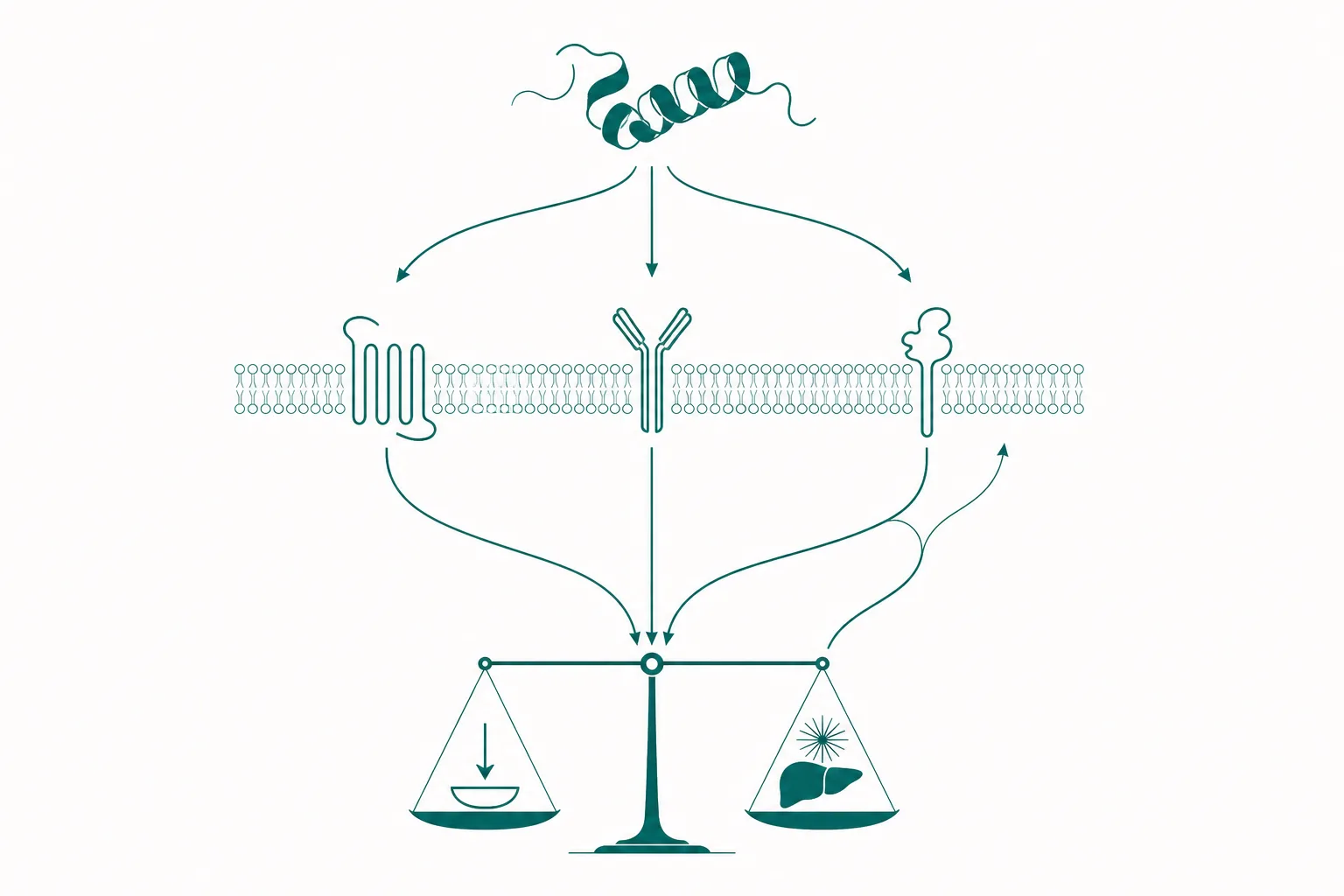
Retatrutide works by activating three receptors at once: the glucagon receptor (GCGR), the receptor for glucose-dependent insulinotropic polypeptide (GIPR), and the glucagon-like peptide-1 receptor (GLP-1R). It is a single synthetic peptide built on the GIP backbone, with α-aminoisobutyric acid substitutions that block dipeptidyl peptidase-4 cleavage and a C20 fatty diacid that binds serum albumin, giving a half-life of roughly six days in humans 1. Two of those arms are the ones tirzepatide engages. The third is new, and it is the reason the molecule warrants a separate article — because on the face of it, adding glucagon receptor agonism to a metabolic drug points the wrong way. Glucagon is the hormone that raises blood glucose.
Three receptors, and what the third one adds
Two of the three arms are well characterised. GLP-1 receptor activation produces glucose-dependent insulin secretion, suppression of glucagon release, delayed gastric emptying, and reduced food intake through hypothalamic and hindbrain circuits 4. GIP receptor activation contributes to the incretin response and has further adipose and central effects whose net direction remains disputed. In energy terms, both act almost entirely on the intake side of the ledger. They make people eat less.
The glucagon receptor is a different proposition. It is a class B G-protein-coupled receptor expressed most densely on hepatocytes, coupling to Gs and raising cAMP much as the GLP-1 receptor does — but in liver rather than beta cell, where the consequence is glycogenolysis and gluconeogenesis. That is the classic counter-regulatory function: glucagon is released from pancreatic alpha cells when glucose falls, and its job is to push glucose back up, in direct opposition to insulin. Agonising that receptor deliberately, in a metabolic drug, looks like an error.
Why the glucagon arm is there anyway
It is there because hepatic glucose output is not the only thing the glucagon receptor does. Glucagon receptor agonism raises resting energy expenditure, stimulates hepatic fatty acid oxidation, and has been observed to reduce hepatic lipid content. Those effects sit on the expenditure side of energy balance, and neither incretin receptor delivers them. The design logic is that one molecule combining all three arms gets appetite suppression from the incretin arms, thermogenic and hepatic effects from the glucagon arm, and uses the first to neutralise the glycaemic liability of the second.
That is a balancing act rather than a free addition. The glucagon arm is not added with its hyperglycaemic effect ignored; it is added on the assumption that GLP-1 receptor-mediated insulin secretion and glucagon suppression cancel it. Set the potencies differently — more glucagon receptor activity relative to GLP-1 receptor activity — and the same molecule raises blood glucose. The in vitro characterisation is consistent with a deliberately weighted design: against the native ligand at each receptor, potency is highest at GIPR and lower at both GLP-1R and GCGR 1. The ratios are the drug.
| Receptor arm | Principal actions | Body weight | Blood glucose |
|---|---|---|---|
| GLP-1 receptor | Glucose-dependent insulin secretion, glucagon suppression, delayed gastric emptying, central appetite suppression | Reduces intake | Lowers |
| GIP receptor | Incretin response; adipose and central effects of disputed direction | Reduces intake | Lowers |
| Glucagon receptor | Hepatic glycogenolysis and gluconeogenesis, raised energy expenditure, fatty acid oxidation | Raises expenditure | Raises |
Both sides of the energy balance equation
This is the genuine pharmacological novelty, and it is easy to overstate. Semaglutide and tirzepatide reduce body weight predominantly by reducing energy intake. Nothing in their receptor profile meaningfully raises energy expenditure, which instead tends to fall during weight loss — one reason weight loss plateaus. Retatrutide is the first agent in the class whose receptor profile addresses the other side of the equation directly.
The evidence that the expenditure arm does real work is strongest in rodents. In diet-induced obese mice, the triple agonist produced greater weight reduction than comparators acting only at the incretin receptors, and the difference was not fully explained by reduced food intake — the standard signature of an added expenditure effect 1. That is a mouse result. The published phase 2 trials report weight, glycaemia and adverse events; they do not partition weight change into intake and expenditure. The human expenditure contribution is inferred from receptor physiology and animal work, not shown by the trials that produced the headline numbers.
A long history of glucagon programmes that failed
Adding a glucagon receptor arm is not a new idea, and its track record is poor. Glucagon-containing co-agonists — mostly built on oxyntomodulin, the endogenous peptide that hits the glucagon and GLP-1 receptors naturally — have been in development for well over a decade, and programme after programme has stalled or been discontinued. The recurring reason is the one first principles predict: the glycaemic penalty. Get the balance wrong and fasting glucose drifts up, endpoints fail, and a drug meant to improve metabolic health worsens the measurement clinicians watch most closely. The question about any triple agonist is therefore whether it struck a balance the earlier ones missed.
- The balance is fixed by receptor potencies set at the design stage. It cannot be adjusted afterwards, only accepted or rejected.
- The offset depends on functioning beta cells. Where beta cell failure is advanced, the compensating arm has less to work with while the glucagon arm is undiminished.
- The mirror experiment makes the point: glucagon receptor antagonists, developed to lower glucose, did lower it but were associated with hepatic fat accumulation and transaminase elevations. The same axis read backwards produces the opposite problem.
- Heart rate and blood pressure increases have accompanied glucagon receptor agonism, with long-term cardiovascular consequences unestablished for this subclass.
What the phase 2 trials showed
The obesity trial randomised 338 adults with a body-mass index of 30 or above, or 27 or above with a weight-related condition, and without type 2 diabetes, to retatrutide or placebo for 48 weeks 2. The top of the 48-week range below is the largest mean weight reduction reported in a randomised trial of any pharmacological agent for obesity to date 2.
| Endpoint | Retatrutide arms | Placebo |
|---|---|---|
| Mean body weight change, 24 weeks | −7.2% to −17.5% | −1.6% |
| Mean body weight change, 48 weeks | −8.7% to −24.2% | −2.1% |
| Most common adverse events | Nausea, diarrhoea, vomiting, constipation | Same categories, less frequent |
The type 2 diabetes trial tests the balancing act directly, which makes it the more mechanistically informative of the two. It randomised 281 adults with type 2 diabetes to retatrutide, placebo, or an active GLP-1 receptor agonist comparator, with change in HbA1c as the primary endpoint 3. Across the retatrutide groups HbA1c fell by up to approximately 2 percentage points at 24 weeks, against approximately 1.4 with the active comparator and essentially no change on placebo; mean weight change reached approximately −17% at 36 weeks 3. Glycaemic control improved. In this population, over this duration, the glucagon arm did not overwhelm the incretin arms.
Adverse events in both trials were predominantly gastrointestinal — nausea, diarrhoea, vomiting, constipation — mostly mild to moderate, more frequent in the higher-exposure arms, and concentrated early 23. The obesity trial also reported exposure-related increases in heart rate that peaked around 24 weeks and declined thereafter 2. That deserves attention: a heart rate increase is what glucagon receptor agonism would be predicted to produce, so it reads as a consequence of the novel arm, not an incidental finding.
Why phase 2 is not phase 3
This is the distinction separating retatrutide from semaglutide and tirzepatide, and it is not a technicality. Both of those are approved medicines with completed phase 3 programmes and, for semaglutide, cardiovascular outcome trials with adjudicated hard endpoints. Retatrutide has neither. Its phase 3 programme is running, and no regulator has approved anything about it.
Phase 2 trials establish that a drug does something and inform the design of what follows. They are smaller, shorter, and enrol populations selected to give the compound a clean test. Phase 3 enrols more people, for longer, with more comorbidity and concomitant medication; it is where uncommon harms first surface and where effect sizes typically shrink. Drug development is full of phase 2 results that did not survive that transition, usually for mundane reasons: a safety signal needing thousands of patient-years to appear, or an effect that shrank once the population resembled the real one. For a molecule whose claim is that a finely poised balance holds, phase 3 is the first study large enough to find where it does not.
Limits and open questions
- No phase 3 efficacy or safety results have been published. Everything above rests on phase 2 and earlier work.
- The glucagon arm's contribution has never been isolated in humans. That needs a comparison against a matched molecule lacking only that arm, and no such trial has been run.
- The energy expenditure claim rests on receptor physiology and rodent data, not human measurements in the phase 2 trials.
- Exposure-related heart rate increases were observed. Whether they carry cardiovascular consequence over years is unknown.
- Glycaemic safety was shown in selected populations over 36 to 48 weeks. Whether the offset holds with advanced beta cell dysfunction, or over years, is untested.
- The proportion of weight lost as lean rather than fat mass is unresolved across this class.
Why the balance is the whole story
Retatrutide is usually summarised as the next step up from tirzepatide: one more receptor, more weight loss. That framing misses both what is novel and what is uncertain. The novelty is not the count of receptors. It is that the third one operates on the opposite side of the energy balance equation from the other two, making this the first agent in the class that can plausibly raise expenditure rather than only lower intake. The uncertainty is that the same receptor raises blood glucose, so the molecule works only if the incretin arms cancel that 14.
The phase 2 data are consistent with that balance having been struck: large weight reductions in adults without diabetes, improved rather than worsened glycaemic control in adults with type 2 diabetes 23. That is a substantial finding. It is also a finding from trials of a few hundred participants lasting under a year, in a subclass whose history is a sequence of programmes that got this exact balance wrong. A demonstrated phase 2 effect with an unfinished phase 3 programme is an honest place for a compound to be. It is not an approved medicine, and that distinction is the most important fact about retatrutide today.
References
- LY3437943, a novel triple glucagon, GIP, and GLP-1 receptor agonist for glycemic control and weight loss: From discovery to clinical proof of concept
- Triple-Hormone-Receptor Agonist Retatrutide for Obesity — A Phase 2 Trial
- Retatrutide, a GIP, GLP-1 and glucagon receptor agonist, for people with type 2 diabetes: a randomised, double-blind, placebo and active-controlled, parallel-group, phase 2 trial
- Mechanisms of Action and Therapeutic Application of Glucagon-like Peptide-1