pharmacology
Tirzepatide: Dual GIP and GLP-1 Receptor Agonism, and Why the Balance Is Uneven
Tirzepatide engages two incretin receptors instead of one, and it does not engage them equally. The receptor-level asymmetry is the most interesting thing about the molecule, and the part of it that is least settled.
Tirzepatide works by activating two incretin receptors at once: the receptor for glucose-dependent insulinotropic polypeptide (GIPR) and the receptor for glucagon-like peptide-1 (GLP-1R). It is a synthetic 39-amino-acid peptide built on the native GIP sequence rather than the GLP-1 sequence, carrying α-aminoisobutyric acid substitutions that block dipeptidyl peptidase-4 cleavage and a C20 fatty diacid attached through a glutamate and two spacer units, which binds serum albumin and extends the half-life to roughly five days 1. Functionally it does everything a GLP-1 receptor agonist does — glucose-dependent insulin secretion, glucagon suppression, delayed gastric emptying, reduced food intake — plus whatever the added GIP receptor arm contributes. The size of that contribution, and the mechanism behind it, is where the genuinely unresolved parts of this molecule sit.
Two incretin receptors, and what each one does
The incretin effect is the observation that oral glucose provokes substantially more insulin release than the same quantity given intravenously. Two hormones account for most of it. GIP is secreted from K-cells in the duodenum and proximal jejunum; GLP-1 comes from L-cells concentrated more distally in the ileum and colon. In healthy humans, GIP is the larger of the two contributors 5. That fact alone made GIP an obvious drug target, and for decades it was not one.
The reason is that in type 2 diabetes the insulinotropic action of GIP is markedly blunted, while the action of GLP-1 is largely preserved 5. Infusing GIP into people with established type 2 diabetes produces little insulin response. That finding effectively removed GIP from the therapeutic agenda and pointed the entire first generation of incretin drugs at the GLP-1 receptor alone. Tirzepatide's results are in part a demonstration that the earlier conclusion was drawn too broadly: GIP receptor responsiveness appears partly restorable once glycaemic control improves, and the GIP receptor has effects outside the beta cell that those infusion studies were never measuring.
Those extrapancreatic sites matter for the rest of this article. GIPR is expressed on adipocytes, in bone, and at several sites in the central nervous system. In adipose tissue, GIP signalling promotes lipid uptake and storage 5. Read peripherally and in isolation, GIP receptor agonism looks like a fat-storage signal — which is exactly the problem the next sections have to deal with.
Imbalanced and biased: what the receptor pharmacology showed
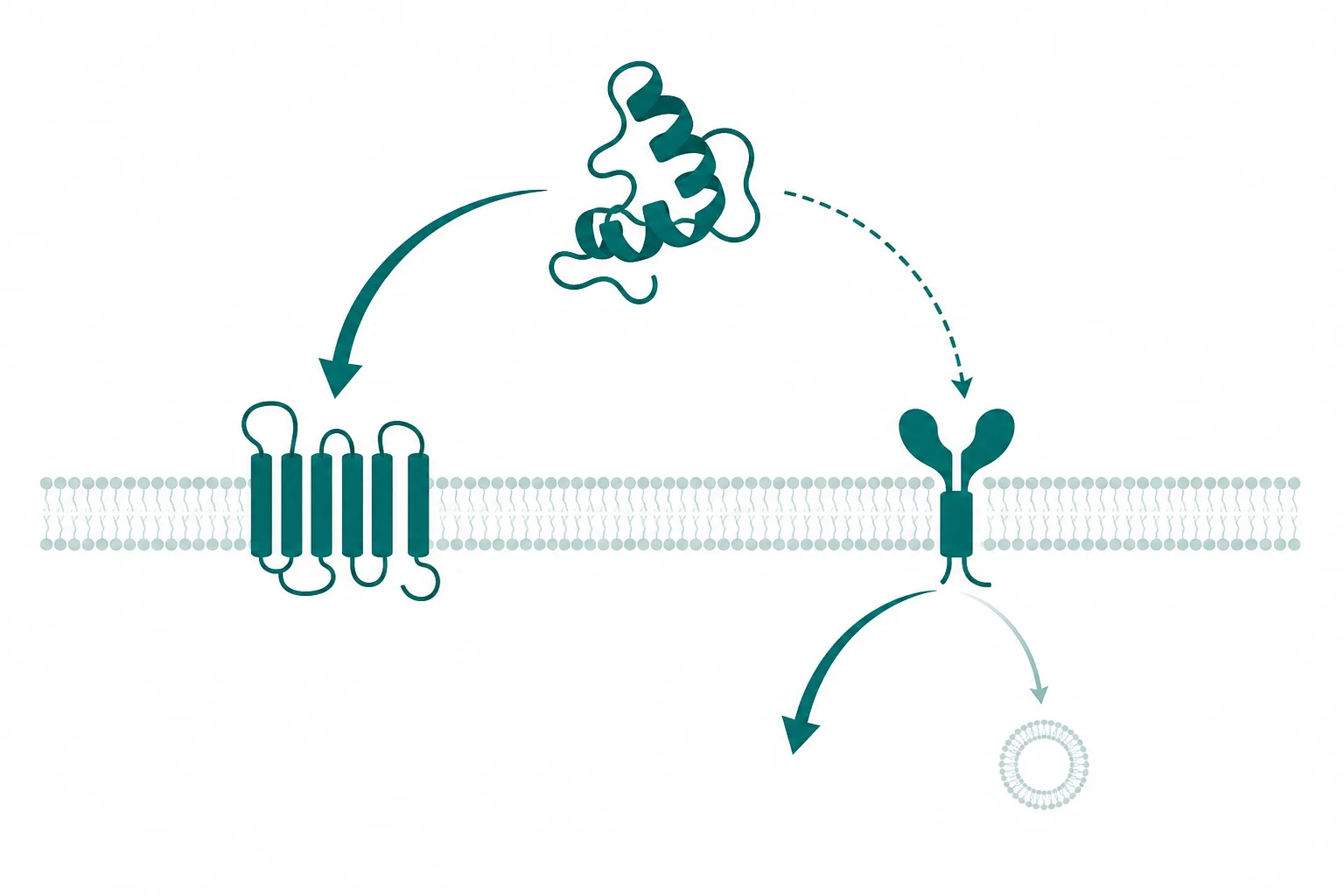
The phrase "dual agonist" implies two equal halves. The receptor characterisation does not support that reading. In cells expressing the human receptors, tirzepatide bound GIPR with an affinity comparable to native GIP, but bound GLP-1R with an affinity roughly five-fold lower than native GLP-1 2. Measured against the endogenous ligand at each receptor, it is a considerably stronger GIP receptor agonist than GLP-1 receptor agonist. The authors used the word imbalanced, and it is the accurate one.
The second finding is subtler and probably more consequential. G-protein-coupled receptors do not transmit a single undifferentiated signal; agonists can preferentially engage one downstream transducer over another, which is biased agonism. At the GLP-1 receptor, tirzepatide generated cAMP comparably to native GLP-1 while recruiting substantially less β-arrestin 2. β-arrestin recruitment is the step that drives receptor internalisation and desensitisation, so weak recruitment means the receptor is pulled off the cell surface more slowly. That is what was observed: reduced GLP-1R internalisation relative to the native peptide 2. At the GIP receptor, by contrast, tirzepatide's profile resembled native GIP, with no comparable bias reported 2.
The attractive inference is that lower affinity is offset by better receptor persistence — fewer receptors occupied at any instant, more of them still at the surface over time. It is a coherent explanation for how a molecule with weaker GLP-1R affinity than a dedicated GLP-1 analogue produces larger clinical effects. It is also only an inference. These are engineered expression systems, and no human trial has measured GLP-1 receptor surface density in target tissue during treatment.
| Property | At the GIP receptor | At the GLP-1 receptor |
|---|---|---|
| Affinity relative to native ligand | Comparable to native GIP | Roughly five-fold lower than native GLP-1 |
| cAMP generation | Comparable to native GIP | Comparable to native GLP-1 |
| β-arrestin recruitment | Comparable to native GIP | Markedly reduced |
| Receptor internalisation | Comparable to native GIP | Reduced relative to native GLP-1 |
| Term used in the source | Full agonism | Imbalanced and biased agonism |
The GIP paradox
Here is the contradiction, stated plainly. Tirzepatide activates the GIP receptor and produces substantial weight loss in humans. Yet blocking the GIP receptor, in combination with GLP-1 receptor agonism, also produces weight loss in the models where it has been tested, and mice lacking a functional GIP receptor are relatively protected from diet-induced obesity 5. Agonism helps. Antagonism appears to help. Both cannot be straightforwardly true of the same signalling axis, which means the simple account — GIP receptor activation causes weight loss — is wrong, incomplete, or true only under conditions nobody has fully specified.
Several reconciliations have been proposed. None is established. They are worth listing because the shape of the disagreement is more informative than any one of them.
- Chronic agonism as functional antagonism. Sustained stimulation may desensitise and downregulate the GIP receptor, so a long-acting agonist and a blocking antibody could converge on a similar downstream state. Desensitisation is demonstrable in cell systems; that it accounts for the clinical picture in human adipose tissue is not.
- Compartment separation. GIPR sits both on adipocytes and centrally, including in the hypothalamus and area postrema. Central GIP receptor signalling reduces food intake in rodents while peripheral adipose signalling favours lipid storage, so the net effect would depend on which compartment a molecule preferentially reaches.
- A tolerability contribution. GIP receptor signalling in the area postrema attenuates nausea and emesis in animal models. If that holds in humans, part of tirzepatide's advantage may be that it permits greater incretin receptor engagement to be tolerated, rather than reflecting a distinct fat-loss pathway.
- Species and assay differences. Much of the antagonist evidence originates in mouse models, and mouse and human GIP receptor pharmacology are not interchangeable.
- Time dependence. Acute and chronic GIP receptor signalling may simply do different things, in which case short mechanistic studies and multi-month trials are measuring different phenomena and only appearing to disagree.
Head-to-head against semaglutide
SURPASS-2 is unusual and therefore useful. Most drugs in a class are tested against placebo and then compared with each other informally across trials, which is unreliable. SURPASS-2 randomised 1,879 adults with type 2 diabetes inadequately controlled on metformin to tirzepatide or to once-weekly semaglutide, open-label, over 40 weeks 3. Two active agents, one protocol, one population.
Baseline HbA1c was approximately 8.28%. Across the three tirzepatide arms, mean HbA1c fell by 2.01 to 2.30 percentage points, against 1.86 percentage points with semaglutide; the prespecified non-inferiority and superiority criteria were met 3. Mean body weight change ran from −7.6 kg to −11.2 kg with tirzepatide against −5.7 kg with semaglutide 3. Adverse events were qualitatively similar between the two drugs, with nausea, diarrhoea and vomiting predominating and concentrated early in treatment — expected, since both act at the receptor that mediates those effects 3.
| Endpoint | Tirzepatide | Semaglutide once weekly |
|---|---|---|
| Mean HbA1c reduction | 2.01 to 2.30 percentage points | 1.86 percentage points |
| Mean body weight change | −7.6 kg to −11.2 kg | −5.7 kg |
| Predominant adverse events | Nausea, diarrhoea, vomiting | Nausea, diarrhoea, vomiting |
| Design | Open-label, randomised, active comparator | Open-label, randomised, active comparator |
Three caveats belong with that result. The trial was open-label, which matters more for subjective endpoints than for HbA1c. The semaglutide comparator was the exposure approved for glycaemic control at the time, not the higher exposure later approved for weight management, so the comparison answers a diabetes question cleanly and a weight-management question only partially. And a ranking established in type 2 diabetes does not automatically transfer to people without diabetes.
A fourth point concerns evidence type rather than magnitude. Semaglutide carries cardiovascular outcome trials with adjudicated hard endpoints in both diabetes and obesity populations. Larger changes in HbA1c and body weight are surrogate advantages: strongly suggestive, but not the same currency as a demonstrated reduction in myocardial infarction, stroke or cardiovascular death. The two should not be conflated when comparing the compounds.
SURMOUNT-1 and the obesity result
SURMOUNT-1 randomised 2,539 adults with a body-mass index of 30 or above, or 27 or above with at least one weight-related complication, and without type 2 diabetes, to tirzepatide or placebo for 72 weeks alongside lifestyle intervention 4. Mean body weight change across the tirzepatide arms was −15.0% to −20.9%, against −3.1% on placebo 4. Between 85% and 91% of tirzepatide participants achieved at least a 5% reduction, against 35% on placebo, and up to 57% achieved at least a 20% reduction, against 3% 4.
For scale, the corresponding placebo-controlled semaglutide trial in a broadly comparable population reported mean weight change of approximately −15% at 68 weeks. Cross-trial comparison is a weak instrument — populations, durations and lifestyle components differed, and the protocols were never designed to be compared — but the SURPASS-2 head-to-head points the same way, and two weak lines of evidence agreeing is worth something. It is still not a randomised head-to-head in an obesity population, which is the study that would settle the ordering.
What SURMOUNT-1 establishes is the magnitude of weight change over 72 weeks in a population without diabetes, under blinded placebo control. What it does not establish is reduction in clinical events, what happens on withdrawal, or the composition of the weight lost. Those are separate questions requiring separate trials.
Limits and open questions
- The contribution of the GIP receptor arm has never been isolated in humans. Doing so would require comparing tirzepatide against a GLP-1-only molecule matched for GLP-1 receptor occupancy, and that experiment has not been run.
- The imbalanced-and-biased characterisation is in vitro. Every clinical inference drawn from it is inference.
- Gastrointestinal adverse effects were the most common in both trials and the leading reason for discontinuation.
- The proportion of lost mass that is lean rather than fat, and the long-term functional consequences of that, remain unresolved. This is a class-wide issue, not specific to tirzepatide.
- Weight regain after stopping is expected on mechanistic grounds, because the drug suppresses appetite while present rather than resetting a regulated set point.
- Rodent studies across the incretin class found thyroid C-cell tumours, handled by contraindication in medullary thyroid carcinoma rather than by extrapolation. Whether the rodent finding translates to humans is unresolved.
Why the asymmetry is the point
Tirzepatide is routinely described as GLP-1 plus GIP, which implies two matched halves added together. The pharmacology does not describe a molecule like that. Relative to the native ligands it is a considerably stronger GIP receptor agonist than GLP-1 receptor agonist, and its engagement of the GLP-1 receptor is qualitatively different from the native peptide's rather than merely weaker — full on the cAMP branch, sharply reduced on β-arrestin recruitment, with correspondingly less internalisation 2. The interesting question is not whether it activates two receptors. It is what an unequal, transducer-biased activation of two receptors produces that a balanced one would not.
That question is open. Whether the advantage over semaglutide arises from GIP receptor activation, from biased GLP-1 receptor signalling, from tolerability permitting greater receptor engagement, or from some combination, has not been separated in humans. The trials establish that the combination outperforms a GLP-1-only comparator on glycaemia and on weight 34. They do not establish why, and the receptor-level work that would explain it currently points in two directions at once 25. A demonstrated effect with an unsettled mechanism is a respectable state for a drug to be in. It is worth keeping those two halves of the sentence distinct, because most writing about this compound collapses them.
References
- LY3298176, a novel dual GIP and GLP-1 receptor agonist for the treatment of type 2 diabetes mellitus: From discovery to clinical proof of concept
- Tirzepatide is an imbalanced and biased dual GIP and GLP-1 receptor agonist
- Tirzepatide versus Semaglutide Once Weekly in Patients with Type 2 Diabetes
- Tirzepatide Once Weekly for the Treatment of Obesity
- Incretin hormones: Their role in health and disease