Incretin pipeline pharmacology
Survodutide: Glucagon Receptor Agonism and the Liver Endpoint
Survodutide engages the glucagon receptor and the GLP-1 receptor, and nothing else. Stripping out the GIP arm makes it the cleanest available test of what glucagon agonism contributes on its own — and the liver is where that contribution should show first.
Survodutide is a single acylated peptide with agonist activity at two receptors: the glucagon receptor and the GLP-1 receptor. It carries no GIP arm. That omission is what makes it interesting, because the compounds it is usually compared with either add glucagon to two incretin receptors or leave glucagon out entirely. Survodutide isolates the pairing. Whatever the glucagon receptor contributes beyond appetite suppression, this is the molecule in which it is least confounded — and the endpoint where it should be visible first is not body weight. It is the liver.
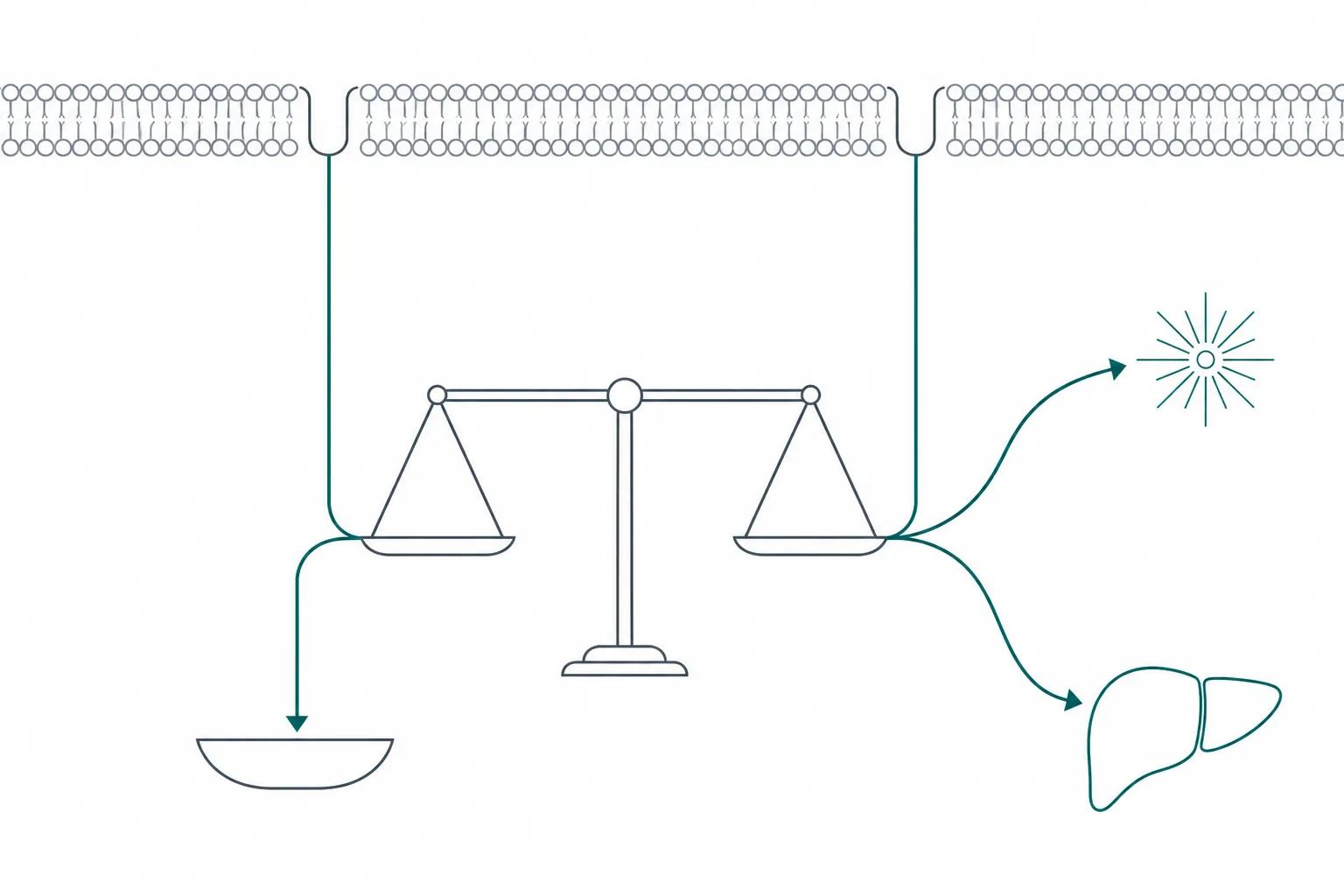
Two receptors, one of which raises blood glucose
The GLP-1 arm needs little restating. GLP-1 receptor activation produces glucose-dependent insulin secretion, suppression of glucagon release, delayed gastric emptying, and reduced food intake through hindbrain and hypothalamic circuits. Every action on that list either lowers glucose or lowers intake.
The glucagon receptor is the counter-regulatory partner of insulin. It is a class B G-protein-coupled receptor expressed most densely on hepatocytes, coupling to Gs and raising intracellular cAMP. In liver, the consequence of that signal is glycogenolysis and gluconeogenesis: glucose leaves the hepatocyte and enters the blood. Alpha cells release glucagon when glucose falls, and its job is to push glucose back up 1. Building a deliberate agonist of that receptor into a drug intended to improve metabolic health looks, on the face of it, like an error.
Hepatic glucose output is not the only thing the glucagon receptor does, and the rest of its biology is why the arm is there. Glucagon receptor activation raises resting energy expenditure, stimulates hepatic fatty acid oxidation, promotes lipolysis, and increases hepatic amino acid turnover — the last of these forming the basis of the liver-alpha cell axis, in which impaired hepatic glucagon signalling raises circulating amino acids and drives compensatory alpha-cell hyperplasia 1. Those are actions on the expenditure and substrate-handling side of energy balance. Neither incretin receptor delivers them.
The idea of pairing that with GLP-1 is old, and its origin is endogenous. Oxyntomodulin is a naturally occurring product of proglucagon processing that activates both the glucagon and GLP-1 receptors at modest potency, and it reduces food intake and body weight. Chemically optimised co-agonists built on that template were shown to normalise adiposity in diet-induced obese rodents at doses where the glycaemic penalty was offset by the GLP-1 arm 2. That work established the design principle the current generation still uses: use the glucagon arm for expenditure and hepatic substrate handling, and use the GLP-1 arm to pay for it.
The tuning problem: the ratio is the drug
A dual agonist is not two drugs in a bottle. It is one molecule with two intrinsic potencies, fixed in the sequence, present in every tissue in the same proportion at every time point. That proportion is the single most consequential design decision, and it cannot be changed after the molecule is made. Shift the balance toward the glucagon receptor and fasting glucose drifts upward; shift it toward the GLP-1 receptor and the molecule becomes an ordinary incretin agonist with an inert extra arm.
Survodutide was characterised preclinically as a balanced dual agonist rather than one heavily weighted to either receptor, with acylation providing albumin binding and a half-life supporting weekly administration. In diet-induced obese rodents it produced weight reduction exceeding that of a GLP-1 receptor agonist comparator, with reductions in hepatic lipid content, and the weight difference was not fully accounted for by reduced food intake 3. That last detail is the standard preclinical signature of an added expenditure effect — and it is a rodent finding. The published human trials report weight, glycaemia, liver histology and adverse events. They do not partition weight change into intake and expenditure components.
Why the liver is the natural endpoint
Glucagon receptor expression is concentrated in the liver. If a receptor arm is going to produce a tissue-specific effect beyond what appetite suppression alone achieves, the liver is where it should appear, and the pharmacology predicts the direction: increased hepatic fatty acid oxidation and reduced hepatic lipid accumulation 1. Metabolic dysfunction-associated steatohepatitis — steatosis with inflammation and hepatocyte injury, progressing in a subset to fibrosis and cirrhosis — is therefore a mechanistically motivated indication for this subclass rather than an opportunistic extension of a weight drug.
The distinction matters because weight loss by any route improves liver histology. A GLP-1 receptor agonist improves steatohepatitis largely because people lose weight. The specific claim for a glucagon-containing co-agonist is that some of the hepatic benefit is direct — receptor-mediated in the hepatocyte, not merely downstream of a smaller body. Separating those two contributions requires either a weight-matched comparison or a mechanistic substudy, and the published phase 2 trials of this compound do neither.
What the human trials established
The obesity trial randomised 387 adults with a body-mass index of 27 or above, without type 2 diabetes, to survodutide across four dose levels or to placebo, over 46 weeks with a 20-week dose-escalation period 4. Mean body weight reduction reached approximately 14.9% at the highest dose level against approximately 2.8% on placebo, with a clear exposure-response relationship across the arms 4. Adverse events were predominantly gastrointestinal — nausea, vomiting, diarrhoea — concentrated during escalation, and discontinuation for adverse events was higher in the upper arms than in most trials of incretin monotherapy.
The steatohepatitis trial is the more distinctive result. It randomised 293 adults with biopsy-confirmed steatohepatitis and fibrosis stage F1 to F3 to survodutide across three dose levels or to placebo, for 48 weeks, with paired liver biopsies 5. The primary endpoint — histological improvement in steatohepatitis with no worsening of fibrosis — was met in 47% to 62% of participants across the survodutide groups against 14% on placebo 5. Improvement in fibrosis by at least one stage, a secondary endpoint, also favoured survodutide. That is a biopsy-confirmed histological result in a field where most candidate agents have failed on exactly this endpoint.
| Obesity trial | Steatohepatitis trial | |
|---|---|---|
| Participants | 387 adults, no type 2 diabetes | 293 adults, biopsy-confirmed disease, fibrosis F1 to F3 |
| Duration | 46 weeks | 48 weeks |
| Primary measure | Mean percentage weight change | Histological improvement without worsening fibrosis |
| Best result across active arms | About 14.9% weight reduction | 47% to 62% meeting the endpoint |
| Placebo | About 2.8% weight reduction | 14% meeting the endpoint |
| Dominant adverse events | Gastrointestinal, during escalation | Gastrointestinal, during escalation |
How this differs from triple agonism, and what remains open
Retatrutide adds a glucagon arm to both incretin receptors; survodutide adds it to one. The difference is not simply that one molecule has more receptors. It is that survodutide has no GIP arm, and GIP is the arm whose contribution to weight regulation is least settled in the field. Removing an ambiguous variable makes the remaining pharmacology easier to attribute: whatever survodutide does that a GLP-1 receptor agonist does not do is attributable to the glucagon receptor, subject to the caveat that potency ratios differ between molecules and no head-to-head trial exists.
The trade is a narrower design space. A triple agonist can distribute the glycaemic burden of the glucagon arm across two incretin receptors, and can lean on GIP for tolerability effects that GLP-1 alone does not provide. A dual agonist must pay for glucagon entirely out of the GLP-1 arm. That constraint plausibly contributes to the tolerability profile observed during escalation in the obesity trial, though no published analysis attributes it directly.
- How much of the histological liver benefit is direct hepatic receptor signalling and how much is downstream of weight loss. No weight-matched comparison has been published.
- Whether the fibrosis signal survives a longer trial with clinical rather than histological endpoints. Histological improvement at 48 weeks is a surrogate.
- Whether energy expenditure rises measurably in humans. The claim rests on receptor physiology and rodent data.
- How the balanced potency ratio behaves in people with advanced beta-cell failure, where the compensating GLP-1 arm has less to work with while the glucagon arm is undiminished.
- Whether the escalation-phase tolerability burden narrows the usable exposure range in a larger and less selected population.
- Long-term cardiovascular effects. Glucagon receptor agonism raises heart rate in this class, and no outcome trial has reported.
The convention in this field is to read receptor count as a measure of ambition, so a dual agonist reads as a step behind a triple agonist. That reading is wrong here. Survodutide is not a triple agonist with a missing arm; it is a deliberate pairing that puts the glucagon receptor next to the one receptor capable of offsetting its glycaemic liability, and then aims at the organ where that receptor is most densely expressed 13.
What the published evidence establishes is narrower than what is often claimed for it. Two phase 2 trials, each under a year, in a few hundred participants: substantial weight reduction in adults with obesity, and biopsy-confirmed histological improvement in adults with steatohepatitis 45. Neither trial isolated the glucagon arm, measured expenditure, or followed anyone long enough to see a clinical liver outcome. Those are the results of a compound that has demonstrated an effect worth testing properly, in a subclass whose history is a sequence of programmes that got the glucagon balance wrong.
References
- The New Biology and Pharmacology of Glucagon
- A new glucagon and GLP-1 co-agonist eliminates obesity in rodents
- BI 456906: Discovery and preclinical pharmacology of a novel GCGR/GLP-1R dual agonist with robust anti-obesity efficacy
- Glucagon and GLP-1 receptor dual agonist survodutide for obesity: a randomised, double-blind, placebo-controlled, dose-finding phase 2 trial
- A Phase 2 Randomized Trial of Survodutide in MASH and Fibrosis