Incretin pipeline pharmacology
GIP Agonism or GIP Antagonism: The Question the Field Has Not Settled
Two development programmes are pushing the same receptor in opposite directions, and both are producing weight loss in humans. That is not a paradox anyone has resolved. It is the largest open question in incretin pharmacology.
Glucose-dependent insulinotropic polypeptide is the other incretin. It was characterised before GLP-1, it accounts for a substantial share of the incretin effect in healthy people, and its receptor is now the target of two clinical development programmes pointed in opposite directions. One activates it. The other blocks it. Both have produced weight reduction in humans. No published experiment has established which interpretation of GIP biology is correct, and treating the question as settled — in either direction — misrepresents the literature.
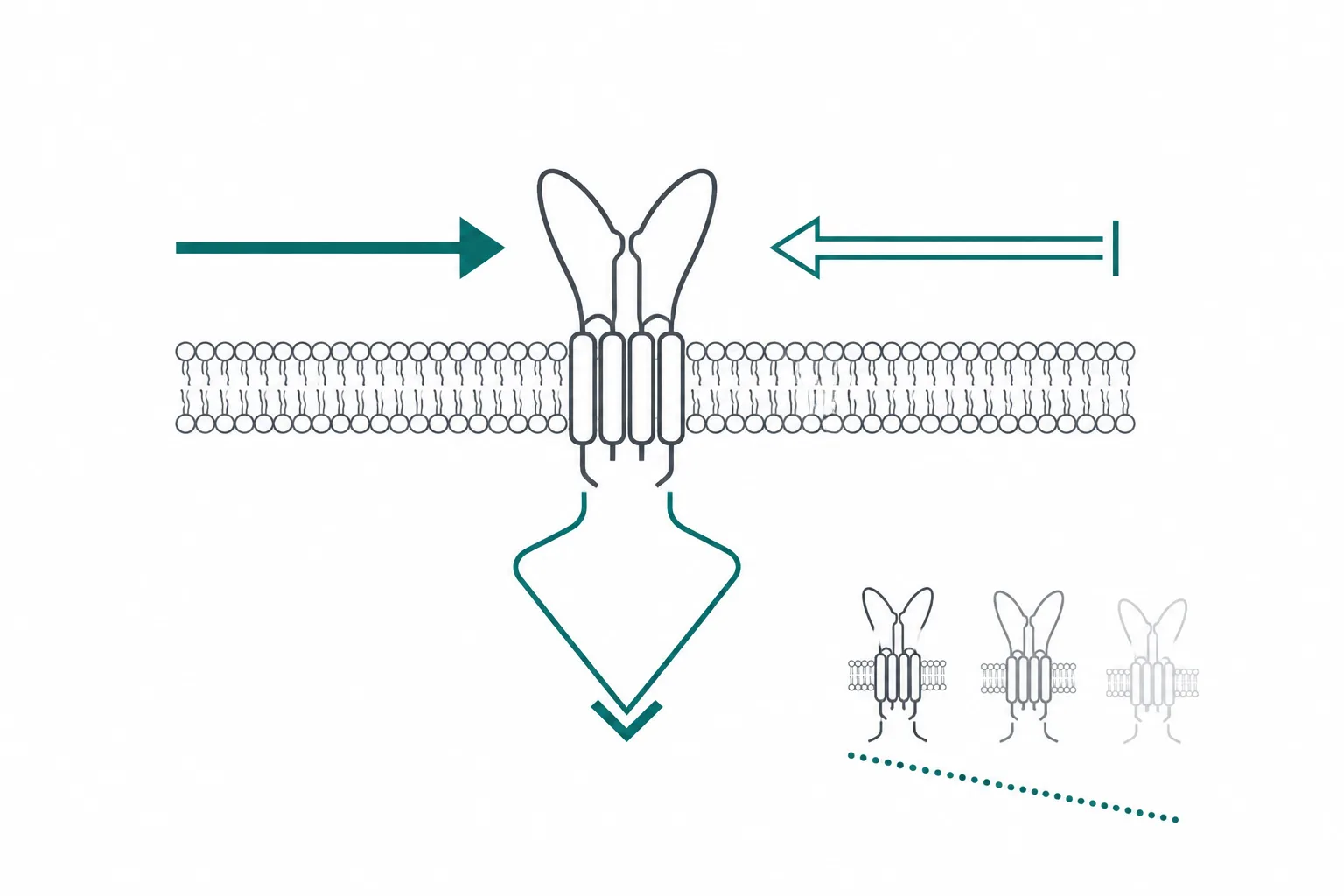
What GIP does, and where the ambiguity starts
GIP is a 42-residue peptide released from enteroendocrine K cells in the duodenum and proximal jejunum in response to nutrient intake, particularly fat and glucose. Acting on the pancreatic beta cell it potentiates glucose-dependent insulin secretion, and together with GLP-1 it accounts for the incretin effect — the observation that oral glucose provokes a substantially larger insulin response than an intravenous load producing the same blood glucose 1. In type 2 diabetes the insulinotropic action of GIP is markedly blunted, which is the historical reason drug development concentrated on GLP-1 instead.
The ambiguity begins outside the pancreas. GIP receptors are expressed on adipocytes, in bone, and in central nervous system regions including the hypothalamus and hindbrain. In adipose tissue, GIP signalling has been described as promoting lipid uptake and storage, which places it on the fat-accumulating side of the ledger. Its glucagonotropic action at low glucose is also unlike GLP-1, which suppresses glucagon 1. Read as a whole, endogenous GIP looks less like an anti-obesity hormone than like a nutrient-storage signal — and that reading is the origin of the antagonist programme.
The case for antagonism
The foundational result is a genetic one. Mice lacking the GIP receptor are protected against diet-induced obesity: on a high-fat diet they gain less fat than wild-type littermates, and crossing the knockout onto an obesity-prone genetic background reduces the resulting adiposity 2. The interpretation offered was direct — GIP signalling is required for efficient nutrient storage in adipose tissue, so removing it limits fat accumulation.
Pharmacological work followed the genetics. Antibody antagonists of the GIP receptor reduced body weight in obese non-human primates and in rodent models, and combining a GIP receptor antagonist with a GLP-1 receptor agonist produced greater weight reduction than the GLP-1 agonist alone 3. That combination result is important, because it is the preclinical template for the clinical molecules that followed: an antibody blocking the GIP receptor, conjugated to GLP-1 receptor agonist peptides, so that one construct antagonises one incretin receptor while activating the other.
That construct has now been tested in humans. A phase 1 programme reported substantial mean weight reduction over a period of weeks, with a pharmacokinetic profile supporting infrequent administration, alongside the gastrointestinal adverse events characteristic of GLP-1 receptor agonism 5. Two limits belong immediately next to that result. It is phase 1, so it was designed to characterise safety and pharmacokinetics rather than to estimate efficacy. And the construct includes GLP-1 receptor agonism, which produces weight loss on its own — so the trial does not isolate the contribution of GIP receptor blockade.
The case for agonism
The case for agonism is weaker in mechanism and stronger in outcome, which is an uncomfortable combination. A dual GIP and GLP-1 receptor agonist has been tested against GLP-1 receptor agonism alone in randomised head-to-head trials in type 2 diabetes and produced greater reductions in glycated haemoglobin and body weight. In obesity, the same molecule produced mean weight reduction at 72 weeks larger than that reported for GLP-1 receptor agonism in comparable populations. Those are phase 3 results with approved-product status behind them, and they are the single largest piece of evidence in this argument.
They are also not clean evidence about GIP. The dual agonist is an imbalanced molecule with different potencies at its two receptors and biased signalling at the GLP-1 receptor, so its advantage over a GLP-1-only comparator could arise from the GIP arm, from the altered GLP-1 pharmacology, from the exposure achieved, or from some combination of the three. Mechanistic accounts of the GIP contribution generally invoke central GIP receptor signalling reducing food intake and improving tolerability, plus adipose effects on lipid handling and insulin sensitivity — all of which are plausible and none of which has been isolated in a human trial.
| Agonism | Antagonism | |
|---|---|---|
| Core claim | GIP receptor activation adds central appetite and adipose benefits to GLP-1 agonism | GIP signalling promotes nutrient storage; blocking it limits fat accumulation |
| Strongest preclinical support | Central GIP receptor effects on food intake in rodents | GIP receptor knockout mice resist diet-induced obesity |
| Strongest human support | Phase 3 superiority of a dual agonist over a GLP-1 agonist comparator | Phase 1 weight reduction with an antagonist conjugate |
| Main confound | Molecule also has altered GLP-1 pharmacology and higher exposure | Construct also contains GLP-1 receptor agonists |
| Isolated human test of the GIP arm | None published | None published |
Why both approaches can produce weight loss, and the desensitisation hypothesis
The simplest explanation for the apparent paradox is also the least satisfying: in every clinical molecule on both sides, the GIP intervention travels attached to GLP-1 receptor agonism, and GLP-1 receptor agonism produces substantial weight loss by itself. A trial showing that an agonist conjugate works, and a trial showing that an antagonist conjugate works, are both consistent with the GIP component contributing nothing at all. Neither trial design can exclude that.
A second possibility is tissue divergence. GIP receptors in adipose tissue and GIP receptors in the central nervous system may not want the same intervention. If central agonism reduces food intake while peripheral agonism promotes fat storage, then a systemic drug is doing both, and the net effect depends on which tissue dominates at a given exposure. Under that model the two programmes are not contradicting each other so much as optimising different tissues, and neither is straightforwardly right.
The reconciliation cited most often is receptor desensitisation. Sustained agonist exposure at a G-protein-coupled receptor commonly leads to phosphorylation, arrestin recruitment, internalisation and reduced surface receptor availability. If chronic GIP receptor agonism desensitises the receptor in adipose tissue, then a long-acting agonist would produce, at that tissue, a state functionally similar to antagonism. Cell and rodent work supports this: chronic agonist exposure reduced adipocyte GIP receptor responsiveness in a manner the authors described as mimicking functional antagonism 4.
It is an elegant hypothesis, and it should be labelled accurately. It rests substantially on cell culture and rodent experiments. No published human trial has measured GIP receptor availability or adipocyte responsiveness under chronic agonist exposure, and no trial has shown that the tissues desensitise at different rates in the way the hypothesis requires — central receptors retaining responsiveness while adipose receptors lose it. The hypothesis also predicts something testable that has not been reported: that the metabolic profile of chronic agonism should converge over time toward that of antagonism.
What would actually settle it, and why the open question is the useful thing
- A randomised human trial of a GIP receptor agonist alone against a GIP receptor antagonist alone, with no GLP-1 component in either arm. Nothing of this design has been published, and commercially it is unattractive because neither arm is expected to perform well on its own.
- A trial comparing a dual agonist against the identical molecule lacking only its GIP activity, at matched GLP-1 exposure. This isolates the arm rather than the molecule.
- Direct human measurement of GIP receptor availability and adipose responsiveness before and during chronic agonist exposure, which would test the desensitisation hypothesis rather than assume it.
- Tissue-specific evidence in humans distinguishing central from adipose GIP receptor effects. Current human data cannot separate them.
- Long-duration data on the antagonist conjugate. Phase 1 results establish tolerability and pharmacokinetics, not durable efficacy or comparative benefit.
It is tempting to resolve this by weighing the evidence and declaring the agonists ahead, because approved phase 3 outcomes outrank a phase 1 report. That is the right way to compare products and the wrong way to answer a mechanistic question. The phase 3 evidence establishes that one particular molecule works better than one particular comparator. It does not establish that GIP receptor activation is the reason, because the trial contained no arm capable of showing that 1.
The genuinely informative position is that a single receptor is being pushed in both directions by serious programmes with serious preclinical foundations, that the mouse genetics favour blockade 23, that the human outcomes so far favour activation, that desensitisation offers a mechanism by which both could be describing the same endpoint 4, and that no published experiment discriminates between them 5. That is not a gap in the summary. It is the state of the field, and any account that reads cleaner than this has removed something that is actually there.
References
- Incretin hormones: Their role in health and disease
- Inhibition of gastric inhibitory polypeptide signaling prevents obesity
- Anti-obesity effects of GIPR antagonists alone and in combination with GLP-1R agonists in preclinical models
- Chronic glucose-dependent insulinotropic polypeptide receptor (GIPR) agonism desensitizes adipocyte GIPR activity mimicking functional GIPR antagonism
- A GIPR antagonist conjugated to GLP-1 analogues promotes weight loss with improved metabolic parameters in preclinical and phase 1 settings