Incretin pipeline pharmacology
Amycretin: One Molecule, Two Receptor Families
Every unimolecular co-agonist before it combined receptors from the same structural family. Amycretin carries GLP-1 and amylin activity on a single chain, and those two receptors are not relatives. That is the design problem, and the source of everything the approach gains and gives up.
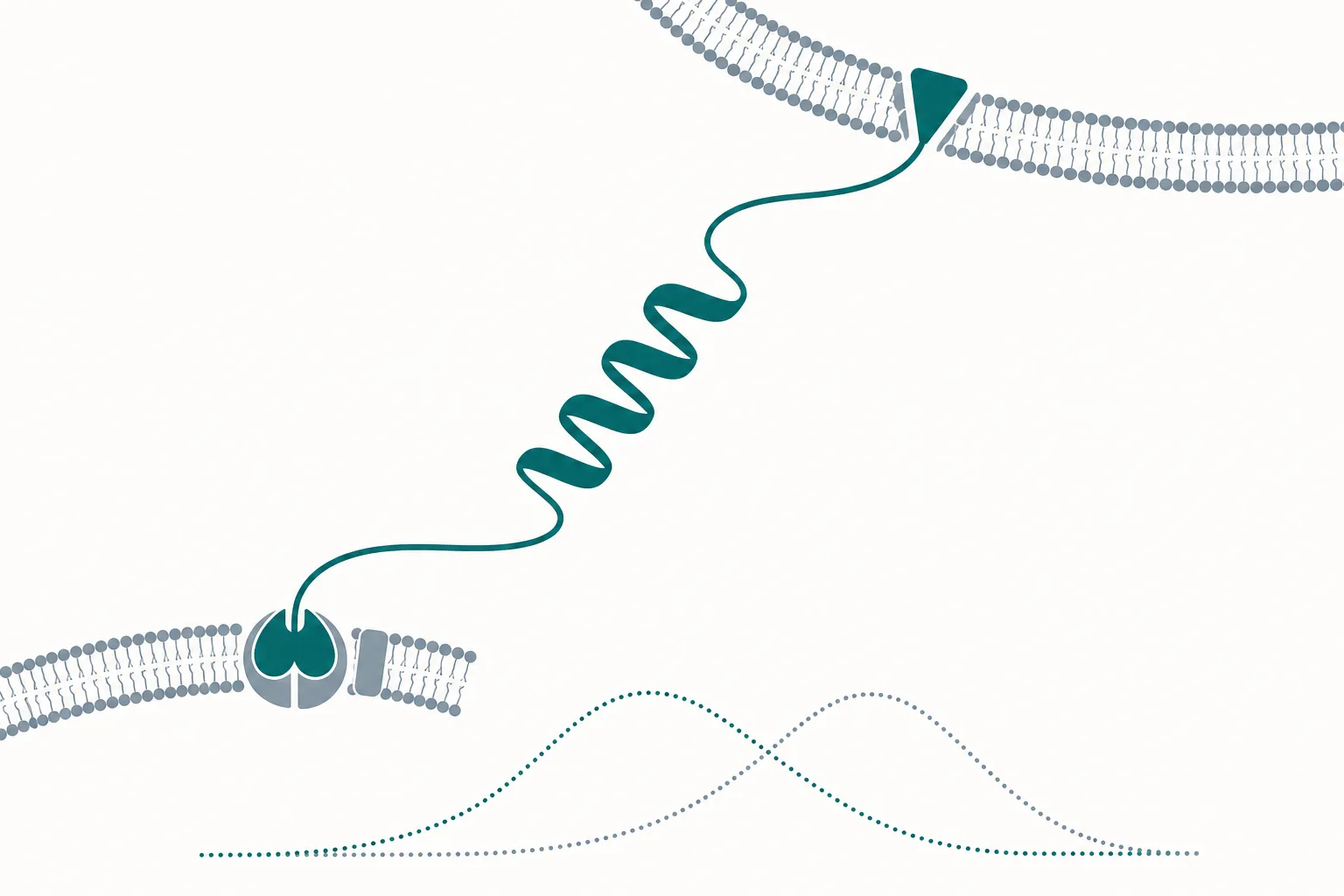
Amycretin is a single peptide with agonist activity at two receptors that are not related to one another: the GLP-1 receptor and the amylin receptor. Every unimolecular co-agonist that reached the clinic before it — dual incretins, triple agonists, glucagon co-agonists — combined receptors from the same class B G-protein-coupled receptor family, engaged by peptides with recognisably shared ancestry. Amylin has none of that ancestry. Its receptor is a calcitonin receptor modified by an accessory protein, and its sequence bears no useful resemblance to GLP-1 34. Putting both activities on one chain is therefore a harder chemistry problem than anything the class has previously solved, and the reasons for attempting it are almost entirely pharmacokinetic.
The unimolecular design problem
A peptide agonist activates its receptor with two functional regions. The N-terminal segment typically inserts into the receptor's transmembrane core and drives activation; the C-terminal segment binds the large extracellular domain and supplies most of the affinity. A hybrid molecule must satisfy both requirements for two different receptors using one continuous chain, without either set of residues destroying the other's fold.
Where the receptors are relatives, that is tractable. The first unimolecular dual incretin agonists were built by grafting GIP and GLP-1 recognition elements onto a shared glucagon-family backbone, exploiting the fact that all three ligands descend from a common ancestral sequence and adopt similar helical folds 1. The triagonist that followed extended the same trick to three receptors on one chain, with potency at each tuned by single-residue substitutions 2. In both cases the chemistry worked because the receptors were reading variations on the same structural theme.
Amylin does not belong to that theme. It is a 37-residue peptide with an intramolecular disulfide bridge and an amidated C-terminus, and its receptors are calcitonin receptors whose ligand preference is set by a bound accessory protein rather than by the receptor gene alone 4. A single chain that activates both an incretin receptor and an amylin receptor cannot be produced by grafting one family member onto another, because there is no shared scaffold to graft onto. It has to be engineered so that regions responsible for two unrelated recognition events coexist without mutual interference, and so that the whole construct still resists proteolysis and still binds albumin for the intended duration.
Why one molecule beats two on pharmacokinetics
The clinical alternative already exists and already has published phase 2 data: give an amylin analogue and a GLP-1 receptor agonist as two separate long-acting molecules. In adults with type 2 diabetes, that co-administration produced mean weight change of approximately 15.6% below baseline over 32 weeks against approximately 5.1% for the GLP-1 agent alone 5. The combination approach works. The unimolecular argument is not that it does not work, but that two molecules cannot hold a fixed relationship to each other in the body.
- Fixed ratio in time. Two molecules with different clearance rates drift apart across the interval between administrations, so the receptor activity balance a trial establishes at peak is not the balance present at trough.
- Fixed ratio in space. Two molecules with different tissue distribution and different degrees of protein binding present different ratios to the liver, the hindbrain and the pancreas. One molecule presents the same ratio everywhere it reaches.
- One absorption process. Two subcutaneously administered peptides have two absorption profiles and two sets of injection-site variability; a single chain has one.
- One set of immunogenicity and impurity questions rather than two, and one manufacturing and stability programme rather than two plus a co-formulation.
- A simpler regulatory object. A fixed-dose combination is assessed as a combination; a single new chemical entity is assessed as one molecule.
The first of those is the substantive pharmacological claim rather than a convenience argument. If the therapeutic effect of combining amylin and GLP-1 agonism depends on a particular balance between the two — and the whole rationale for the pairing is that the pathways are complementary rather than redundant — then a combination whose balance oscillates is delivering the intended pharmacology only part of the time. A single molecule delivers it continuously, at whatever ratio was designed in.
One molecule, two administration routes
Amycretin has been advanced in parallel as an injectable and as an orally administered formulation of the same peptide. That is unusual, and it is worth being precise about what it does and does not mean. It does not mean the molecule is orally bioavailable in any ordinary sense. Peptides of this size are digested and excluded by the gut epithelium, and the only route currently demonstrated for a large peptide is co-formulation with an absorption enhancer that transiently permits transcellular uptake across the gastric mucosa — a process with single-digit-percentage efficiency at best.
What a shared molecule across both routes does mean is that receptor pharmacology and delivery have been decoupled. The same two activities, in the same fixed ratio, can be presented either as a weekly subcutaneous exposure or as a daily oral exposure with a very different concentration profile. Those are pharmacologically distinct propositions built from one chain, and the evidence for each has to be generated separately. A result obtained with one route does not transfer to the other.
What a single chain costs
The ratio that is the unimolecular approach's main advantage is also its main limitation. It is chosen once, at the design stage, and it is thereafter a property of the sequence. If the balance turns out to be wrong — too much amylin activity for tolerability, too little to add anything over an incretin agonist alone — the response is a new molecule and a new development programme, not a change in proportions. A two-agent combination can be re-proportioned between trials, and the components can be titrated independently. That flexibility is precisely what the single chain trades away.
There is a second cost that is easy to overlook. Because the two activities are inseparable, they cannot be attributed separately either. A trial of a dual-activity molecule cannot show which arm produced which effect without a comparator molecule identical except for one arm, and such comparators are rarely made. The co-administration trials have a structural advantage here: they included single-agent arms, so the contribution of each component was visible within the same study 5. Unimolecular programmes generally cannot offer that, which leaves their mechanism claims resting on receptor-level in vitro data rather than on clinical dissection.
| One molecule | Two molecules co-administered | |
|---|---|---|
| Activity ratio over time | Fixed by sequence | Drifts with differing clearance |
| Activity ratio across tissues | Constant | Varies with distribution and protein binding |
| Adjustable after design | No | Yes, independently |
| Contribution of each arm separable in trials | Only with a purpose-built comparator | Yes, with single-agent arms |
| Manufacturing and stability | One programme | Two, plus co-formulation |
| Published human evidence to date | Early phase | Phase 2 and beyond |
What the evidence supports, and why the design question is the interesting one
This is where an honest account has to be blunt. The design argument above is well grounded in peer-reviewed work on unimolecular co-agonism and on amylin receptor pharmacology 1234. The evidence that this particular molecule realises the argument is not of the same quality. Early-phase results for both formulations have been reported publicly and describe substantial weight reduction over relatively short exposure periods in small numbers of participants, but early-phase trials are designed to characterise safety, tolerability and pharmacokinetics rather than to estimate efficacy, and their weight figures come from small groups with wide intervals around them.
The comparison that should be resisted is the one made most often: setting an early-phase percentage from this molecule against a phase 3 percentage from an approved medicine and reading the difference as a ranking. Effect sizes in this field shrink as populations grow, durations lengthen and enrolment criteria loosen. The relevant question about amycretin is not whether an early number is large. It is whether the fixed ratio designed into the chain turns out to be the right one, and that cannot be answered until trials large enough to detect a mismatch have reported.
Amycretin is usually introduced as a successor: more weight loss, one injection, an oral option. That framing puts the emphasis on numbers that the published evidence cannot yet support. The durable interest in the molecule is structural. It is the first serious attempt to carry two unrelated receptor families on one peptide chain, and it tests a question the class has not previously had to answer — whether the pharmacokinetic tidiness of a single molecule is worth the loss of the ability to adjust the balance between its two arms 12.
Both answers are defensible in advance. If the intended pharmacology depends on holding a specific ratio continuously, the single chain wins and the combination approach is a compromise. If the right ratio differs between people, or changes as weight is lost, or has to be relaxed for tolerability, then the ability to titrate two components independently is worth more than a constant ratio and the combination wins. Nothing in the current evidence base decides between those positions, and the trials that could decide it have not reported.
References
- Unimolecular dual incretins maximize metabolic benefits in rodents, monkeys, and humans
- A rationally designed monomeric peptide triagonist corrects obesity and diabetes in rodents
- Amylin: Pharmacology, Physiology, and Clinical Potential
- Multiple amylin receptors arise from receptor activity-modifying protein interaction with the calcitonin receptor gene product
- Efficacy and safety of co-administered once-weekly cagrilintide 2·4 mg with once-weekly semaglutide 2·4 mg in type 2 diabetes: a multicentre, randomised, double-blind, active-controlled, phase 2 trial