Incretin pipeline pharmacology
Amylin Receptor Agonists: Cagrilintide and a Second Satiety Pathway
Amylin is not an incretin. It is co-secreted with insulin, it enters the brain through a different door, and its receptor is a calcitonin receptor wearing an accessory protein. That separation from GLP-1 is the entire argument for the class.
Amylin, also called islet amyloid polypeptide, is a 37-residue peptide hormone co-secreted with insulin from pancreatic beta cells after a meal. It is not an incretin. It does not act at the GLP-1 receptor, it does not potentiate glucose-dependent insulin secretion, and the circuit it engages in the brain is anatomically distinct from the one incretin agonists engage 1. That separation is the whole argument for developing amylin receptor agonists alongside GLP-1 receptor agonists rather than as competitors to them. Cagrilintide is the long-acting analogue that made the argument testable in humans.
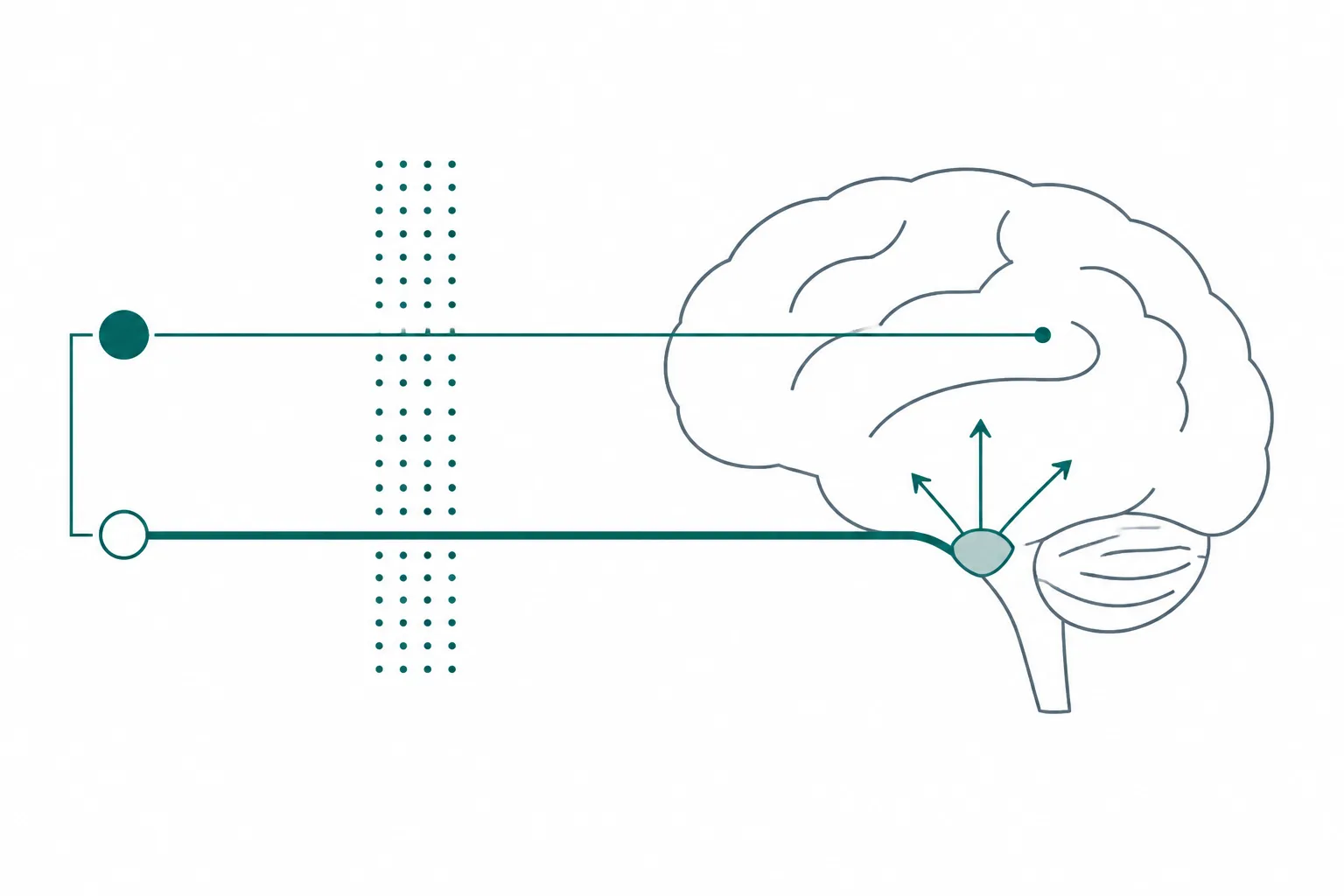
Amylin, and what the beta cell releases alongside insulin
Amylin is stored in the same secretory granules as insulin and released with it, at a molar ratio usually given as about 1 to 100. Its secretion therefore tracks insulin secretion: it rises after a meal, falls between meals, and is absent in type 1 diabetes for exactly the reason insulin is absent. Three physiological actions are well established: it slows gastric emptying, it suppresses postprandial glucagon secretion, and it reduces meal size 1. The third made it a drug target.
The site of that third action is unusual and worth stating precisely, because it explains why a circulating peptide can act centrally without being engineered to cross anything. The area postrema, in the dorsal hindbrain, is a circumventricular organ — a region where the blood-brain barrier is fenestrated and blood-borne signals reach neurons directly. Ablation of the area postrema in rodents abolishes the anorectic response to peripheral amylin. From there the signal projects to the nucleus of the solitary tract and the lateral parabrachial nucleus, and onward into hypothalamic circuits 1.
Why native amylin cannot be a drug
Human amylin is among the most amyloidogenic peptides in human physiology. In solution it self-associates into beta-sheet oligomers and then into insoluble fibrils. That is a formulation failure before it is anything else: the peptide precipitates, adsorbs to surfaces, and aggregates in the container. The residues chiefly responsible sit in the 20 to 29 region of the sequence 2.
The same property has a pathological counterpart. Islet amyloid composed of fibrillar amylin is present in the pancreatic islets of the large majority of people with type 2 diabetes at autopsy, and the intermediate oligomeric species rather than the mature fibrils are the forms most closely associated with beta-cell toxicity 2. Whether islet amyloid causes beta-cell failure or follows from it remains unsettled. The deposits are a consistent finding; the causal direction is not.
The receptors, and why amylin agonism is not GLP-1 agonism
The receptor pharmacology is the part most often stated wrongly in summaries of this class. No gene encodes an amylin receptor. Amylin receptors are heteromers: the calcitonin receptor, a class B G-protein-coupled receptor, in complex with a receptor activity-modifying protein. Three RAMPs exist, and the calcitonin receptor paired with RAMP1, RAMP2 or RAMP3 produces the three amylin receptor phenotypes designated AMY1, AMY2 and AMY3 3. The accessory protein does not merely traffic the receptor to the cell surface. It changes what the receptor binds.
| Phenotype | Composition | What the accessory protein changes |
|---|---|---|
| Calcitonin receptor alone | CTR | Responds well to calcitonin, poorly to amylin |
| AMY1 | CTR + RAMP1 | Amylin affinity rises by orders of magnitude; calcitonin response retained |
| AMY2 | CTR + RAMP2 | Amylin-responsive; least well characterised of the three |
| AMY3 | CTR + RAMP3 | Amylin-responsive; distinct trafficking and signalling behaviour |
Two consequences follow. First, amylin and calcitonin pharmacology are entangled at the receptor rather than merely resembling one another: the same receptor protein serves both ligands, and which one it prefers depends on the accessory protein bound to it 3. Second, subtype selectivity is hard to engineer and hard to measure, and no compound in clinical development has been shown to be selective for a single amylin receptor phenotype. Cagrilintide is characterised as a non-selective analogue, active across amylin receptors and at the calcitonin receptor.
The two mechanisms are routinely collapsed into the phrase "both act on satiety", which flattens a real distinction. GLP-1 receptor agonists reduce food intake through GLP-1 receptors in hypothalamic and hindbrain circuits, delay gastric emptying, and in the pancreas potentiate glucose-dependent insulin secretion. Amylin receptor agonism does none of the pancreatic work and does not touch the GLP-1 receptor at all. Its principal central entry point is the area postrema, and its behavioural signature in rodents is reduced meal size — satiation, the termination of an eating episode — rather than a general reduction in appetite between meals 1.
There is a further rodent observation that deserves an explicit label. Amylin agonism restores sensitivity to leptin in diet-induced obese rodents, and amylin-leptin combinations produce greater weight reduction than either agent alone 1. That is a rodent result. Leptin-based combination approaches have a poor translational record in humans, and nothing in the published human trials of amylin analogues has shown that leptin sensitisation contributes to the observed weight effect. It is a mechanistic hypothesis carried forward from animal work, not a demonstrated human mechanism.
Cagrilintide, the combination, and what the trials establish
Cagrilintide is an acylated, non-selective, long-acting amylin analogue. Its design addresses the two liabilities of the native hormone simultaneously. The sequence is modified so the molecule does not fibrillate at formulation concentrations, and a fatty diacid side chain confers reversible albumin binding that extends circulating half-life into a range compatible with once-weekly administration. The albumin-binding strategy is the same one used on the GLP-1 backbone in semaglutide, transplanted onto an unrelated peptide.
The dose-finding phase 2 trial randomised just over 700 adults with overweight or obesity and without diabetes to once-weekly cagrilintide across five dose levels, to placebo, or to a licensed daily GLP-1 receptor agonist as an active comparator, over 26 weeks 4. Mean weight reduction rose with exposure to 10.8% at the highest dose level, against 3.0% on placebo and 9.0% on the active comparator 4. Adverse events were predominantly gastrointestinal, nausea in particular, and mostly mild to moderate. Two things are established by that result: an amylin receptor agonist alone produces clinically meaningful weight reduction in humans, and it does so on a weekly schedule.
The argument for combining an amylin analogue with a GLP-1 receptor agonist is mechanistic rather than arithmetic. Two agents that converge on the same receptor mostly buy dose when combined. Two agents acting through separate receptor systems, with separate entry points into the central circuitry, can in principle exceed what either achieves at its own tolerated maximum — and because the dose-limiting toxicity of each is largely gastrointestinal, there is at least a reasonable expectation that the ceiling is not strictly additive. Amylin and GLP-1 satisfy the separateness condition better than any other pairing currently in clinical development, because the receptors do not share a family.
The phase 2 test of that idea randomised 92 adults with type 2 diabetes to cagrilintide plus semaglutide, to semaglutide alone, or to cagrilintide alone, at matched weekly exposures, over 32 weeks 5. Mean body weight change was approximately 15.6% below baseline on the combination against approximately 5.1% on semaglutide alone, with HbA1c falling by roughly 2.2 percentage points on the combination against roughly 1.8 on semaglutide 5. The weight separation is far larger than the glycaemic separation. That pattern is what the pharmacology predicts: the amylin arm contributes to intake, not to insulin secretion.
A phase 3 obesity programme for the fixed-dose combination has since reported results, with mean weight reduction over 68 weeks in adults without diabetes in the low twenties as a percentage of baseline. Those figures come from trial reports rather than from the peer-reviewed sources cited here, and the reported number fell short of some pre-trial expectations, which is itself a useful reminder that phase 2 effect sizes in small populations tend to shrink. The pharmacological argument below rests on what the published literature supports.
Limits, and why the second pathway is the point
- Cagrilintide monotherapy has phase 2 evidence only. No phase 3 single-agent programme has reported.
- The contribution of calcitonin receptor activity to the observed human effects has never been separated from the contribution of amylin receptors. A non-selective agonist cannot distinguish them.
- The claim that amylin agonism preserves lean mass better than incretin agonism is asserted more often than it is demonstrated. Published body-composition data in this class are limited and mostly secondary.
- Long-term consequences of chronic amylin receptor agonism for islet amyloid deposition are unknown. The analogues are engineered not to fibrillate; whether decades of receptor agonism affects endogenous deposition has not been studied.
- Whether combination tolerability is genuinely sub-additive cannot be established by a 92-participant trial. Gastrointestinal adverse events dominate in every study of the class.
- No cardiovascular outcome trial of an amylin receptor agonist has reported.
The incretin field has spent a decade adding receptors to a single molecule: GLP-1, then GIP, then glucagon. Every one of those receptors is a class B G-protein-coupled receptor from the same structural family, engaged by peptides with recognisably related sequences. Amylin is the first serious attempt to bring in a pathway from outside that family. Its secretion partner is insulin rather than a gut endocrine cell, its central entry point sits outside the blood-brain barrier, and its receptor is a calcitonin receptor modified by an accessory protein rather than a receptor of its own 13.
That is why the combination result carries more weight than the monotherapy result. Cagrilintide alone produced weight reduction comparable to a first-generation GLP-1 receptor agonist — useful, not decisive. Added to semaglutide it produced roughly three times the mean weight change of semaglutide alone over 32 weeks in a small phase 2 population 5. If that separation survives larger and longer trials, the interesting claim will not be that amylin agonism is unusually powerful. It will be that the two pathways are genuinely independent, and that independence is a resource the field has barely begun to spend.
References
- Amylin: Pharmacology, Physiology, and Clinical Potential
- Islet amyloid polypeptide, islet amyloid, and diabetes mellitus
- Multiple amylin receptors arise from receptor activity-modifying protein interaction with the calcitonin receptor gene product
- Once-weekly cagrilintide for weight management in people with overweight and obesity: a multicentre, randomised, double-blind, placebo-controlled and active-controlled, dose-finding phase 2 trial
- Efficacy and safety of co-administered once-weekly cagrilintide 2·4 mg with once-weekly semaglutide 2·4 mg in type 2 diabetes: a multicentre, randomised, double-blind, active-controlled, phase 2 trial