Incretin pipeline pharmacology
Oral GLP-1: Absorption Enhancers and the Bioavailability Problem
A 31-residue peptide swallowed into a protein-digestion system should not reach the circulation at all. One does, at roughly one percent, and only because an excipient rewrites the local chemistry of a few square millimetres of stomach lining for a few minutes.
Semaglutide is a 31-residue peptide of roughly 4,100 daltons carrying a fatty diacid side chain. The gastrointestinal tract is a system built to reduce exactly such molecules to their component amino acids, and it does so efficiently. That a tablet formulation of this peptide reaches the systemic circulation in sufficient quantity to lower glycated haemoglobin in a randomised trial is a genuine pharmaceutical achievement, and it is worth understanding precisely what was achieved: not a peptide made resistant to the gut, but an excipient that alters a few square millimetres of stomach lining for a few minutes at a time 1.
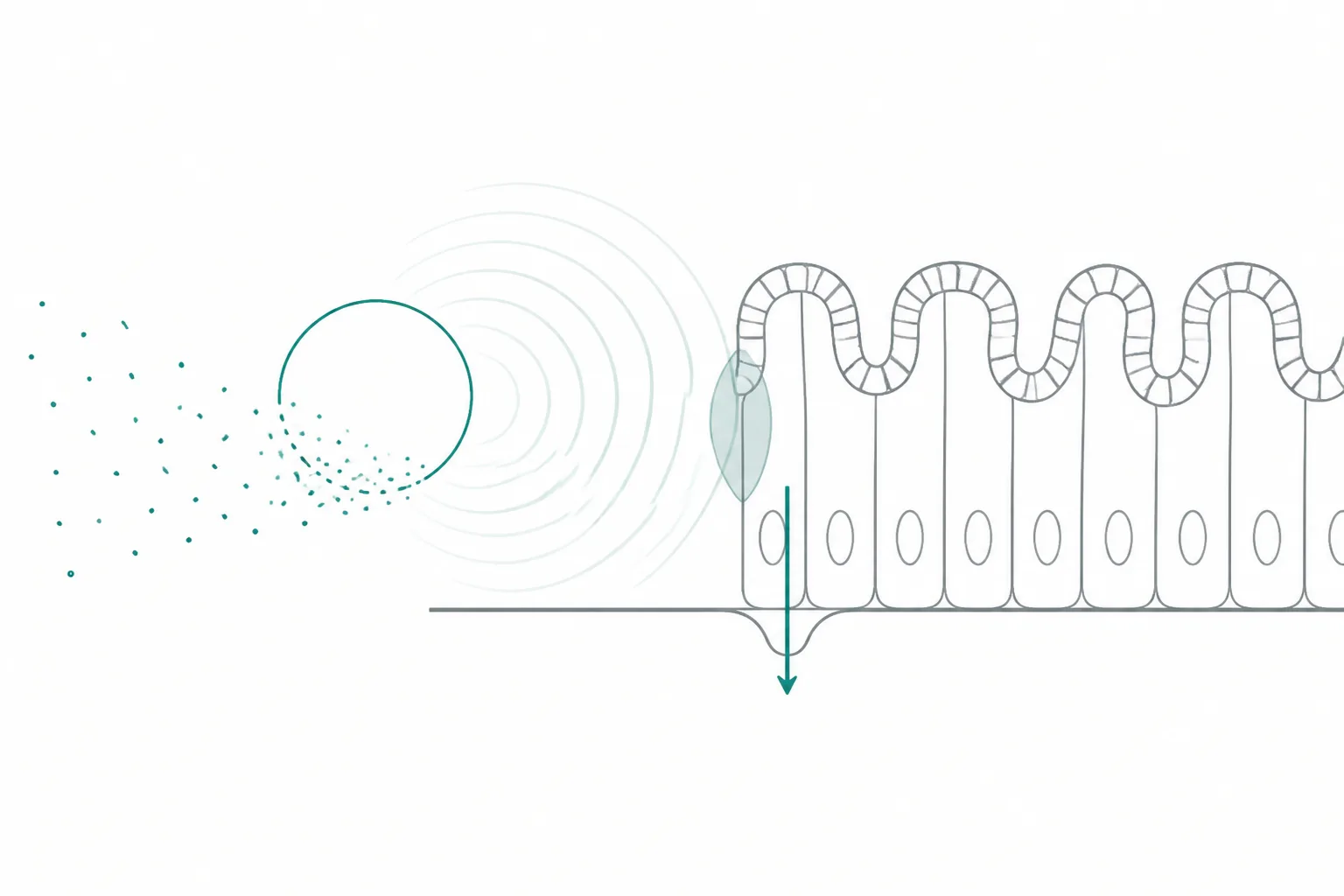
Why a 31-residue peptide should not survive the gut
Five barriers stand between a swallowed peptide and the bloodstream, and a molecule of this class fails at each of them independently. Gastric acid at a pH close to 1 to 2 promotes hydrolysis and denaturation. Pepsin cleaves preferentially at hydrophobic and aromatic residues, of which a GLP-1 backbone has several. Beyond the pylorus, pancreatic trypsin, chymotrypsin and elastase, plus brush-border aminopeptidases, complete the job. A mucus layer several hundred micrometres thick impedes diffusion to the epithelial surface. And the epithelium itself is sealed by tight junctions whose functional pore radius is on the order of a nanometre — far smaller than a folded peptide of this size.
Modifications made for circulating stability do not help with any of this. The alpha-aminoisobutyric acid substitution at position 8 blocks dipeptidyl peptidase 4, and the fatty diacid provides reversible albumin binding for a long plasma half-life. Both operate after the molecule is in the blood. Neither addresses getting it there, and the solution to that was not a change to the peptide at all 1.
SNAC, and the finding that absorption happens in the stomach
The tablet co-formulates the peptide with SNAC, a small amphiphilic carrier molecule, in large molar excess. The mechanistic characterisation established something that had not been the working assumption of the field: absorption occurs in the stomach rather than the small intestine. In dogs, exposure tracked the site of tablet erosion, and directly instilling the formulation into the stomach reproduced absorption while intestinal delivery did not 1. That single finding reframed the problem, because it moved the target away from the protease-rich small intestine entirely.
As the tablet erodes it creates a small, transient microenvironment against the mucosa in which SNAC performs several functions at once. It buffers local pH upward, which both protects the peptide from pepsin — an enzyme substantially inactivated well before neutrality — and keeps the peptide in solution. It promotes monomerisation of the peptide, which otherwise self-associates, presenting a smaller species to the membrane. And it increases transcellular permeability of the gastric epithelium, apparently by partitioning into and fluidising the membrane rather than by opening tight junctions 15.
- Local. The effect is confined to mucosa immediately adjacent to the eroding tablet, not distributed across the gastric surface.
- Concentration-dependent. It operates only where SNAC is present above a threshold local concentration, which the tablet geometry creates and nothing else sustains.
- Transient and reversible. The epithelium returns to baseline as SNAC diffuses away and is itself absorbed and cleared.
- Transcellular rather than paracellular. It does not depend on opening the junctions between cells, which is the mechanism that raises the most obvious safety objections.
Those four properties are why the approach is tolerable rather than merely effective. An enhancer that opened the gut wall durably and non-selectively would increase permeability to everything present in the lumen, including bacterial products and dietary antigens. Localised, self-limiting, transcellular enhancement is a far narrower intervention, and it is the reason this particular chemistry cleared regulatory review when many earlier enhancers did not 5.
One percent, the variance around it, and the conditions the trials specified
Absolute oral bioavailability for this formulation is approximately 1%, with published estimates clustering below that figure 2. Two consequences follow directly. The quantity of peptide in an oral tablet must be very much larger than the injected quantity to produce comparable exposure — on the order of a hundredfold more material through the entire manufacturing chain for the same pharmacological effect. And the economics of oral peptide delivery are therefore set by synthesis capacity as much as by clinical performance.
The harder problem is not the low mean but the spread around it. Between-subject variability in exposure is high, with coefficients of variation reported in the region of 100% or above, and within-subject variability between one administration and the next is also substantial 2. A process that depends on tablet erosion in a particular place, in a particular local volume of fluid, in a stomach whose emptying rate and contents vary, will vary. The pharmacokinetic response to that is a long half-life: with a plasma half-life of about a week, day-to-day fluctuation in absorbed fraction is smoothed into a steady-state concentration that is comparatively stable even though each individual absorption event is not.
Because absorption depends on conditions in the stomach, the clinical trial protocols for this formulation specified those conditions tightly, and the specifications are unusually strict for an oral medicine. Participants took the tablet in the fasting state, with no more than a small fixed volume of water, and waited a defined interval before any food, drink or other oral medication. The pharmacokinetic studies that established those constraints showed that food in the stomach and larger fluid volumes both reduced exposure substantially 2.
This is described here as study design, and the reason is worth stating plainly. Those conditions are not general handling advice and not a protocol anyone should reconstruct from an article. They are the controlled conditions under which the trial results below were generated, and they are part of how those results should be read: the efficacy figures come from a setting in which absorption conditions were standardised, which is a more favourable setting than ordinary use. Adherence to such conditions is itself a variable, and one that trials measure imperfectly.
What the human trials showed
The monotherapy trial randomised 703 adults with type 2 diabetes inadequately controlled by diet and exercise to oral semaglutide at three dose levels or to placebo for 26 weeks 3. Glycated haemoglobin fell by between roughly 0.6 and 1.1 percentage points across the active groups against roughly 0.1 on placebo, with weight reduction of up to a few kilograms and the gastrointestinal adverse event profile characteristic of the receptor class 3. That trial established the basic proposition: an orally administered peptide GLP-1 receptor agonist produces the pharmacology expected of the receptor.
The cardiovascular safety trial is the more demanding evidence. It randomised 3,183 adults with type 2 diabetes at high cardiovascular risk to oral semaglutide or placebo, with a composite of cardiovascular death, non-fatal myocardial infarction and non-fatal stroke as the primary outcome, over a median follow-up of about 16 months 4. The trial met its non-inferiority objective against placebo 4. A trial of that size and duration is also the setting in which an absorption process this variable is tested at scale, across thousands of participants and many thousands of administration events.
| Evidence | Establishes | Does not establish |
|---|---|---|
| Mechanistic absorption work | Absorption site is gastric; enhancement is local, transcellular and reversible | Efficiency in humans across varied conditions |
| Pharmacokinetic studies | Approximately 1% bioavailability; high between- and within-subject variance; sensitivity to food and fluid | Clinical outcomes |
| Monotherapy trial | Glycaemic and weight effects consistent with the receptor class | Long-term or cardiovascular outcomes |
| Cardiovascular safety trial | Non-inferiority for major adverse cardiovascular events against placebo | Superiority over injectable administration of the same peptide |
The other enhancer chemistries, and how to read a claim of oral activity
SNAC is one answer to one barrier, and the wider field has attacked the problem from several directions with modest success. Sodium caprate, a medium-chain fatty acid salt, acts principally in the small intestine and increases both paracellular and transcellular permeability; it has an approved product behind it and a longer safety record, but its paracellular component makes selectivity a live question 5. Transient permeability enhancers based on medium-chain fatty acid derivatives have supported an approved oral formulation of a much smaller peptide. Protease inhibitor co-formulation works in animal models but is unattractive as a chronic strategy and is necessarily incomplete.
The structural routes are more general but harder. Cyclisation removes the free termini that exopeptidases require and pre-organises the molecule; backbone N-methylation strips hydrogen-bond donors and raises membrane permeability. Both push a peptide toward the behaviour of the small number of naturally orally absorbed cyclic peptides, and neither has yet produced an oral incretin agonist. The route that most decisively sidesteps the problem is not a peptide at all: orally administered small-molecule GLP-1 receptor agonists are absorbed by ordinary mechanisms, require no enhancer, and answer the bioavailability question by declining to be peptides.
The general lesson from this programme is not that peptides can be given orally. It is how narrow the conditions were. A decade of work produced one purpose-built excipient, a demonstrated absorption site nobody had targeted, a formulation whose performance depends on the local state of a small patch of stomach lining, and a yield of about one percent with variability that only a week-long half-life renders manageable 12.
That is the benchmark against which any claim of oral peptide activity should be read. The relevant questions are which barrier the claim addresses, what absolute bioavailability was measured and by what method, how variable it was, and whether any of it was established in humans rather than inferred from cell monolayers or rodent instillation studies. For this compound, all of those questions have published answers 12345. For most peptides marketed as orally active, none of them do — and the absence of an absolute bioavailability figure is usually the most informative thing about such a claim.
References
- Transcellular stomach absorption of a derivatized glucagon-like peptide-1 receptor agonist
- Pharmacokinetics, Safety and Tolerability of Oral Semaglutide in Subjects with Type 2 Diabetes
- PIONEER 1: Randomized Clinical Trial of the Efficacy and Safety of Oral Semaglutide Monotherapy in Comparison With Placebo in Patients With Type 2 Diabetes
- Oral Semaglutide and Cardiovascular Outcomes in Patients with Type 2 Diabetes
- Intestinal Permeation Enhancers for Oral Delivery of Macromolecules: A Comparison Between Salcaprozate Sodium (SNAC) and Sodium Caprate (C10)