Safety signals and pharmacovigilance
Rodent C-Cell Tumours and the Species Question
Lifetime rodent studies found thyroid C-cell tumours with GLP-1 receptor agonists. Whether that finding transfers to people turns on receptor density, calcitonin data and cohort epidemiology, and two regulators read the same package differently.
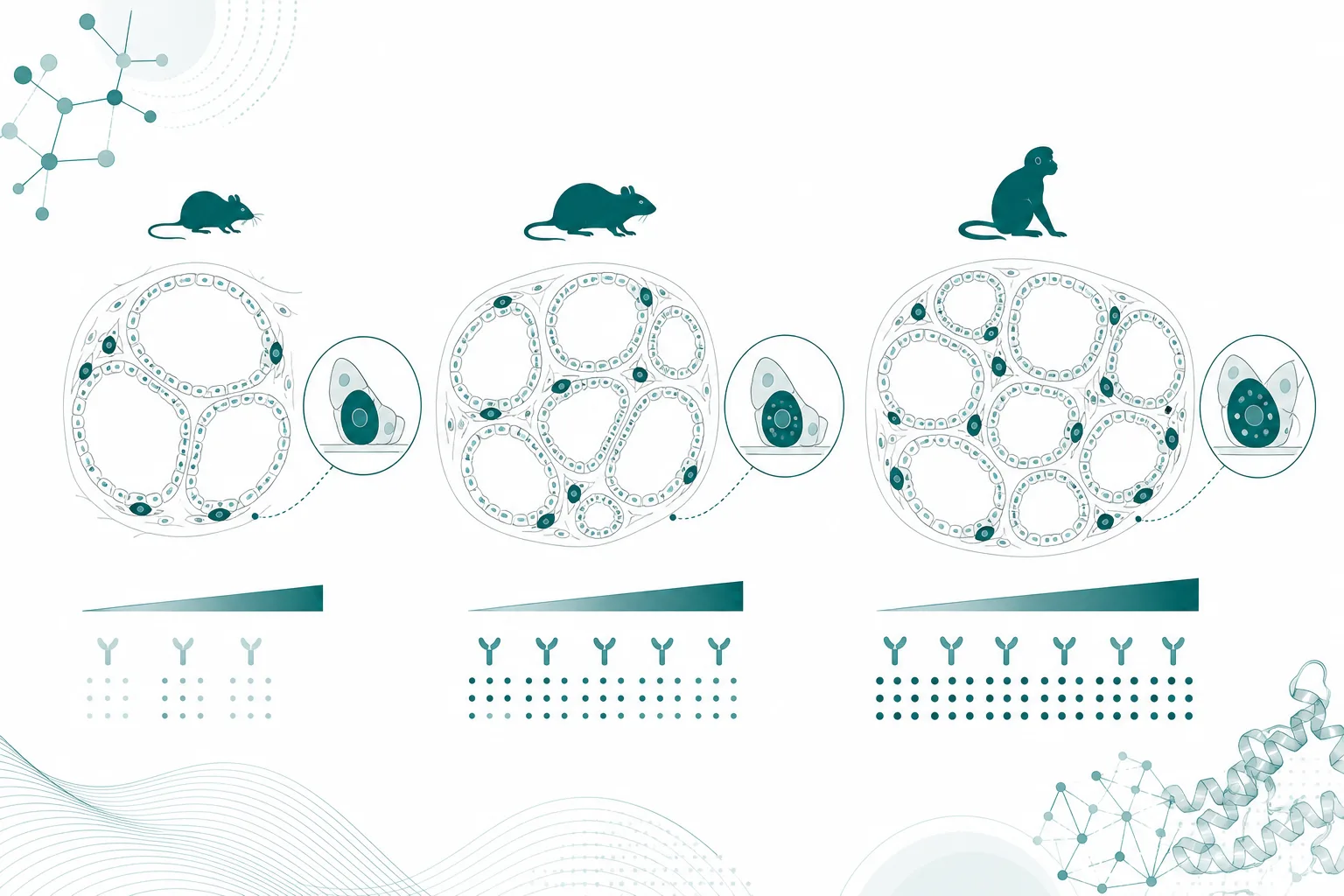
Rodent studies showed that long-term exposure to GLP-1 receptor agonists increases thyroid C-cell hyperplasia, adenomas and, in some cases, carcinomas, and that the effect runs through the GLP-1 receptor on the C-cell itself 12. The finding is real in rats and mice. Whether it is relevant to people is a different question, and it is answered by different evidence: receptor density in primate and human tissue, calcitonin measurements, a long primate study and large observational cohorts.
Two regulators have read the same preclinical package and labelled the products differently 78. This article sets out what each tier of evidence shows, states the tier for every section, and explains where the divergence comes from. It is the pillar for the safety-signals cluster on this site: it teaches the species-extrapolation method that the compound-specific pieces then rely on.
C-cells, calcitonin and medullary thyroid carcinoma
Thyroid C-cells, also called parafollicular cells, are endocrine cells scattered among the follicles that make thyroid hormone. They secrete calcitonin. Medullary thyroid carcinoma arises from these cells, not from follicular cells, and the hereditary forms are tied to activating mutations in the RET proto-oncogene 2. The US label reviewed for this article treats a personal or family history of the carcinoma, or the multiple endocrine neoplasia type 2 syndrome, as a contraindication 7.
Calcitonin matters for a second reason. It is the circulating marker that links the tissue finding to anything measurable in a living animal or patient. Rodent studies used it as an early readout of C-cell stimulation, and clinical programmes have used it as a monitoring marker. Whether it performs that job in people is taken up below. Evidence tier for this section: background physiology and regulatory text, not a trial result.
The rodent findings
The injectable semaglutide prescribing information summarises two-year carcinogenicity studies in mice and rats. In mice, a statistically significant increase in C-cell adenomas and a numerical increase in carcinomas appeared in males and females at every exposure tested, which ran from about twice to about 59 times the human exposure at the maximum recommended dose. In rats, adenomas increased significantly at every exposure level, and carcinomas increased significantly in males at clinically relevant exposures 7. The label describes the effect as dependent on both dose and treatment duration, and states that human relevance has not been determined.
The mechanism has been worked out in more detail. In rodents the receptor sits on the C-cell. Agonist exposure stimulated calcitonin release, raised calcitonin gene expression, and then produced C-cell hyperplasia, more in rats than in mice 1. In mice, thirteen weeks of continuous exposure raised plasma calcitonin and hyperplasia incidence in wild-type animals, while mice with the receptor knocked out showed neither 2. Activation of the RET pathway was not detected; the signal ran through a ribosomal S6 phosphorylation route consistent with mTOR activation rather than the MAPK route 2.
| Finding | Species and design | What it establishes |
|---|---|---|
| Adenomas and carcinomas rise with exposure and duration | Mouse and rat, two-year carcinogenicity studies | A tumour signal at clinically relevant exposures |
| Calcitonin release, then C-cell hyperplasia | Rat, and to a lesser extent mouse | A stepwise, receptor-linked sequence preceding tumours |
| Effect absent without the receptor | Mouse, wild-type against receptor knockout, 13 weeks | The effect is GLP-1 receptor mediated |
| No RET activation detected | Mouse, immunohistochemistry | The pathway differs from the hereditary human tumour driver |
Receptor density across species
The species argument is a density argument. In the 2010 study that mapped it, the receptor was localised to rodent C-cells, whereas humans and cynomolgus monkeys showed low receptor expression in thyroid C-cells. In primate preparations the agonists did not activate adenylate cyclase or produce calcitonin release 1. The same report found that 20 months of treatment in monkeys, at more than 60 times human exposure, did not produce C-cell hyperplasia 1.
Two cautions apply. Several authors of the primate and mouse papers were employed by the manufacturer of one of the agonists, which is not a flaw in the data but is a reason to want independent replication 12. And the original authors themselves wrote that the long-term consequences of sustained receptor activation in the human thyroid remain unknown 1. Evidence tier: animal model and primate tissue, with a human calcitonin substudy covered below.
What immunostaining of human tissue found
An independent group examined human thyroid tissue by immunofluorescence: medullary carcinoma in 12 samples, C-cell hyperplasia in 9, papillary carcinoma in 17 and normal thyroid in 15. Receptor immunoreactivity coincided with calcitonin in both the carcinoma and the hyperplasia samples. It was found in 3 of 17 papillary carcinomas (18%), and in 5 of 15 normal thyroids, covering about 35% of the C-cells assessed in those cases 3.
This does not contradict the primate result, but it narrows what that result can mean. The receptor is present on human C-cells and is expressed by neoplastic ones. What the tissue work cannot supply is function: staining shows protein, not signalling output, and the sample is small. The honest reading is that human C-cells are not receptor-free, which is why the question could not simply be closed on tissue grounds 3. Evidence tier: human tissue, in vitro, small samples.
Calcitonin as a monitoring marker, and why it underperformed
If human C-cells responded as rodent C-cells do, calcitonin should rise. The manufacturer-authored 2010 report found mean calcitonin in patients treated for two years stayed at the low end of the normal range, with no difference in the proportion crossing the clinical cut-off of 20 pg/ml 1. The randomised LEADER trial of liraglutide, with 9,340 participants followed for 3.5 to 5 years, reported estimated treatment ratios for calcitonin at 36 months of 1.03 (95% CI 1.00 to 1.06) in men and 1.00 (0.97 to 1.02) in women. No C-cell hyperplasia or medullary carcinoma occurred in the liraglutide group 4.
A null calcitonin result is reassuring about stimulation. It is weaker as a screening tool. The US prescribing information states that routine calcitonin monitoring or thyroid ultrasound is of uncertain value for early detection, because calcitonin has low specificity and thyroid disease has a high background incidence, so monitoring may add unnecessary procedures 7. A marker that is poorly specific cannot be both the early warning and the reassurance. Evidence tier: randomised trial for the calcitonin ratios, though the trial was not designed or powered to detect a rare tumour.
The human epidemiology: two cohorts, two readings
The Scandinavian cohort used nationwide registers in Denmark, Norway and Sweden from 2007 to 2021 and an active-comparator, new-user design. Mean follow-up was 3.9 years in the agonist group and 5.4 years in the comparator group. Thyroid cancer occurred in 76 of 145,410 agonist users (1.33 per 10,000 person-years) and 184 of 291,667 users of the comparator class, dipeptidyl peptidase 4 inhibitors (1.46 per 10,000). The hazard ratio was 0.93 (95% CI 0.66 to 1.31) and the rate difference was -0.13 per 10,000 person-years (-0.61 to 0.36). For medullary carcinoma the hazard ratio was 1.19 (0.37 to 3.86), and against sodium-glucose cotransporter 2 inhibitors the all-thyroid-cancer ratio was 1.16 (0.65 to 2.05) 5.
The French analysis was a nested case-control study of people with type 2 diabetes on second-line therapy, with 2,562 thyroid cancer cases matched to 45,184 controls. Use for one to three years was associated with an adjusted hazard ratio of 1.58 (95% CI 1.27 to 1.95) for all thyroid cancer and 1.78 (1.04 to 3.05) for medullary carcinoma 6.
| Feature | Scandinavian cohort | French nested case-control |
|---|---|---|
| Design | Active-comparator new-user cohort, three countries | Case-control within a diabetes cohort, one national database |
| Headline estimate | HR 0.93 (0.66 to 1.31), all thyroid cancer | HR 1.58 (1.27 to 1.95), one to three years of use |
| Medullary carcinoma | HR 1.19 (0.37 to 3.86) | HR 1.78 (1.04 to 3.05) |
| Absolute figure reported | 1.33 against 1.46 per 10,000 person-years | Not summarised as a rate difference in the abstract |
How to weigh them. Neither contradicts the other outright: the Scandinavian interval is consistent with no more than a 31% increase, and the French interval at one to three years excludes no effect. Differences in design, comparator, exposure windowing and the window in which the effect appears explain part of the gap. Heightened thyroid imaging in treated patients could also inflate detection of cancers in a case-control analysis, though that is a hypothesis neither paper settles. The medullary estimates have wide intervals in both. The Scandinavian authors note a mean follow-up of 3.9 years, and a tumour with a long latency would need longer observation to appear 5.
Two regulators, one dataset
The US text reviewed carries a boxed warning on thyroid C-cell tumours, records that human relevance has not been determined and could not be determined by clinical or nonclinical studies, and contraindicates use in people with a personal or family history of medullary carcinoma or multiple endocrine neoplasia type 2 7. The European Summary of Product Characteristics reviewed states that non-lethal rodent C-cell tumours are a class effect, that the mechanism is non-genotoxic and receptor-mediated, and that rodents are particularly sensitive to it. It concludes that relevance for humans is considered low but cannot be completely excluded. Its contraindications section lists only hypersensitivity 8.
Where the evidence stops
Settled in animals: a receptor-mediated C-cell proliferative response at clinically relevant exposures in rats and mice 127. Supported in primates: low receptor expression and no hyperplasia in a 20-month study 1. Mixed in human tissue: receptors are present on diseased C-cells 3. Reassuring but underpowered in humans: calcitonin did not rise in a large trial, and one large cohort found no increase 45. Contested: a case-control analysis found an elevated estimate in the one-to-three-year window 6.
A researcher reading this literature should ask of any statement about thyroid risk which species, which tier and which time window it describes. A rodent finding does not transfer by default, and an absence of signal in a cohort with 3.9 years of mean follow-up does not exclude a late effect. Both statements are true at once, and the divergence between regulators is the visible form of that.
References
- Glucagon-like Peptide-1 receptor agonists activate rodent thyroid C-cells causing calcitonin release and C-cell proliferation
- GLP-1 receptor agonists and the thyroid: C-cell effects in mice are mediated via the GLP-1 receptor and not associated with RET activation
- Glucagon like peptide-1 receptor expression in the human thyroid gland
- No Evidence of Increase in Calcitonin Concentrations or Development of C-Cell Malignancy in Response to Liraglutide for Up to 5 Years in the LEADER Trial
- Glucagon-like peptide 1 receptor agonist use and risk of thyroid cancer: Scandinavian cohort study
- GLP-1 Receptor Agonists and the Risk of Thyroid Cancer
- Ozempic (semaglutide) injection: prescribing information
- Ozempic: EPAR product information (Summary of Product Characteristics)