receptor pharmacology fundamentals
Selectivity: How a Peptide Chooses Its Receptor, and What Happens When It Does Not
Selectivity is a ratio between numbers measured at two receptors, and it survives only within the range of concentrations where that ratio holds. Most claims of selectivity in this field are missing both the comparison and the range.
Selectivity describes how strongly a ligand prefers one receptor over others. It is always a ratio and never an absolute property: a compound is selective for one receptor relative to named alternatives, by a stated factor, measured under stated conditions. A ligand said simply to be selective, with no comparison given, has been described rather than characterised 6.
Peptides raise the question in a particular form. Hormone receptors typically exist as families of closely related proteins, arising by gene duplication and retaining similar binding sites, and a peptide derived from or modelled on the natural ligand starts out with some affinity for several of them. Achieving preference for one is a design problem, and the concentration range over which that preference holds is finite.
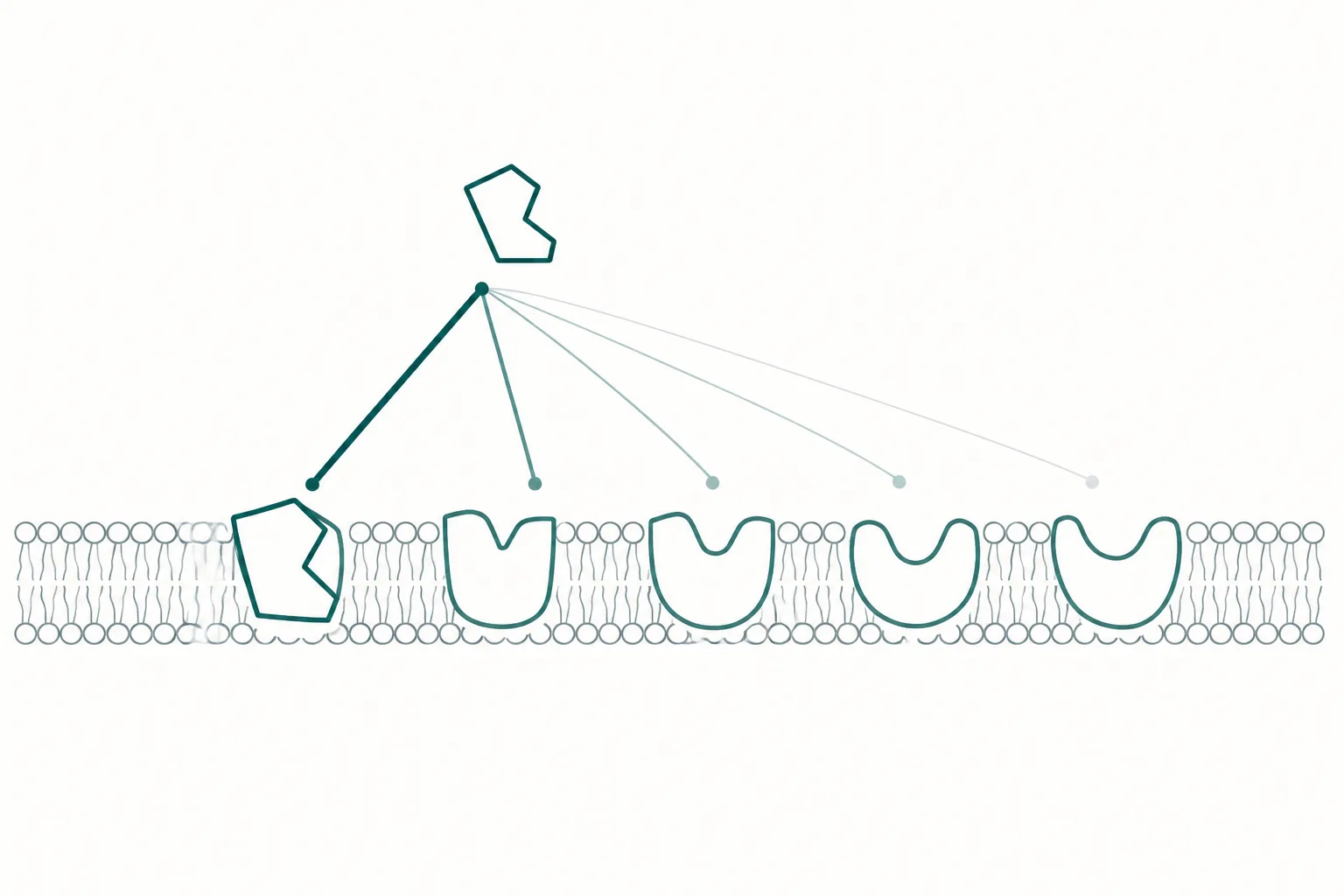
What a selectivity number is made of
The usual construction is a quotient of two constants measured in the same laboratory under the same conditions. If a ligand's dissociation constant is a hundred times lower at one receptor than at another, it is described as a hundredfold selective for the first. Everything depends on those two constants being comparable, which is why selectivity assembled from separate publications is unreliable even when each figure is individually correct.
There is a standing complication in how the underlying numbers are obtained. Competition binding experiments yield the concentration of test ligand that displaces half of a labelled reference ligand, and that value depends on the concentration and affinity of the reference used. Converting it into a constant that does not depend on the experimental setup requires a correction that has been standard since the early 1970s 4. A selectivity ratio built from uncorrected displacement values measured against different reference ligands is not a ratio of receptor affinities at all.
Binding is not the same as activating
A ligand that binds two receptors with equal affinity may activate them unequally, because affinity and efficacy are separate properties. Functional selectivity is the resulting preference in response rather than in occupancy, and it can point in a different direction from binding selectivity. A ligand may even act as an agonist at one family member and an antagonist at another, which no binding measurement would reveal 6.
This is why claims should specify which kind of selectivity is meant. A compound characterised by binding alone has been screened; a compound characterised by response at each receptor has been tested. The second is considerably more informative and considerably less common in the literature on research-supply peptides.
The melanocortin family as the worked example
The melanocortin receptors are the standard teaching case, for a structural reason. They were identified as a set of related G-protein-coupled receptors sharing responsiveness to peptides cleaved from a single precursor protein, cloned in the early 1990s as a recognisable subfamily 1. Five subtypes are described. They are similar enough in their binding regions that ligands resembling the natural agonists bind several of them.
What makes the family instructive is that the subtypes govern unrelated physiology. One drives pigmentation; one is the receptor for corticotropin in the adrenal cortex; two are distributed through the central nervous system and periphery with roles in energy balance and in sexual response; one is largely exocrine. The system also possesses endogenous antagonists acting at some of the subtypes, an unusual arrangement among peptide receptor families 2.
The consequence for any ligand in this family is direct. Insufficient selectivity does not produce a diluted version of the intended effect; it produces a categorically different additional effect in a different tissue. Pigmentary changes accompanying a compound intended to act centrally are the well-documented illustration, and the effect follows from receptor distribution rather than from any impurity in the material 2.
| Feature | Within a closely related family | Across unrelated receptors |
|---|---|---|
| Binding site similarity | High — shared ancestry | Low |
| Likelihood a ligand binds both | Substantial | Lower, but not negligible |
| Physiology of the second site | Often entirely unrelated to the first | Unrelated |
| How the second activity is usually found | Systematic subtype panels | Investigation of an unexplained effect |
| Tractability by medicinal chemistry | Difficult; the sites are alike | Usually easier |
How second targets are actually discovered
In pharmaceutical development, broad in vitro profiling against panels of receptors, enzymes, transporters and ion channels is routine, precisely because undesirable off-target activity is a leading cause of candidate failure and of post-approval withdrawal. The panels are assembled from targets with known links to adverse effects, and profiling is performed early enough to influence which molecules advance 3.
Compounds circulating as research chemicals have not generally been through that process, and the contrast matters when reading their descriptions. A compound with no reported off-target activity may have been profiled and found clean, or may never have been profiled. Those two situations produce identical documentation and are not distinguishable from the absence of a finding 3.
The alternative route to discovery is investigative. One well-documented case in the peptide literature concerns the growth hormone releasing peptides, where cardiovascular effects could not be accounted for by the receptor these compounds were characterised against. Pursuing the anomaly identified binding to a scavenger receptor involved in fatty acid transport, structurally unrelated to the intended target and present in cardiac tissue 5. The second target was found because an effect demanded an explanation, which is the general pattern.
Selectivity is concentration-dependent
This is the property most often lost in summary. A hundredfold preference means that at concentrations near the primary receptor's active range, occupancy of the secondary site is slight. Raise the concentration by two orders of magnitude and the secondary site is substantially occupied. The selectivity has not changed; the exposure has moved into the range where the second affinity matters 6.
- A selectivity ratio implies a window, not a guarantee. The window's width is the ratio itself.
- In vitro selectivity does not account for tissue distribution. A compound concentrating in a tissue rich in the secondary receptor can produce off-target effects despite a favourable ratio.
- Receptor abundance differs between tissues, so a modest affinity at an abundantly expressed secondary receptor can outweigh a high affinity at a sparse primary one.
- Metabolites are separate molecules with their own selectivity. A selective parent compound can yield a less selective product.
- Selectivity measured against a subtype panel says nothing about targets outside the panel.
How selectivity is engineered
Improving a peptide's preference for one family member is a structural exercise with a limited set of moves. Residues can be substituted at positions where the subtypes differ, so that the modified ligand fits one pocket better than its neighbours. The peptide's backbone can be conformationally constrained — by cyclisation, or by residues that restrict rotation — so that it presents only the shape the target site accepts, at the cost of flexibility that might have allowed it to adapt to a related pocket. Terminal groups can be altered, which sometimes shifts subtype preference substantially for a very small chemical change.
Two constraints limit how far this can go. The first is that the regions binding the endogenous ligand are the regions most conserved across a receptor family, precisely because they must accommodate a common natural agonist; the features a chemist would exploit to discriminate are therefore the features least likely to differ. The second is that a modification improving subtype preference may simultaneously reduce efficacy, alter susceptibility to degradation, or change the ligand's signalling profile at the target receptor, so selectivity is rarely optimised in isolation 6.
Species differences add a further caveat that is easy to miss when reading preclinical work. Receptor sequences differ between species, and so do selectivity ratios measured against them. A compound characterised as selective at rodent receptors is not thereby selective at the human orthologues, and the peptide literature contains cases where a single residue difference between species abolishes or confers activity outright. A selectivity figure without a stated species is incomplete in the same way as one without a comparator.
When non-selectivity is the design
Selectivity is not a virtue in itself. Several modern peptide agents are deliberately engineered to engage more than one receptor, on the argument that combined activation produces an effect neither receptor delivers alone. For such compounds the relevant characterisation is the balance between the targets rather than the exclusion of one, and that balance is a designed quantity reported as part of the compound's pharmacology.
The distinction that matters is between intended and unintended polypharmacology. A deliberately dual agonist has both activities measured, balanced and reported. An unintentionally promiscuous compound has one activity reported and the others undiscovered. The difference is not in the molecules' behaviour but in how much is known about it 3.
The general point
Selectivity is one of the most frequently asserted and least frequently evidenced properties in descriptions of research peptides. The word carries an implication of cleanliness that the underlying data rarely supports, and the implication survives because the missing elements — comparator, measurement type, ratio, range — are unremarkable by their absence 6.
The defensible position for most compounds in this category is narrower than what is usually stated. A primary receptor has typically been identified and characterised. Related subtypes have sometimes been tested. Targets outside the immediate family have usually not been examined at all, and the history of this field suggests that when they are examined, second binding sites are found more often than not 5.
References
- The cloning of a family of genes that encode the melanocortin receptors
- Studies on the physiological functions of the melanocortin system
- Reducing safety-related drug attrition: the use of in vitro pharmacological profiling
- Relationship between the inhibition constant (K1) and the concentration of inhibitor which causes 50 per cent inhibition (I50) of an enzymatic reaction
- CD36 mediates the cardiovascular action of growth hormone-releasing peptides in the heart
- Signalling bias in new drug discovery: detection, quantification and therapeutic impact