peptide pharmacokinetics
Immunogenicity: When the Immune System Notices a Peptide
A short synthetic peptide is a poor immunogen on paper. In practice anti-drug antibodies to peptide products are measured routinely, and the usual culprits are not the sequence itself but aggregation and the impurities that come with making it.
On immunological first principles a short synthetic peptide should be close to invisible. Raising an antibody response against a soluble protein normally requires the antigen to be large enough to present a B-cell epitope and to supply a peptide fragment that a helper T cell can recognise on a major histocompatibility complex molecule; molecules below a few kilodaltons generally cannot do both at once, and many peptide products are copies of human sequences the immune system is tolerant to. Yet anti-drug antibodies to peptide products are measured routinely, are found, and occasionally matter. The interesting question is not whether peptides can be immunogenic but what makes a particular product so 24.
The answers assembled over the last two decades point away from the sequence and towards the material. Aggregates provide the repetitive, multivalent structure a monomeric peptide lacks. Synthesis and storage generate related chains — deletions, insertions, substitutions, racemised residues, oxidation and deamidation products — that are no longer the human sequence and may carry an epitope the parent does not. Excipients and container materials can promote higher-order structures. Immunogenicity, in other words, is largely a product-quality property rather than an intrinsic one 23.
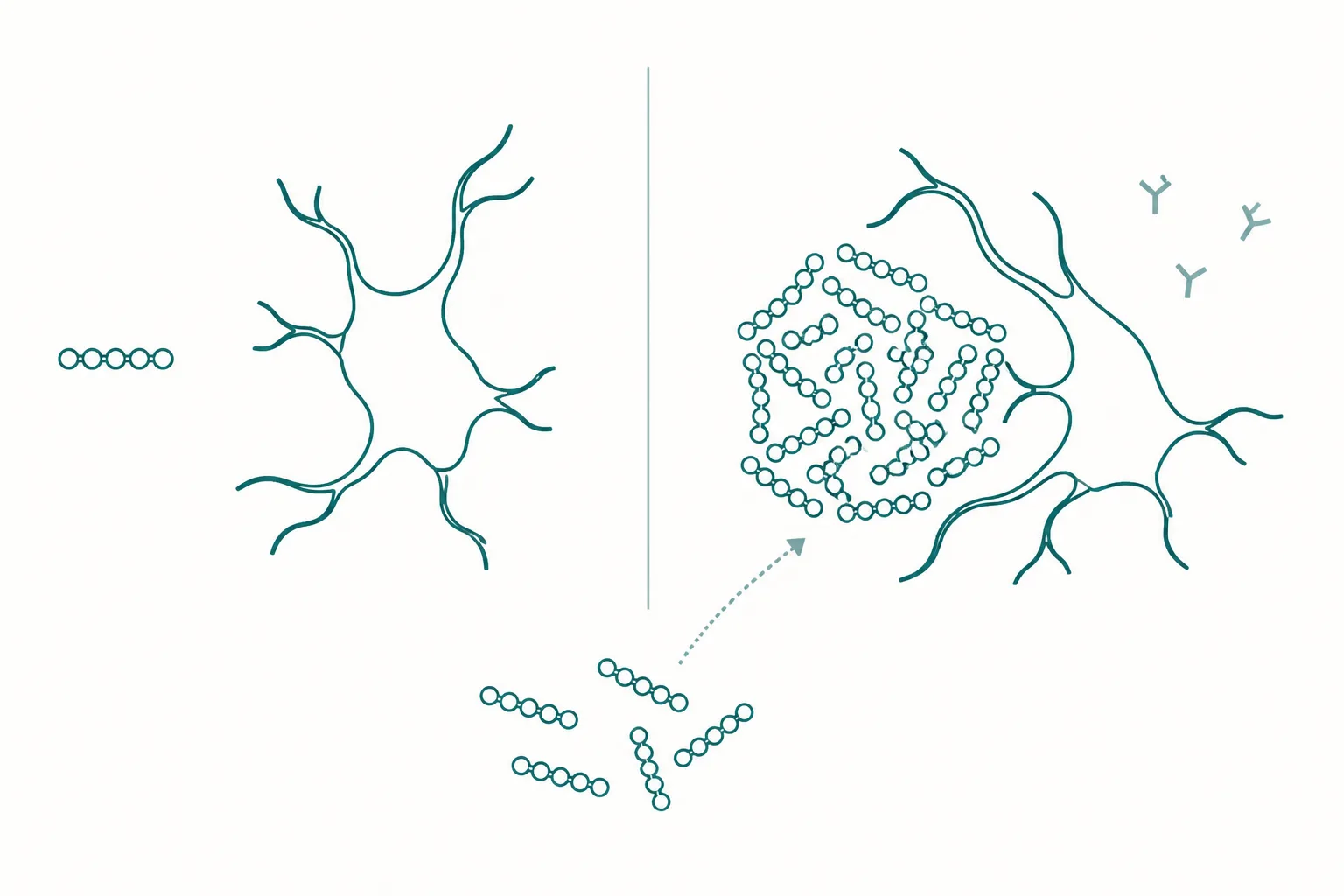
What an immune response to a peptide requires
The conventional pathway to a high-affinity, class-switched antibody response runs through T-cell help. An antigen-presenting cell internalises the material, processes it, and displays fragments on major histocompatibility complex class II molecules; a helper T cell whose receptor recognises that combination licenses B cells specific for the same antigen to proliferate and mature. Two requirements follow: the molecule must contain a fragment that binds an HLA allele in the recipient, and it must present something a B-cell receptor can engage 2.
Small peptides are poorly placed on both counts. A ten-residue chain is barely long enough to fill an HLA binding groove, let alone supply a separate B-cell epitope. Sequences identical to endogenous human hormones face a further obstacle in central and peripheral tolerance. This is why the peptide class as a whole shows lower immunogenicity than therapeutic proteins and antibodies, and why the topic was historically treated as a protein problem 4.
Non-human sequences are the obvious exception. A peptide taken from another species, or an engineered sequence with no human counterpart, carries genuinely foreign determinants, and antibodies against such products have been documented consistently — salmon calcitonin and the lizard-derived incretin analogue exenatide being the familiar examples. In the exenatide programme, treatment-emergent antibodies were common, titres peaked early and then declined, and the antibodies tested did not cross-react with human glucagon-like peptide-1 or glucagon 6. That last detail is the one that matters most mechanistically: the response tracked the foreign portion, not the shared pharmacology.
Aggregation supplies what a monomer lacks
The best-developed mechanistic account of biotherapeutic immunogenicity concerns aggregates. A monomer displays one copy of each determinant; an aggregate displays many, in a repeating spatial array, which is precisely the configuration that crosslinks B-cell receptors efficiently. Repetitive arrays can drive antibody production with less T-cell help than a soluble monomer requires, and the capacity of aggregated protein to enhance responses to the monomeric form has been recognised for decades 1.
Aggregates also differ qualitatively from monomer, not just quantitatively. Partial unfolding within an aggregate exposes surfaces that are buried in the correctly folded molecule, creating determinants the immune system has never been tolerised to, and particulate material is taken up by antigen-presenting cells more readily than soluble material 1. For peptides this is directly relevant because many are intrinsically aggregation-prone: hydrophobic acylation chains promote self-association, several sequences form fibrils readily, and adsorption to container surfaces can nucleate the process.
The formulation consequences are unglamorous and decisive. Excipients, extractables and leachables from the container closure have the potential to promote oligomers, fibrils and aggregates, which is why immunogenicity risk assessment for peptide products treats formulation and packaging as part of the analysis rather than as a separate pharmaceutical matter 2. A sequence does not have an immunogenicity; a product in a container does.
Impurities: the part specific to synthetic peptides
Solid-phase synthesis does not produce a single molecular species. It produces a target sequence accompanied by chains that failed at some step: a residue omitted, a residue inserted, an incorrect residue coupled, a protecting group retained, a stereocentre inverted. Storage adds oxidation and deamidation products. Each such species is, by definition, a sequence that is not the intended human one, and therefore a candidate carrier of a determinant the intended sequence does not have. This is the risk factor that distinguishes synthetic peptides from recombinant proteins, where the failure modes are different 3.
Regulatory thinking has concentrated on exactly this. Guidance for generic versions of peptide products referring to recombinant originators asked sponsors to identify and characterise peptide-related impurities from about a tenth of a percent of the drug substance upward, and to assess new impurities in the range between a tenth of a percent and half a percent for immunogenicity risk, with thresholds applied case by case 2. The specific numbers matter less than the principle they encode: an impurity too small to affect potency can still be large enough to raise an immune response.
The screening toolkit is mostly computational. Impurity sequences are run through algorithms that predict binding to HLA alleles, on the reasoning that a fragment which cannot occupy a binding groove cannot recruit T-cell help. Hits are then followed with in-vitro work such as HLA binding assays and T-cell activation or proliferation readouts in donor cells. Reviews of the practice are candid about its limits: these tools screen and rank, they do not establish clinical immunogenicity, and a negative prediction is not a clearance 23.
This framework is also still moving. On 28 July 2026 the US Food and Drug Administration withdrew its May 2021 guidance on abbreviated applications for certain highly purified synthetic peptide products, stating that it no longer reflected the agency's current scientific thinking, and published revised draft product-specific guidances covering a group of peptide products including salmon calcitonin, glucagon, teriparatide, liraglutide, semaglutide and tirzepatide 7. Anyone citing threshold numbers from the withdrawn document should note that it has been withdrawn.
How anti-drug antibodies are actually measured
Detection follows a tiered scheme that is standardised enough to be described generically. A sensitive screening assay is run first, with a cut point set so that a small proportion of antibody-negative samples screen positive rather than risking false negatives. Screen-positive samples go to a confirmatory assay, usually a competition step in which excess drug is added to establish that binding was drug-specific. Confirmed positives are titrated, and then characterised for neutralising activity in a cell-based or competitive ligand-binding format. The guidance describing this scheme is directed at therapeutic proteins and states that it may also apply to peptides case by case 5.
| Tier | Question it answers | Characteristic difficulty |
|---|---|---|
| Screening | Does this sample contain antibody-like binding activity? | Cut point set for sensitivity, so some positives are false |
| Confirmation | Is that binding specific to the drug? | Competition with excess drug must be interpretable |
| Titre | How much antibody is present? | Titres are assay-relative and not comparable between programmes |
| Neutralisation | Does the antibody block the drug's activity? | Requires a functional assay of adequate sensitivity |
| Cross-reactivity | Does the antibody also bind the endogenous counterpart? | Hardest question, and the most consequential for peptide copies of human hormones |
Two problems dominate in practice. The first is drug interference: circulating drug in the sample binds the antibody being measured and hides it, so an assay's drug tolerance determines what it can detect, and a long-acting peptide present for weeks makes this worse. The second is endogenous cross-reactivity. When the product is identical or near-identical to a human hormone, an antibody raised against the product may also bind the body's own molecule, and distinguishing that outcome from a harmless response is the central analytical challenge for this class 56.
Because of both, a reported incidence figure is a property of an assay as much as of a product. A programme using a highly sensitive screen with a low cut point reports more positives than one using a less sensitive method on the same samples. Comparing antibody incidences across products, or across eras of assay technology, is therefore not meaningful without the assay details, and the harmonised-terminology literature exists precisely because such comparisons were being made 4.
What the evidence does and does not support
The mechanistic account — T-cell help, aggregation as an enhancer, impurities as novel determinants — rests on a mixture of basic immunology, in-vitro assays, animal work and in-silico prediction, and the reviews in this area say so plainly 123. Antibody incidences and their consequences for named products come from clinical programmes and are human data, but they are assay-specific and mostly concern non-human sequences, where the biology is least surprising 6. For the large majority of synthetic research peptides no immunogenicity data of any kind exists, because no one has looked.
Three things follow for reading claims in this field. An assertion that a peptide is non-immunogenic because it is small skips the aggregation and impurity routes, which are the ones that usually matter. An antibody incidence quoted without its assay is not interpretable. And a purity figure on a certificate speaks to how much of the intended sequence is present, not to which related chains make up the remainder, whereas immunogenicity risk assessment is concerned with the identity of that remainder 3. These are laboratory research materials, and the immunological question about them is not settled by a single number on a specification sheet.
References
- Effects of protein aggregates: an immunologic perspective
- Immunogenicity of therapeutic peptide products: bridging the gaps regarding the role of product-related risk factors
- Immunogenicity risk assessment of synthetic peptide drugs and their impurities
- Beyond Efficacy: Ensuring Safety in Peptide Therapeutics through Immunogenicity Assessment
- Immunogenicity Testing of Therapeutic Protein Products — Developing and Validating Assays for Anti-Drug Antibody Detection: Guidance for Industry
- Clinical relevance of anti-exenatide antibodies: safety, efficacy and cross-reactivity with long-term treatment
- FDA Publishes Revised Draft Product-Specific Guidances for Certain Generic Peptide Products