Safety signals and pharmacovigilance
Residual Gastric Content Under GLP-1 Exposure
Ultrasound and endoscopy studies measure more retained stomach content in people exposed to GLP-1 receptor agonists. What they have not measured is the clinical outcome the finding is meant to predict.
Gastric ultrasound and endoscopy studies consistently find more residual gastric content, meaning solids or excess liquid in the stomach despite a fast, in people exposed to GLP-1 receptor agonists than in people who are not 1234. That is an observed surrogate finding. What remains an inference is that it translates into a higher rate of pulmonary aspiration, because the studies that measured aspiration directly found it rare and did not detect a difference 56.
This article describes what each method measured, reports prevalence ratios and odds ratios with their intervals, and separates the surrogate from the outcome. It reports observations only. It does not give pre-procedure instructions, and the clinical-society documents it cites are described as evidence, not followed as advice. Every study discussed is human observational, apart from one meta-analysis of observational studies.
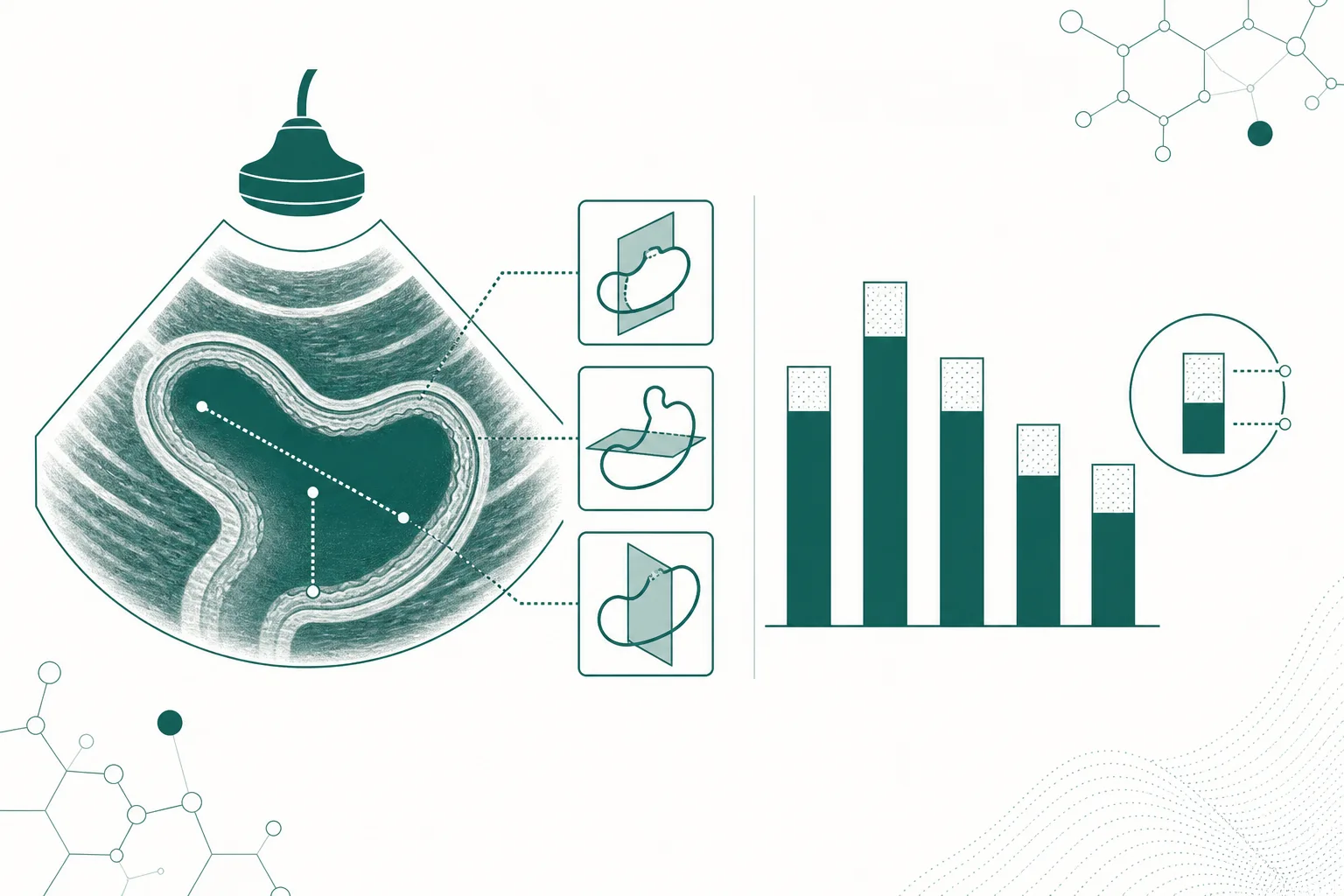
From receptor pharmacology to gastric motility
GLP-1 receptor agonists slow gastric emptying. A 2025 narrative review describes the sustained effect on delayed emptying as the source of the new challenges for endoscopy under sedation, and summarises evidence from scintigraphy, capsule endoscopy and gastric ultrasound 7. That is the mechanism in brief: a pharmacodynamic effect on the stomach that can leave food behind after a fast designed for an unaffected stomach.
The mechanism predicts the surrogate, not the outcome. A stomach holding more contents is a precondition for aspiration under sedation. It is not aspiration, and the step from one to the other depends on airway protection, anaesthetic technique, the volume and type of content, and chance. Each of the studies below belongs on the surrogate side of that line. Evidence tier for this section: pharmacology and narrative review.
Gastric ultrasound as a measurement method
Point-of-care ultrasound of the gastric antrum lets an examiner see solids, thick liquid and clear liquid and estimate volume. It is non-invasive and can be done at the bedside. It is also operator-dependent, and it requires the patient to lie in a specific position; one study excluded people who could not lie in the right lateral decubitus position for that reason 1. Different studies also define increased content differently, so ratios from different papers are not strictly comparable.
In the studies discussed here, ultrasound-defined increased content meant any solid or any volume of clear liquid above a weight-based threshold of 1.5 mL/kg 12. Endoscopy-based studies defined it instead by any solid content or a fluid volume collected in the suction canister above a lower weight-based threshold 3. A threshold set on one scale is not a threshold set on the other.
The cross-sectional ultrasound comparisons in fasted patients
The JAMA Surgery study prospectively enrolled 124 patients from a tertiary hospital between 6 June and 12 July 2023. Participants followed the preprocedural fasting guidance before elective procedures under anaesthesia. Increased content was present in 35 of 62 patients using a once-weekly agonist (56%) and 12 of 62 not using one (19%). After adjustment using inverse probability weighting, use was associated with a 30.5% higher prevalence (95% CI 9.9 to 51.2) and an adjusted prevalence ratio of 2.48 (1.23 to 4.97). The duration of drug interruption showed no association with content, with an adjusted odds ratio of 0.86 (0.65 to 1.14) 1.
A second prospective study, from a different centre, recruited 220 patients, 107 who had received semaglutide within ten days of the procedure and 113 who had not. Increased content was found in 43 of 107 (40%) against 3 of 113 (3%), with a propensity-weighted odds ratio of 36.97 (16.54 to 99.32). No pulmonary aspiration occurred 2. An odds ratio that large reflects a very low prevalence in the comparison group, which inflates the ratio. The prevalence difference of 37 percentage points is the more stable summary, and both studies are samples of a few hundred patients.
Endoscopy series: retained-content prevalence and the missing control groups
An earlier retrospective chart review of elective upper endoscopy under deep sedation found increased content in 8 of 33 semaglutide patients (24.2%) and 19 of 371 others (5.1%). The weighted odds ratio was 5.15 (95% CI 1.92 to 12.92). Preoperative digestive symptoms were associated with increased content, odds ratio 3.56 (2.2 to 5.78), and the combination of endoscopy with colonoscopy, which involves bowel preparation, was associated with a lower odds, 0.25 (0.16 to 0.39). One pulmonary aspiration occurred, in the semaglutide group 3.
A single-centre Chicago series analysed 1,284 outpatient endoscopies from September 2022 to October 2023, of which 128 involved a GLP-1 agonist user. Retained contents were recorded in 18 of 128 users (14.1%) against about 3.8 to 3.9% of non-users (the paper gives both figures), with an adjusted odds ratio of 5.4 (2.451 to 12.083). Bowel preparation for a same-day lower procedure was associated with an odds ratio of 0.157 (0.070 to 0.352). The proportions of aborted procedures were 2.3% and 2.2%, and the paper reported no significant increase in adverse outcomes with retained contents 4. Its own limitations section lists endoscopist judgement of retained contents with no standardised scoring, a single centre, and exposure type, dose and duration analysed only exploratorily 4.
| Study | Method and sample | Increased or retained content, users against others | Aspiration outcome |
|---|---|---|---|
| JAMA Surgery 2024 | Prospective ultrasound, 124 patients | 56% against 19%; adjusted prevalence ratio 2.48 | Not reported as an outcome |
| Anaesthesia 2024 | Prospective ultrasound, 220 patients | 40% against 3%; weighted odds ratio 36.97 | None occurred |
| Journal of Clinical Anesthesia 2023 | Retrospective endoscopy, 404 analysed | 24.2% against 5.1%; weighted odds ratio 5.15 | One case, in the user group |
| Frontiers in Medicine 2025 | Retrospective endoscopy, 1,284 analysed | 14.1% against about 3.9%; adjusted odds ratio 5.4 | No significant increase in adverse outcomes reported |
| Gastrointestinal Endoscopy 2025 | Meta-analysis, 23 studies, 262,018 patients | Pooled odds ratio 4.54 (3.30 to 6.24) | Aspiration pneumonia odds ratio 0.96 (0.53 to 1.75) |
Confounding by diabetes, glycaemic control and exposure
People using these drugs frequently have diabetes, and diabetes itself slows gastric emptying in some people. In the Chicago series, a history of gastroparesis carried an odds ratio of 4.55 (1.831 to 11.322) and chronic kidney disease 3.47 (1.084 to 11.152) for retained contents, comparable in size to the drug effect 4. Digestive symptoms before the procedure carried an odds ratio of 3.56 in the earlier review 3. Studies that adjust for these variables may still have measured them poorly, and many compare users with non-users whose indication for the procedure may differ.
Exposure details are the other gap. The agent, whether it was recently started or long established, and the time since the last administration all plausibly change gastric emptying. The JAMA Surgery study found no relationship between interruption duration and content 1, and in the earlier endoscopy review the mean interruption was 10.5 days in users with increased content and 10.2 days in users without 3. The Chicago authors state that type, dose and duration were not analysed in a powered way 4. These are the variables on which any dose-dependent or time-dependent conclusion would rest, and none has been analysed with adequate power.
Surrogate findings against aspiration outcomes
The pooled analysis of 23 studies found a significantly raised odds ratio for retained contents (4.54, 95% CI 3.30 to 6.24, I-squared 68%) and for premature endoscopy termination (4.54, 3.05 to 6.75), and no significant difference for aspiration pneumonia (0.96, 0.53 to 1.75, I-squared 70%). Same-day endoscopy with colonoscopy was associated with fewer retained contents, odds ratio 0.28 (0.22 to 0.36) 5. The heterogeneity on the first and third outcomes is substantial.
A claims-database cohort covered 6,806,046 upper endoscopies in adults aged 18 to 64 with type 2 diabetes between 2005 and 2021. Pulmonary adverse events within 14 days were rare, at 6 to 25 per 10,000 procedures. Against users of dipeptidyl peptidase 4 inhibitors, crude relative risks for GLP-1 agonist users were 0.67 (95% CI 0.25 to 1.75) for aspiration, 0.95 (0.40 to 2.29) for aspiration pneumonia and 1.07 (0.62 to 1.86) for pneumonia 6. Claims data identify events by billing codes, which probably undercount mild aspiration, and they do not measure gastric content at all.
Why society guidance describes itself as limited by evidence
The American Gastroenterological Association communication states in its methods that it incorporates recently published studies and reflects the experiences of authors who are experts in bariatric medicine or endoscopy 8. That is an honest description of a rapid update written when little outcome data existed. It also means the guidance is not the product of a systematic review of aspiration outcomes.
The 2025 review contrasts societies that advocate individualised management based on procedure, symptoms, treatment phase and point-of-care ultrasound with the systematic discontinuation recommended by the American Society of Anesthesiologists, as the review characterises it, and calls for prospective validation, safety outcome studies and intersocietal consensus 7. Disagreement among societies is what a thin evidence base predicts.
Where the evidence stops
Established: more residual content on ultrasound and endoscopy in exposed people, in several settings, with consistent direction 12345. Not established: that the excess causes more aspiration, that it varies with agent or timing, or that any interval or protocol changes outcomes. Prospective designs that would answer it include a registry of procedures under sedation with verified exposure and pre-specified aspiration endpoints, a randomised comparison of ultrasound-guided against standard management, and target-trial emulations built on large records with adjudicated events. Until one is done, the finding sits where the data put it: a measured pharmacodynamic effect with an unmeasured clinical consequence.
References
- Glucagon-Like Peptide-1 Receptor Agonist Use and Residual Gastric Content Before Anesthesia
- Relationship between residual gastric content and peri-operative semaglutide use assessed by gastric ultrasound: a prospective observational study
- Relationship between perioperative semaglutide use and residual gastric content: A retrospective analysis of patients undergoing elective upper endoscopy
- GLP-1 receptor agonist increase retained gastric contents on EGD and same-day colonoscopy reduces this risk
- Glucagon-like peptide-1 receptor agonist use and the risk of residual gastric contents and aspiration in patients undergoing GI endoscopy: a systematic review and a meta-analysis
- Glucagon-Like Peptide-1 Receptor Agonists Do Not Increase Aspiration During Upper Endoscopy in Patients With Diabetes
- GLP-1 Receptor Agonists and Gastrointestinal Endoscopy: A Narrative Review of Risks, Management Strategies, and the Need for Clinical Consensus
- AGA Rapid Clinical Practice Update on the Management of Patients Taking GLP-1 Receptor Agonists Prior to Endoscopy: Communication