trial readouts 2026
Orforglipron: The First Non-Peptide GLP-1 Agonist, and Why It Is Not a Peptide Story
A small organic molecule reaches the same receptor as the incretin peptides by a different route, needs no absorption enhancer, and carries no fasting conditions. Its approval is a pharmacology story more than a peptide one.
Orforglipron is not a peptide. It is a small organic molecule that activates the GLP-1 receptor, taken once daily by mouth, and on 1 April 2026 the FDA approved it for chronic weight management in adults with obesity, or overweight with weight-related conditions, under the brand name Foundayo 23. It is the first GLP-1 receptor agonist that is not peptide-based to reach approval. In ATTAIN-1, the trial at the centre of the application, mean body-weight change at 72 weeks in the high arm was 12.4% under the efficacy estimand and 11.2% under the treatment-regimen estimand, against 0.9% and 2.1% on placebo 14.
The question this article answers is what that approval means for peptides. How oral peptide GLP-1 agonists cross the gut wall, by way of a permeation enhancer, is covered separately on this site, as is the reason most peptides cannot be swallowed at all. Orforglipron does not solve that problem. It sidesteps it, and the consequences worth examining are in binding, formulation, manufacture and the trial data.
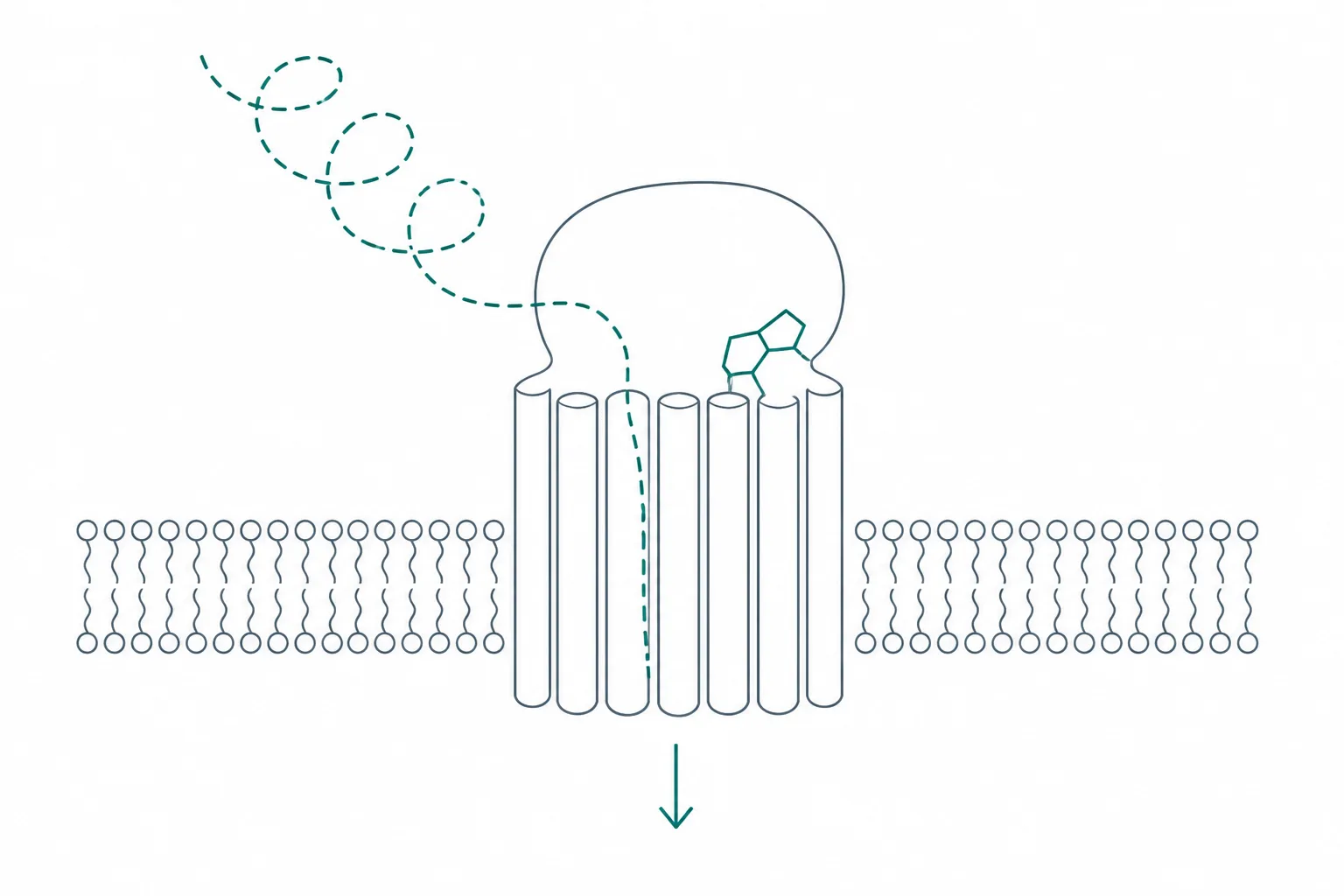
What orforglipron is, chemically
Every GLP-1 receptor agonist approved before orforglipron was peptide-based: a modified copy or analogue of the native hormone, long enough to fold into the shape the receptor recognises, sometimes fused to a larger protein. Orforglipron is a synthetic organic compound of a different kind, small enough to be absorbed from the gut by ordinary mechanisms and made by conventional chemical synthesis. Lilly describes it as a once-daily small-molecule, non-peptide oral agonist; it was discovered by Chugai Pharmaceutical and licensed to Lilly in 2018 3.
The names carry the distinction. Peptide analogues in this class end in -glutide, as semaglutide and liraglutide do. The small-molecule agonists end in -glipron, as orforglipron and the discontinued danuglipron do. Orforglipron is not a fragment, not a mimetic assembled from amino acids, not a cyclised or stapled peptide. Asking whether it is a research peptide misreads the category. It belongs with the orally available small molecules that make up most of pharmacology, and it happens to act at a receptor that until now only peptides could reach.
How a small molecule activates a peptide receptor
The GLP-1 receptor is a class B G-protein-coupled receptor. Its native ligand is a peptide of about thirty residues that engages the receptor across a large surface, its N-terminus reaching into the transmembrane core. A small molecule cannot reproduce that footprint. The structural characterisation of orforglipron, published under its development code, showed it bound in a distinct pocket in the upper part of the helical bundle, contacted by the extracellular domain, the second extracellular loop and several transmembrane helices 5. It stabilises an active receptor conformation by a route the peptide does not use.
Two functional properties were reported alongside that binding mode. The molecule was a partial agonist, biased toward G-protein activation over β-arrestin recruitment, and highly selective against other class B receptors 5. Its oral glucose-lowering effect was demonstrated in mice engineered to express the human receptor, and in non-human primates it produced insulin-secretion and food-intake effects comparable in size to an injectable peptide agonist 5. The humanised mice are worth noticing. A small molecule that binds a less conserved pocket can behave differently at different species' receptors in a way a peptide copying the native ligand typically does not, and that changes how its animal data should be read.
What changes when the drug is not a peptide
| Property | Oral peptide GLP-1 agonist | Orforglipron |
|---|---|---|
| Absorption | Needs a co-formulated permeation enhancer; bioavailability around one percent | Ordinary small-molecule absorption; no enhancer |
| Conditions in the trials or label | Fasting, a small volume of water, a wait before food | No food or water restrictions on the label |
| Source of duration | Albumin binding via a fatty-acid side chain | Small-molecule pharmacokinetics suited to once-daily use |
| Manufacture | Peptide synthesis and purification | Conventional organic synthesis |
| Receptor engagement | Full agonist at the native binding site | Partial, G-protein-biased agonist at a distinct pocket |
The label difference is the one most often reported. The oral peptide formulation was studied under strict conditions because its absorption depends on local conditions in the stomach. Orforglipron was approved with no restriction on food or water intake 3. That is not a convenience feature added to the drug. It is a direct consequence of the molecule not being a peptide.
The manufacturing difference may matter more over time. Peptide supply has constrained the incretin class, and an oral peptide magnifies the constraint, because far more material must be made for each unit of systemic exposure. A small molecule made by conventional synthesis draws on a different and larger manufacturing base. That is an inference from chemistry rather than a published supply analysis, and it should be read as such.
ATTAIN-1: the trial behind the approval
ATTAIN-1 was a phase 3, multinational, randomised, double-blind trial in 3,127 adults with obesity, or overweight with at least one weight-related comorbidity, and without diabetes; about 36% had prediabetes 1. Participants were randomised to one of three once-daily maintenance levels or to placebo, as an adjunct to diet and physical activity, for 72 weeks 1.
| Arm | Efficacy estimand | Treatment-regimen estimand | Discontinuation for adverse events |
|---|---|---|---|
| Low | −7.8% | −7.5% | 5.3% |
| Mid | −9.3% | −8.4% | 7.9% |
| High | −12.4% | −11.2% | 10.3% |
| Placebo | −0.9% | −2.1% | 2.7% |
In the high arm, 59.6% of participants reached at least 10% body-weight change and 39.6% reached at least 15%, against 8.6% and 3.6% on placebo, under the efficacy estimand 4. Among participants with prediabetes, the proportion reaching near-normal glucose rose substantially over placebo 4.
Set against the injectable peptide agonists, these are smaller numbers, and cross-trial comparison does nothing to change that. The phase 2 trial had reported up to 14.7% at 36 weeks, but in an arm above the highest level carried into phase 3, so the two figures are not a like-for-like comparison 6. The case for the drug does not rest on matching injectable magnitudes. It rests on being a tablet with no absorption conditions that can be manufactured at scale.
Adverse events, and the liver question
| Event | Orforglipron arms | Placebo |
|---|---|---|
| Nausea | 28.9% to 35.9% | 10.4% |
| Constipation | 21.7% to 29.8% | 9.3% |
| Diarrhoea | 21.0% to 23.1% | 9.6% |
| Vomiting | 13.0% to 24.0% | 3.5% |
Adverse events were those of the receptor class, predominantly gastrointestinal and mostly mild to moderate, and they rose with exposure 14. Discontinuation for adverse events reached 10.3% in the high arm, almost four times the placebo rate 4. No hepatic safety signal was observed 4.
The liver result is not a formality. Small-molecule GLP-1 agonists have a history here. In April 2025 Pfizer ended development of danuglipron after a trial participant developed potential drug-induced liver injury, while noting that liver-enzyme elevations across its programme were in line with those seen with approved agents 7. Peptide agonists are cleared largely by proteolysis. Small molecules are typically metabolised by the liver, which exposes them to a kind of hepatic risk that peptides largely avoid. The absence of a hepatic signal in ATTAIN-1 is the result that separated orforglipron from its predecessor. It is also a result from 72 weeks and about three thousand participants, which is not enough to exclude rare idiosyncratic liver injury.
The approval
The FDA approved the drug on 1 April 2026 for use with a reduced-calorie diet and increased physical activity in adults with obesity, or overweight with weight-related comorbidities 2. It was the first new molecular entity approved under the agency's national priority voucher programme, issued 50 days after filing, which the FDA described as the fastest approval of a new molecular entity since 2002 2. The agency cited two randomised, double-blind, placebo-controlled 72-week trials. The label carries the boxed warning for thyroid C-cell tumours common to the class, with further warnings including pancreatitis, severe gastrointestinal reactions, acute kidney injury, hypoglycaemia, diabetic retinopathy and gallbladder disease 2.
The speed of the review is itself a limit worth stating. A 50-day review is fast by any standard. Post-marketing experience in a large treated population, not the registration trials, is where uncommon adverse events — hepatic ones included — will first become visible.
What it implies for peptide half-life engineering
The peptide incretins are a sustained exercise in half-life engineering: amino-acid substitutions against protease cleavage, fatty-acid side chains for albumin binding and, in the oral case, an enhancer to push a small fraction of the material across the stomach wall. Orforglipron needs none of it. Its duration comes from small-molecule pharmacokinetics suited to oral use, and its absorption from ordinary uptake 5.
That does not make the peptide approach obsolete. On cross-trial comparison the injectable peptide agonists remain the more effective agents, weekly administration suits many patients, and multi-receptor peptides such as tirzepatide and retatrutide engage receptor combinations no small molecule yet reaches. What orforglipron changes is the boundary. For a single receptor with a druggable pocket, the peptide is no longer the only way in, and any future peptide programme at such a receptor now competes against a tablet.
Limits
- ATTAIN-1 excluded people with diabetes. Its figures describe that population only.
- Seventy-two weeks of data say nothing about durability or what happens after stopping.
- No cardiovascular outcome trial of this molecule has reported.
- Rare hepatic injury cannot be excluded by trials of this size, given the history of the small-molecule class.
- The binding-site and signalling-bias data are preclinical. Whether partial, biased agonism matters clinically is not established.
- Cross-trial comparison with injectable agents is unreliable; populations, durations and estimands differ.
References
- Orforglipron, an Oral Small-Molecule GLP-1 Receptor Agonist for Obesity Treatment
- FDA Approves First New Molecular Entity Under National Priority Voucher Program
- FDA approves Lilly's Foundayo (orforglipron), the only GLP-1 pill for weight loss that can be taken any time of day without food or water restrictions
- Lilly's oral GLP-1, orforglipron, demonstrated meaningful weight loss and cardiometabolic improvements in complete ATTAIN-1 results published in The New England Journal of Medicine
- Structural basis for GLP-1 receptor activation by LY3502970, an orally active nonpeptide agonist
- Daily Oral GLP-1 Receptor Agonist Orforglipron for Adults with Obesity
- Pfizer Provides Update on Oral GLP-1 Receptor Agonist Danuglipron