trial readouts 2026
Retatrutide TRIUMPH-1: What a 2,339-Person Phase 3 Actually Established
An 80-week phase 3 trial, read with both estimands, the discontinuation table, and the most quoted figure put back in its place. What TRIUMPH-1 settled about body-weight change, and what it left open.
TRIUMPH-1 established three things. Across 2,339 adults with obesity or overweight, all three retatrutide arms produced body-weight change at 80 weeks well beyond placebo under both of the sponsor's analysis estimands. The size of that change rose with each step from the low arm to the high arm. And the proportion of participants stopping treatment because of adverse events rose with it, reaching 11.3% in the high arm against 4.9% on placebo 1. The trial did not establish durability after stopping, the composition of the mass lost, or any effect on clinical events. Those questions belong to trials still running.
This article is the readout. The receptor pharmacology — why a glucagon receptor arm sits beside two incretin arms, and the balance that design requires — is treated separately on this site and is not repeated here. What follows is the design, the two estimands, the 104-week extension figure that circulates most widely, the adverse-event profile, the earlier TRIUMPH-4 knee osteoarthritis result, and what remains open.
Design: a master protocol, four arms, 80 weeks
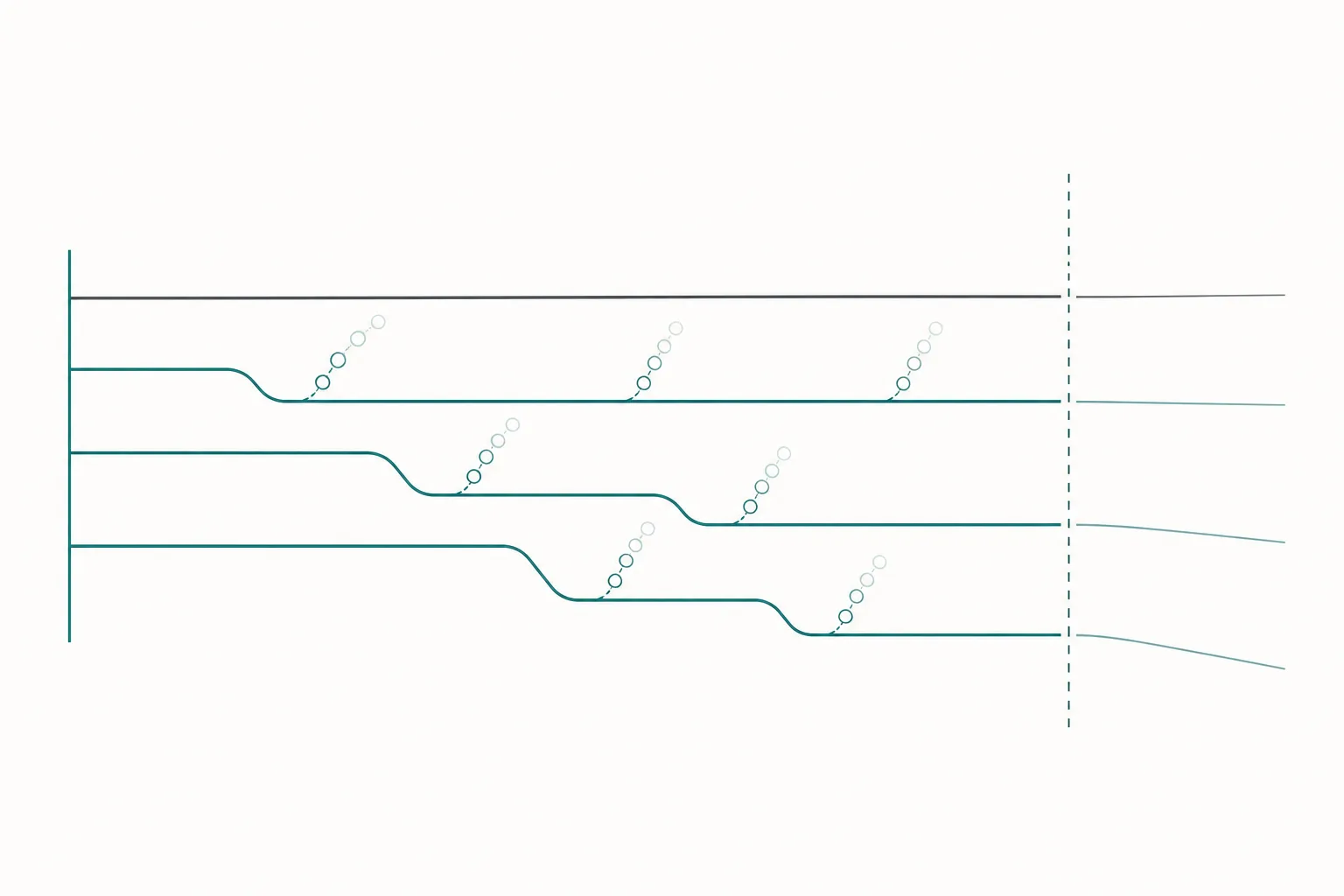
TRIUMPH-1 is a phase 3, randomised, double-blind, placebo-controlled master trial. It enrolled adults with obesity, or with overweight and at least one weight-related condition, and randomised 2,339 of them in a 1:1:1:1 ratio to one of three retatrutide maintenance levels or to placebo, administered once weekly for 80 weeks 1. Participants in the active arms reached their assigned level by stepwise escalation at four-week intervals, a design common to the class and intended to limit early gastrointestinal intolerance. The primary and key secondary endpoints concerned body-weight change from baseline, and the sponsor reports that all three arms met them 1.
Two features of the design matter for reading the result. First, 80 weeks is longer than the pivotal obesity trials of the approved incretin agents: SURMOUNT-1 ran for 72 weeks and STEP 1 for 68 45. Any cross-trial comparison therefore carries a duration mismatch before differences in population are even considered. Second, a master trial hosts nested sub-studies in participants with particular comorbidities under one protocol. The headline figures describe the overall population. Sub-study results are separate analyses with their own, smaller denominators, and should not be read as confirmations of the main result.
The primary result, and why there are two sets of numbers
Obesity trials now report their results under two estimands, and TRIUMPH-1 is no exception. The treatment-regimen estimand analyses everyone as randomised, whatever happened afterwards, including participants who stopped the drug. It answers the question a regulator asks: what happens to a population offered this treatment. The efficacy estimand models what would have happened had everyone stayed on treatment as assigned. It answers a pharmacological question and produces larger numbers. Neither is wrong. They answer different questions, and a figure quoted without its estimand is incomplete 1.
| Arm | Treatment-regimen estimand | Efficacy estimand |
|---|---|---|
| Low | −17.6% | −19.0% |
| Mid | −23.7% | −25.9% |
| High | −25.0% | −28.3% |
| Placebo | −3.9% | −2.2% |
The gap between the two estimands widens with exposure: 1.4 percentage points in the low arm, 3.3 in the high arm 1. That is the pattern the discontinuation data predict. More participants stopped in the higher arms, and the treatment-regimen analysis carries their smaller changes into the average. Placebo moves the other way, because the treatment-regimen estimand retains events that the efficacy estimand sets aside. The placebo-adjusted difference in the high arm is therefore about 21 percentage points on the conservative analysis and about 26 on the favourable one.
The exposure–response curve is also flatter at the top than at the bottom. Under the treatment-regimen estimand, the step from low to mid added 6.1 percentage points; the step from mid to high added 1.3 1. Whether that reflects a pharmacological ceiling, the higher discontinuation rate in the high arm, or both, cannot be separated from a topline release. It is the kind of question the full report should answer.
| Threshold | Low | Mid | High | Placebo |
|---|---|---|---|---|
| At least 25% below baseline | 27.8% | 52.9% | 62.5% | 2.2% |
| At least 30% below baseline | 15.3% | 37.9% | 45.3% | 0.5% |
| At least 35% below baseline | 5.9% | 20.8% | 27.2% | 0.3% |
The 104-week extension, and what 30.3% describes
The most repeated number from this readout is 30.3%. It does not come from the randomised comparison. It comes from an extension in which 532 participants with a baseline body-mass index of 35 or above, who had completed 80 weeks, continued to 104 weeks with every arm — including the former placebo arm — moved to the highest tolerated maintenance level 1. Participants originally assigned to the high arm reached 30.3% below baseline. Those originally on the low and mid arms reached 27.9% and 29.5%. Former placebo participants, after switching to active treatment, reached 19.2% 1.
Three restrictions attach to that figure. The population is selected by baseline body-mass index, a group in which relative change tends to run larger. It is selected again by completion, which removes the participants who stopped — disproportionately those who tolerated treatment least. And after week 80 there is no placebo comparator, because everyone is on active drug. The extension shows that body-weight change had not plateaued by 80 weeks in this subgroup. It does not show that 30% is the expected outcome for the trial population, and it should not be quoted as though it were.
Discontinuations and adverse events
Adverse events followed the incretin class pattern, and their frequency rose with exposure. Gastrointestinal events dominated. Discontinuation because of adverse events was 4.1%, 6.9% and 11.3% across the low, mid and high arms, against 4.9% on placebo 1. The low arm sat slightly below placebo. The high arm was more than double it, which means roughly one participant in nine assigned to the most effective arm stopped for reasons of tolerability.
| Event | Retatrutide arms | Placebo |
|---|---|---|
| Nausea | 28.6% to 42.4% | 14.8% |
| Diarrhoea | 25.2% to 34.1% | 13.5% |
| Constipation | 23.8% to 26.1% | 10.9% |
| Vomiting | 10.6% to 25.3% | 4.8% |
| Dysesthesia | 5.1% to 12.5% | 0.9% |
| Urinary tract infection | 7.5% to 8.8% | 5.3% |
| Discontinuation for adverse events | 4.1% to 11.3% | 4.9% |
Dysesthesia warrants separate attention because it is not part of the established incretin adverse-event profile. The term describes abnormal or unpleasant skin sensation: tingling, burning, or altered touch. It occurred in up to one participant in eight in the high arm of TRIUMPH-1 against fewer than one in a hundred on placebo, and in 20.9% of the high arm in TRIUMPH-4 12. The sponsor characterised the TRIUMPH-4 events as generally mild and rarely leading to discontinuation 2. No mechanism has been published. Whether it relates to the glucagon receptor arm, to the rate of body-weight change, or to something else is unknown.
Two measures that the phase 2 programme made salient are absent from the topline release. The phase 2 obesity trial reported exposure-related heart-rate increases that peaked around 24 weeks and declined thereafter 3. The TRIUMPH-1 release does not report heart rate, and it does not report body composition. Both will need the full report before the adverse-event picture can be called complete.
TRIUMPH-4: the knee osteoarthritis trial
TRIUMPH-4 reported first, in December 2025, and was the programme's first completed phase 3 trial. It randomised 445 adults with obesity or overweight and knee osteoarthritis in equal proportions to the mid or high retatrutide arm or to placebo for 68 weeks, and reported body-weight change alongside knee pain measured on the WOMAC pain subscale 2.
| Outcome | Mid arm | High arm | Placebo |
|---|---|---|---|
| Body-weight change, efficacy estimand | −26.4% | −28.7% | −2.1% |
| Body-weight change, treatment-regimen estimand | −20.0% | −23.7% | −4.6% |
| WOMAC pain change, efficacy estimand | −75.8% | −74.3% | −40.3% |
| Discontinuation for adverse events | 12.2% | 18.2% | 4.0% |
| Dysesthesia | 8.8% | 20.9% | 0.7% |
Read for its negatives, TRIUMPH-4 is instructive. Knee pain in the placebo arm fell by about 40%, a large response typical of pain trials and a reminder that the drug-attributable share is the difference between arms, not the headline figure 2. The high arm produced more body-weight change than the mid arm but no additional pain reduction. Discontinuation for adverse events reached 18.2% in the high arm, higher than in TRIUMPH-1. The sponsor reported that rates were lower among participants with a baseline body-mass index of 35 or above, and that some discontinuations were attributed to perceived excessive reduction in body weight 2. That category implies that, for part of the population, the highest maintenance level overshoots what participants wanted or needed.
What TRIUMPH-1 did not settle
- Peer review. The figures above come from sponsor releases and a conference presentation in June 2026. A full peer-reviewed report of TRIUMPH-1 was not located at the time of writing, and topline figures are sometimes revised in full publication.
- Durability. No data describe what happens after retatrutide is stopped. For the approved incretin agents, regain after withdrawal is well documented.
- Maintenance. Whether a lower maintenance level can hold a body-weight change once reached has not been reported.
- Composition. No body-composition data were released. At changes of this size, the lean-mass fraction is not a detail.
- Clinical events. No cardiovascular outcome data exist. The trials in participants with cardiovascular disease and with type 2 diabetes had not reported when the TRIUMPH-1 release was issued.
- Dysesthesia. The signal rises with exposure and has no published mechanism.
- Rare harms. 2,339 participants over 80 weeks is adequate for common events and inadequate for uncommon ones.
What the trial did establish
Stated narrowly, TRIUMPH-1 is the first phase 3 confirmation that the retatrutide phase 2 result was not an artefact of a small, short trial. The phase 2 obesity trial reported up to 24.2% body-weight change at 48 weeks in 338 participants 3. Phase 3, with roughly seven times the participants and 32 more weeks of follow-up, reported 28.3% in the high arm on the favourable estimand and 25.0% on the conservative one 1. Effects of this kind often shrink between phase 2 and phase 3. This one did not.
Stated with its costs, TRIUMPH-1 is also a trial in which roughly one participant in nine in the high arm stopped because of adverse events, in which a sensory adverse event outside the class profile appeared at a rate that rose with exposure, and whose most quoted figure comes from a selected extension without a comparator. Those facts sit alongside the efficacy figures rather than beneath them 12. A readout this large settles the size of the effect. It leaves the harder questions — what happens afterwards, what the lost mass was made of, and whether clinical events change — to the trials still running.
References
- Lilly's triple agonist, retatrutide, delivered powerful weight loss in pivotal Phase 3 obesity trial
- Lilly's triple agonist, retatrutide, delivered weight loss of up to an average of 71.2 lbs along with substantial relief from osteoarthritis pain in first successful Phase 3 trial
- Triple-Hormone-Receptor Agonist Retatrutide for Obesity — A Phase 2 Trial
- Tirzepatide Once Weekly for the Treatment of Obesity
- Once-Weekly Semaglutide in Adults with Overweight or Obesity