Cyclisation: Locking a Peptide Into One Shape
A linear peptide in solution is a population of thousands of conformations, only one of which binds. Closing the chain into a ring removes most of the rest before the receptor is ever encountered.
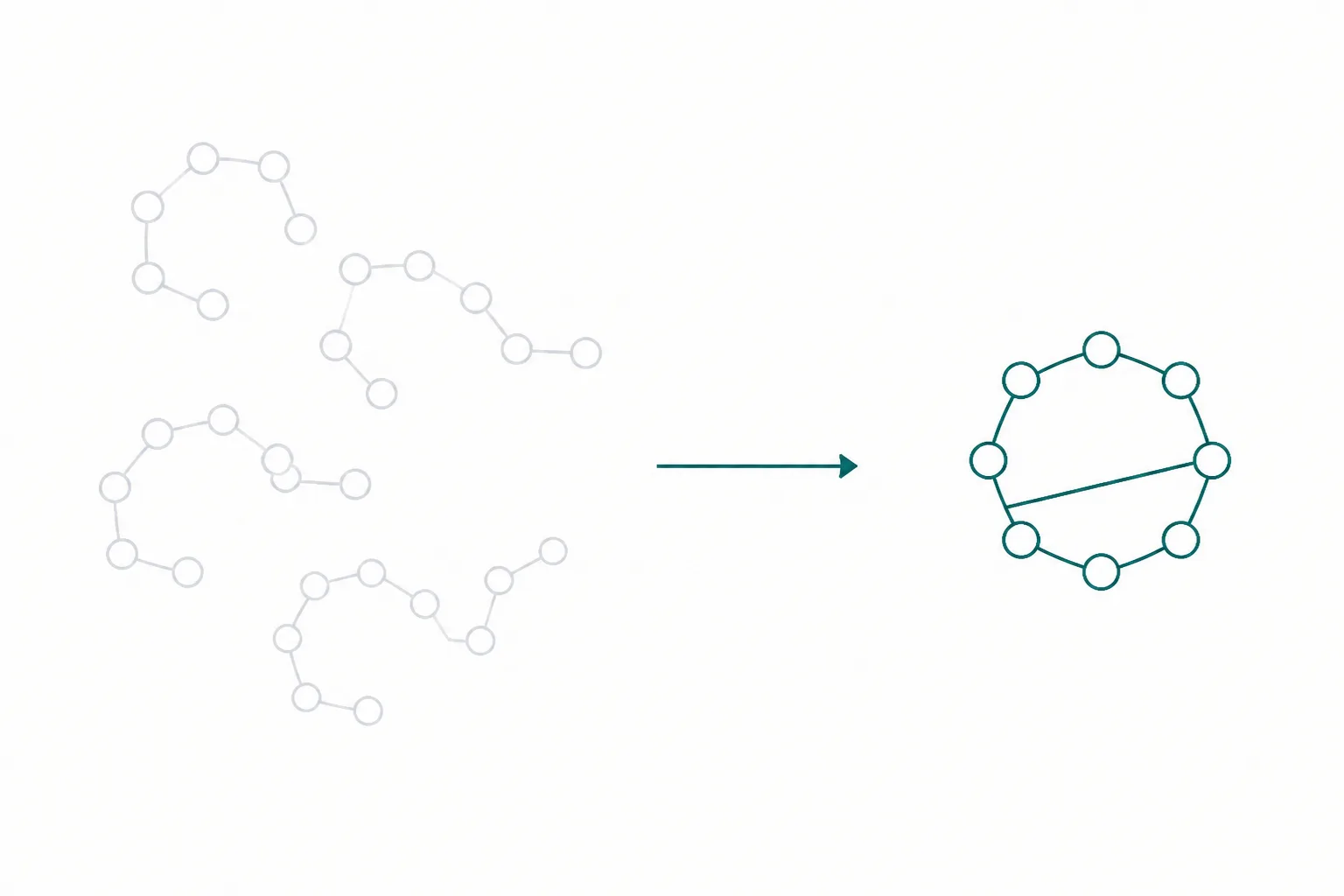
A linear peptide in aqueous solution has no shape in any useful sense. Each residue contributes two freely rotating backbone torsion angles, plus side-chain rotations, and the molecule samples an enormous conformational ensemble on a nanosecond timescale. Exactly one member of that ensemble binds the target. Everything a receptor sees is therefore a rare event, and everything a protease sees is an extended segment presented sooner or later at the enzyme's groove. Cyclisation attacks both problems with one operation: it closes the chain so that most of that ensemble no longer exists 3.
The Entropic Cost of a Floppy Chain
Binding affinity is governed by free energy, which has an enthalpic term reflecting the contacts made and an entropic term reflecting the order imposed. When a flexible peptide binds, it collapses from a large ensemble of conformations into a single bound geometry. That collapse is a loss of conformational entropy, and it appears in the free energy balance as a penalty that the contacts must overcome before any net affinity is observed. Every rotatable bond frozen on binding contributes to that penalty.
Constraining the peptide before it meets the target moves that cost off the binding event and onto the synthesis. If the ring holds the molecule in or near the bound conformation, the entropy was surrendered during manufacture rather than at the receptor, and the same set of contacts now buys more affinity. This is the entire theoretical case for macrocyclisation, and it is why the gains, when they appear, can be large from a change that adds almost no molecular weight.
The same rigidity handles proteolysis by a different route than a D-amino acid substitution does. A protease does not merely need a recognisable sequence; it needs the substrate stretched into an extended conformation across the active-site groove, with the scissile bond aligned against the catalytic machinery. A small ring physically cannot adopt that geometry. Resistance therefore applies across the whole cycle rather than at one designed position, which makes cyclisation the more general stability strategy of the two 3.
Four Ways to Close a Ring
Closure can be made between any two points the chemistry can reach, and the choice determines what part of the molecule is sacrificed. Head-to-tail cyclisation forms an amide between the amino and carboxyl termini, giving a fully continuous backbone with no free ends at all. That is the most complete constraint available and it removes both termini as recognition elements, which is a gain against exopeptidases and a loss wherever a free terminus was part of the pharmacophore.
| Route | Bond formed | Principal advantage | Principal limitation |
|---|---|---|---|
| Head-to-tail | Backbone amide between the two termini | Complete backbone continuity, no exposed ends | Both termini lost; small rings are strained and cyclodimerise |
| Side-chain to side-chain | Lactam between a lysine and an aspartate or glutamate | Termini preserved; bridge length tunable | Consumes two side chains that may be needed for binding |
| Disulfide | Cystine bond between two cysteines | Forms spontaneously under oxidising conditions | Reversible; scrambles and is cleaved by reducing environments |
| Synthetic bridge | Hydrocarbon, thioether or triazole crosslink | Chemically inert and not reducible | Requires non-natural residues and specialised chemistry |
Side-chain to side-chain closure, most often a lactam formed between a lysine amine and an aspartate or glutamate carboxylate, leaves both termini intact and allows the bridge length to be tuned by choosing the pair. Disulfide closure is the cheapest of all, since two cysteines will oxidise to a cystine bond without any coupling reagent, but the resulting bond is reversible and vulnerable in reducing conditions in a way that a carbon-carbon bridge is not.
Ring size is the persistent practical difficulty. Rings of roughly five to seven residues are strained enough that cyclisation competes poorly against intermolecular reaction, and the common failure mode is cyclodimerisation, in which two linear chains join head-to-tail into a ring of twice the intended size. High dilution, on-resin cyclisation and the deliberate inclusion of turn-inducing residues such as glycine, proline or a D-amino acid are the standard countermeasures. The last of these is the point at which the two major constraint strategies converge: a D-residue placed to nucleate a turn is doing conformational work, not stability work.
Stapled Peptides and the Hydrocarbon Bridge
A large fraction of protein-protein interactions are mediated by a single alpha-helix on one partner. Excised from its protein, that helix almost always unfolds, because the fold was stabilised by the rest of the structure. The stapling approach fixes this by installing a covalent brace across one face of the helix. Two alpha-methyl, alpha-alkenyl residues are placed at positions separated by one helical turn, at the i and i-plus-four spacing, or two turns at i and i-plus-seven, and a ruthenium-catalysed ring-closing metathesis joins their olefin side chains into a single all-hydrocarbon crosslink 1.
The reported consequences of that brace are threefold: markedly increased helical content by circular dichroism, resistance to proteolytic degradation, and in favourable cases the ability to enter cells, which unmodified helical peptides generally cannot do. The alpha-methyl substitution contributes independently to both helicity and protease resistance, so the staple and the residues that carry it act together rather than the crosslink acting alone.
The demonstration that made the approach prominent applied it to a BH3 death domain helix. The stapled construct bound its target with high affinity, entered cells, triggered apoptosis, and suppressed leukaemia growth in a mouse xenograft model 2. That is a strong result and it must be read for what it is: activity in cell culture and in mice. Translating stapled helices into human evidence has proved considerably harder than the preclinical literature of the 2000s implied, and cell entry in particular has been found to depend heavily on the specific sequence and staple placement rather than following from stapling as such.
Affinity, Permeability and the Limits of the Gain
Where cyclisation succeeds against a receptor, the gain shows up as improved affinity and often as improved selectivity, since a rigid ligand cannot deform to fit a related off-target site. Somatostatin analogue chemistry illustrates the combination: a short disulfide-closed ring carrying D-residues at two positions converts a hormone with a one-to-three-minute half-life into a compound with a half-life measured in hours and an altered receptor subtype profile.
Because the bioactive conformation is rarely known in advance, the productive modern approach has been to make the ring size and bridge position a search variable rather than a design decision. Display technologies now build and screen very large macrocycle libraries directly: phage display can be adapted to produce bicyclic peptides by reacting a displayed three-cysteine sequence with a small trivalent chemical scaffold, and messenger-RNA display coupled to reprogrammed translation can generate libraries of thioether-cyclised macrocycles numbering in the trillions. Both approaches select for binding while the constraint is already in place, which inverts the classic order of operations: the ring is not added to an optimised linear lead, it is present from the first round of selection 3.
The permeability effect is more surprising and better established mechanistically than it is exploited practically. Crossing a lipid bilayer passively requires shedding the hydration shell, and backbone amide hydrogens are the most expensive groups to desolvate. Cyclisation helps twice over: it removes the charged amino and carboxyl termini, and it enables intramolecular hydrogen bonds that satisfy backbone amides internally rather than with water. Work on synthetic cyclic hexapeptide diastereomers established the point quantitatively, with permeability across a set of stereochemical variants differing by orders of magnitude while composition stayed constant 4. Conformation, not composition, was the determinant.
This is the structural basis for the small class of orally absorbed peptides, of which cyclosporine A is the standard example: an eleven-residue cyclic peptide, extensively N-methylated, that adopts a compact conformation burying its polar groups in a lipid environment while remaining soluble in water. Such molecules sit far outside conventional small-molecule property guidelines and are absorbed anyway. They are rare, and no reliable design rule reproduces them on demand 5.
Why Cyclic Peptides Dominate the Natural-Product Record
Peptides that organisms secrete into the environment are overwhelmingly cyclic, and the reason is selective rather than chemical. A molecule released outside the cell faces proteases from every other organism present. Linear secreted peptides are degraded; cyclic ones persist. Bacterial and fungal non-ribosomal peptide synthetases carry terminal thioesterase domains whose specific function is to cyclise the finished chain, so cyclisation is built into the biosynthetic machinery rather than added afterwards.
The resulting inventory is disproportionately represented in the clinic. Vancomycin, daptomycin, polymyxin, bacitracin and cyclosporine are all cyclic; so are the vertebrate hormones oxytocin and vasopressin, both closed by a disulfide, and so is essentially the entire conotoxin and cyclotide record. Cyclotides are the extreme case, combining head-to-tail backbone closure with three interlocking disulfides into a cystine knot that survives boiling and resists proteolysis almost completely.
For synthetic work the practical conclusion is narrower than the natural record suggests. Cyclisation reliably improves proteolytic stability, and that much can be assumed. It improves affinity only when the constrained conformation matches the bioactive one, which is an empirical question settled by screening rather than by design. It improves permeability only for a small subset of ring sizes and substitution patterns, and most of that evidence comes from artificial membrane and cell monolayer assays rather than from human absorption data. Those three claims have very different evidential weight, and they are routinely presented as though they had the same 35.
References
- An All-Hydrocarbon Cross-Linking System for Enhancing the Helicity and Metabolic Stability of Peptides
- Activation of apoptosis in vivo by a hydrocarbon-stapled BH3 helix
- Cyclic peptide therapeutics: past, present and future
- Testing the conformational hypothesis of passive membrane permeability using synthetic cyclic peptide diastereomers
- Trends in peptide drug discovery