Lipidation and Albumin Binding: How a Fatty Acid Buys a Week of Half-Life
A single fatty acid chain, hung off one lysine through a short spacer, turns a peptide that survives two minutes into one that survives a week. It works not by protecting the peptide but by tethering it to albumin.
Native glucagon-like peptide-1 survives one to two minutes in human plasma. Semaglutide, which shares almost all of its sequence, has a terminal half-life of approximately 165 hours. The difference is not a new backbone, not a delivery device, and not an enzyme inhibitor. It is one fatty acid chain attached to a single lysine side chain through a short spacer. The chain does very little to the peptide itself. What it does is bind albumin, and albumin is the thing the kidney does not filter 34.
The Clearance Problem a Fatty Acid Solves
Two systems remove peptides from circulation, and they run in parallel. Circulating and membrane-bound peptidases cut the chain wherever an accessible motif is presented. The kidney filters what is left. The glomerular filtration barrier passes solutes below roughly 5 kDa essentially without restriction, becomes progressively more selective through the tens of kilodaltons, and retains albumin almost completely at 66.5 kDa. Most therapeutic peptides sit at 1 to 5 kDa. They are, from the kidney's point of view, indistinguishable from small metabolites.
Blocking proteolysis alone therefore achieves very little. A peptide made completely protease-resistant is still filtered on close to the first pass through the kidney. This is the central asymmetry that explains why half-life extension in this class is dominated by size rather than by stability. Enzymatic stability is necessary but rarely sufficient; renal escape is the step that actually buys days rather than minutes.
The engineering options for renal escape are limited. One can make the molecule genuinely larger by fusing it to an antibody fragment or to albumin itself. One can attach a synthetic polymer with a large hydrodynamic radius. Or one can attach a small chemical handle that makes the peptide bind non-covalently to a large protein already present in plasma at high concentration. The third option is the cheapest in molecular weight, and it is the one that produced the weekly analogues now in wide clinical use 4.
Albumin as a Reversible Depot
Human serum albumin is an unusually good carrier for this purpose. It circulates at roughly 600 micromolar, around 40 grams per litre, which is orders of magnitude above the plasma concentration of any acylated peptide. Its own half-life is approximately 19 to 21 days, sustained by neonatal Fc receptor recycling that rescues it from lysosomal degradation. And it evolved to carry fatty acids: crystallographic work has mapped seven principal long-chain fatty acid sites distributed across the molecule, in addition to the two classical drug-binding pockets.
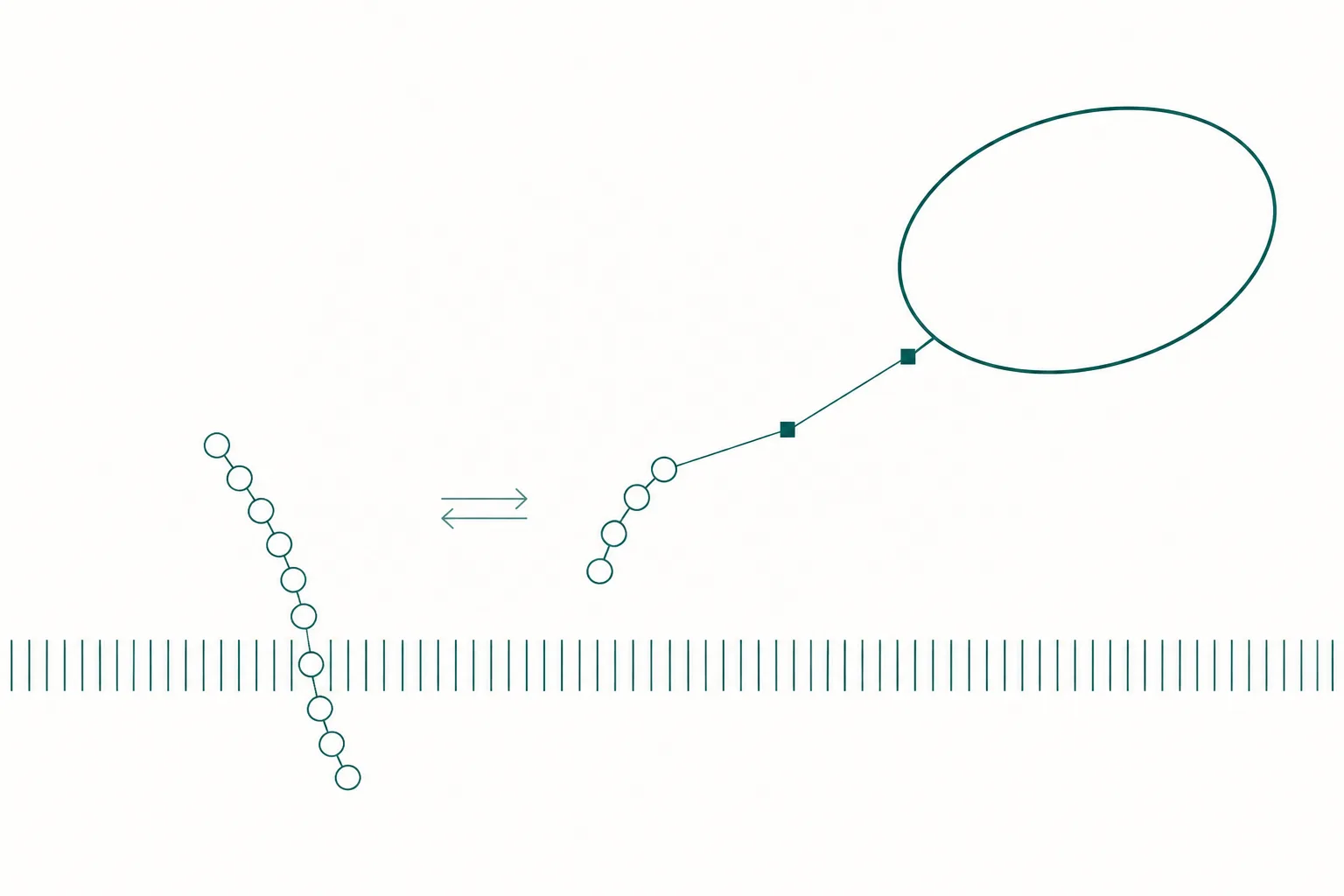
The consequence is that a peptide carrying a fatty acid is not a free peptide with a lipid stuck to it. It is a molecule that spends the overwhelming majority of its time associated with albumin. Reported plasma protein binding for semaglutide exceeds 99 percent, meaning the unbound fraction available for glomerular filtration at any instant is below one percent. Filtration still occurs, but only on that small free fraction, so the effective clearance rate falls by roughly the same factor 3.
The reversibility is the essential design constraint, and it is easy to miss. If the fatty acid bound albumin irreversibly, or if the peptide were covalently conjugated to albumin, the bound pool would never release and the molecule could not reach its receptor. What is required is an equilibrium fast enough that free peptide is continuously regenerated as it is consumed, and tight enough that the free fraction stays small. The generality of this approach was established early: attaching an albumin-binding moiety to otherwise short-lived proteins extended their circulating half-life by well over an order of magnitude in animal models, and did so independently of the protein being carried 2.
Anatomy of an Acylation: Chain, Spacer, Attachment Site
A modern acylation is a three-part construct, and each part solves a distinct problem. The first requirement is a single, unambiguous attachment point. Acylation chemistry targets the epsilon-amino group of lysine, so a sequence containing more than one lysine will give a mixture of positional isomers. The standard solution is to substitute the competing residues. In liraglutide, the native lysine at position 34 is replaced by arginine, which leaves position 26 as the only site the chemistry can reach 1.
The second part is the fatty acid itself, and chain length is the principal dial. Longer chains bind albumin more tightly and extend half-life further, but they also increase hydrophobicity, which degrades solubility and promotes aggregation. Beyond a certain length the molecule becomes difficult to formulate at all. A refinement that proved decisive was moving from a monoacid to a diacid, in which the distal end of the chain carries a second carboxylate. That terminal charge restores aqueous solubility and tunes albumin affinity downward from what a plain alkyl chain of the same length would give, which is desirable rather than a compromise: affinity that is too high slows release from the depot and reduces the free fraction below what the receptor needs.
The third part is the spacer that connects the two. A gamma-glutamate residue is close to universal here. It introduces a negative charge adjacent to the peptide surface and, more importantly, holds the fatty acid far enough from the backbone that albumin binding and receptor binding do not have to compete for the same face of the molecule. Semaglutide extends the spacer further with two 8-amino-3,6-dioxaoctanoic acid units, a short flexible ethylene-glycol-like segment that adds reach without adding hydrophobicity 3.
- Attachment site: a lysine epsilon-amine, made unique by substituting any competing lysine, usually with arginine.
- Spacer: a gamma-glutamate, frequently extended with one or two short ethylene-glycol-like units to increase reach.
- Fatty acid: a C16 to C20 chain, increasingly a diacid whose distal carboxylate restores solubility and tunes albumin affinity.
- Protease protection: a separate, independent modification, because acylation alone does not stop enzymatic cleavage at the amino terminus.
That last point is worth stating explicitly, because it is the most common misreading of this chemistry. Acylation defeats renal filtration. It does not defeat proteolysis. Semaglutide additionally carries alpha-aminoisobutyric acid at position 8, a non-proteinogenic residue that blocks dipeptidyl peptidase-4 cleavage, and that substitution is orthogonal to the fatty acid. Both changes are required. Either alone would leave one of the two clearance routes fully intact 34.
Three Analogues, Three Chain Lengths
The clearest way to see the dial in operation is to place three acylated analogues side by side. All three descend from short-lived native peptides. All three use the same architecture. They differ mainly in chain length and spacer composition, and their human pharmacokinetics track those differences closely 135.
| Analogue | Native peptide and half-life | Fatty acid | Spacer | Reported human half-life |
|---|---|---|---|---|
| Liraglutide | GLP-1, 1 to 2 minutes | C16 palmitic monoacid | Gamma-glutamate | Approximately 13 hours |
| Semaglutide | GLP-1, 1 to 2 minutes | C18 octadecanedioic diacid | Gamma-glutamate plus two ethylene-glycol-like units | Approximately 165 hours |
| Cagrilintide | Amylin, roughly 13 minutes | C20 diacid | Gamma-glutamate plus ethylene-glycol-like units | Approximately one week |
The step from liraglutide to semaglutide is the instructive one. Adding two carbons, converting the monoacid to a diacid and lengthening the spacer moved the half-life from roughly half a day to roughly a week, a change of more than an order of magnitude from what is, in structural terms, a modest edit. Cagrilintide demonstrates that the same architecture transfers to an unrelated peptide family: amylin analogues have a different receptor, a different secondary structure and a different aggregation profile, yet a C20 diacid acylation produced weekly kinetics by the same route 5.
Acylation also slows absorption from the subcutaneous depot, which contributes to the flat concentration profile independently of albumin binding. Liraglutide self-associates into heptamers at the injection site, and the resulting oligomer must dissociate before absorption can proceed. The observed half-life is therefore a composite of slow absorption and slow elimination, and the two are not always easy to separate in human data 4.
What It Costs, and How the Result Is Measured
Every half-life extension is paid for, and lipidation is no exception. The first cost is receptor potency. A fatty acid is a large hydrophobic substituent placed on a molecule whose receptor evolved to bind the unmodified sequence, and in vitro potency at the target receptor is typically reduced relative to the native peptide. Semaglutide is less potent than native GLP-1 in cell-based receptor assays, and that loss is accepted because sustained exposure more than compensates for it in vivo 3. The trade is exposure for intrinsic activity, and it only works when the exposure gain is large.
The second cost is physicochemical. Hydrophobic chains promote self-association, fibrillation and surface adsorption, which constrains formulation pH, excipient choice and container materials. The diacid design exists largely to claw back solubility lost to the chain. The third cost is pharmacokinetic inflexibility: a molecule with a week-long half-life takes four to five weeks to approach steady state and a comparable period to wash out. Any effect, wanted or unwanted, persists on that timescale. Reversibility of albumin binding does not confer reversibility of exposure.
Measurement proceeds on three levels. Albumin affinity is characterised in vitro, most often by surface plasmon resonance against immobilised albumin, yielding a dissociation constant that can be compared across chain lengths before any animal is involved. Free fraction is measured by equilibrium dialysis or ultrafiltration of plasma, which separates unbound from albumin-associated drug; this is the number that predicts filtration, and it is technically demanding at binding above 99 percent because small analytical errors dominate the result.
Total plasma concentration over time is then measured by validated liquid chromatography with tandem mass spectrometry, from which half-life, clearance and volume of distribution are derived. Preclinical pharmacokinetic screening for this class has conventionally used minipigs, whose albumin binding and subcutaneous absorption behaviour proved more predictive of human kinetics than rodent models, in which acylated analogues are cleared substantially faster 3. Species differences in albumin sequence and fatty acid binding are large enough that rodent half-life data for an acylated peptide should never be read as an estimate of the human figure.
The strategy is now mature, and its limits are visible. It works best for peptides whose receptors tolerate a bulky substituent at an accessible position, and least well for short, constrained or heavily structured peptides with no spare lysine and no tolerant surface. It cannot solve oral delivery on its own. And because the extension depends on a host protein, its performance is a property of the patient's plasma as much as of the molecule. Within those limits, one fatty acid chain remains the most efficient half-life extension available to peptide chemistry, and it is the reason essentially every weekly analogue introduced in the last decade looks the way it does 45.
References
- Potent derivatives of glucagon-like peptide-1 with pharmacokinetic properties suitable for once daily administration
- Albumin binding as a general strategy for improving the pharmacokinetics of proteins
- Discovery of the Once-Weekly Glucagon-Like Peptide-1 (GLP-1) Analogue Semaglutide
- The Discovery and Development of Liraglutide and Semaglutide
- Development of Cagrilintide, a Long-Acting Amylin Analogue