receptor pharmacology fundamentals
Orthosteric or Allosteric: Where a Peptide Ligand Binds and Why It Changes the Pharmacology
A ligand occupying the site the natural hormone uses competes with it. A ligand binding somewhere else modulates it. The two produce different ceilings, different dependence on the endogenous signal, and different failure modes.
The orthosteric site of a receptor is the site the endogenous ligand occupies. An allosteric site is any binding site on the same receptor that is topographically distinct from it. The distinction is positional, and everything pharmacologically interesting follows from it: two ligands at the orthosteric site compete for one another's place, whereas an orthosteric and an allosteric ligand can occupy the receptor simultaneously, each altering what the other does 12.
For peptide ligands the answer to where they bind is usually orthosteric, and for a structural reason worth stating early. Peptide hormones engage their receptors over a large interface, frequently involving an extracellular domain as well as the transmembrane core, and a synthetic analogue built on the natural sequence inherits that binding mode. Allosteric ligands have historically been small molecules. The exceptions are informative, and there are some.
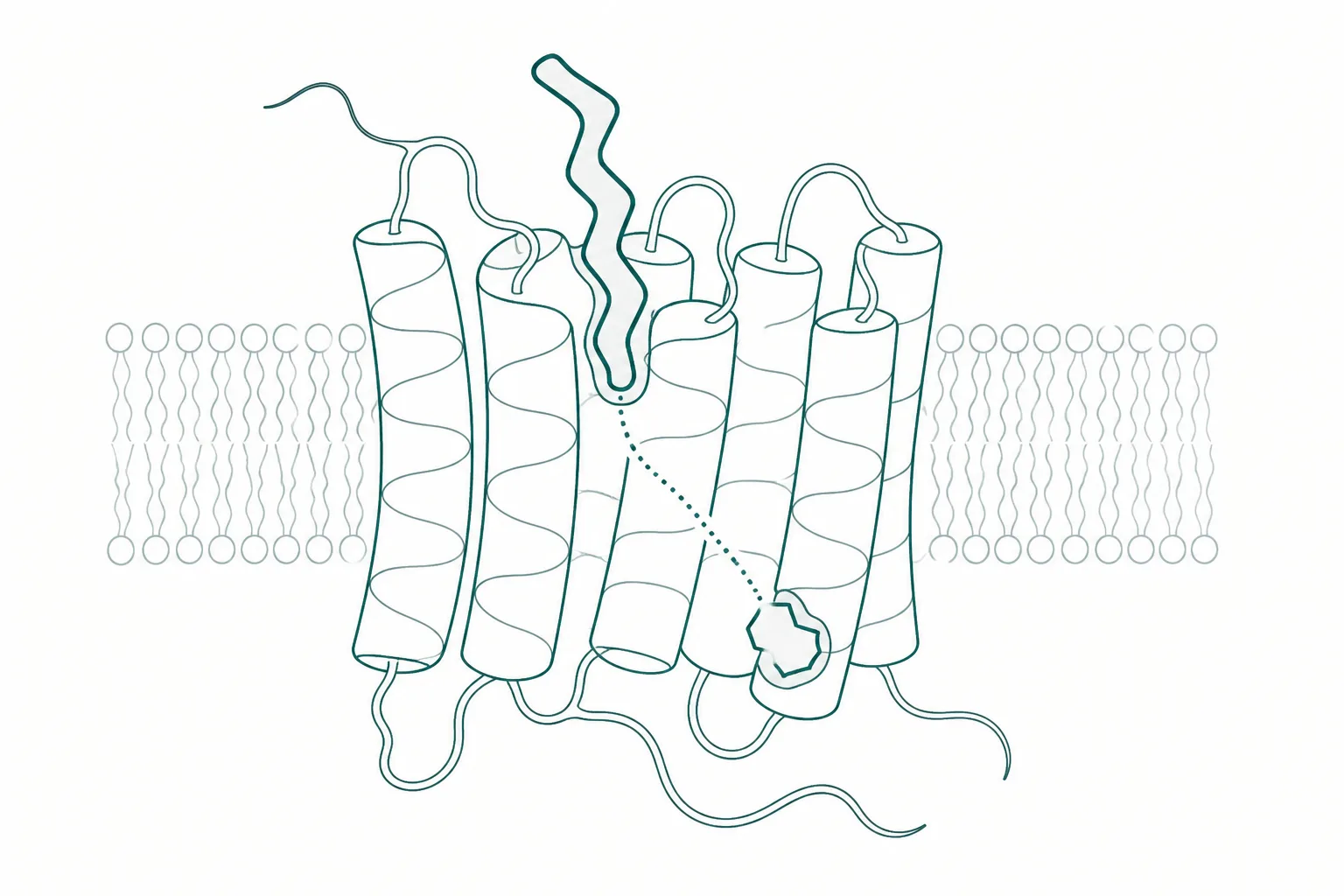
Why the geometry changes the pharmacology
Two ligands competing for the same site produce a familiar pattern. Their effects are mutually exclusive at the level of the individual receptor, and raising the concentration of one displaces the other. The interaction is described by competition, and a sufficient concentration of either can in principle exclude the other entirely.
Two ligands at different sites cannot exclude each other. Instead, binding at one site changes the conformation of the receptor and therefore the properties of the other site — its affinity for its ligand, the efficacy of the resulting complex, or both. This is cooperativity, and it can be positive or negative. The consequence is that the effect of an allosteric ligand is conditional on the presence of the orthosteric one, which is a fundamentally different kind of pharmacology from competition 1.
Receptors of this family are naturally allosteric proteins in any case, which is the conceptual foundation of the whole area. Agonist binding at one face of the receptor produces a change at a topographically distinct intracellular face where the transducer couples. The receptor's ordinary function is already a transmission of conformational information between separated sites, and an allosteric drug simply introduces a third site into that system 1.
| Orthosteric ligand | Allosteric ligand | |
|---|---|---|
| Site occupied | The endogenous ligand's site | A distinct site on the same receptor |
| Interaction with the natural ligand | Competition; mutually exclusive | Cooperativity; both can bind at once |
| Effect when the natural ligand is absent | Acts on its own as agonist or antagonist | Often none, unless it also has intrinsic agonism |
| Upper limit of effect | Set by the system's maximal response | Set additionally by saturation of the allosteric site |
| Dependence on which orthosteric ligand is present | Not applicable | Probe-dependent; varies by partner ligand |
| Typical prospects for subtype selectivity | Constrained by conserved binding sites | Often better; allosteric sites are less conserved |
The vocabulary, used precisely
The terminology was formalised because the literature had become inconsistent. A positive allosteric modulator increases the effect of the orthosteric ligand; a negative one decreases it; a neutral or silent one occupies the site without changing the orthosteric response, which is detectable only by its ability to block another modulator. A ligand that binds an allosteric site and activates the receptor by itself is an allosteric agonist, and one doing both — activating alone and enhancing the endogenous ligand — is described as an ago-allosteric modulator 2.
Two properties in that scheme are independent and commonly conflated. Affinity concerns whether the modulator binds; cooperativity concerns what its binding does to the orthosteric site. A modulator can bind tightly and exert weak cooperativity, or bind weakly and exert strong cooperativity, and a single potency figure conveys neither cleanly 2.
The ceiling, and why it is attractive
A pure allosteric modulator produces no effect of its own; it changes the response to whatever endogenous signal is present. Once every allosteric site is occupied, adding more modulator can do nothing further, because the modulator's action is entirely mediated by receptors it has already bound. The effect therefore self-limits 3.
Two properties follow that explain the interest in this class. The first is that the effect remains proportional to the endogenous signal, so a modulator amplifies physiological release patterns rather than overriding them — attractive for any axis where the natural signal is pulsatile or context-dependent. The second is subtype selectivity: allosteric sites are under less evolutionary pressure to be conserved than the site the endogenous ligand must fit, so they differ more between related receptors and offer a better prospect of discriminating between them 3.
The same properties are also the limitations. A modulator with no intrinsic activity does nothing where the endogenous ligand is absent or exhausted, and its ceiling caps the achievable effect regardless of concentration. Whether that is a safety feature or a therapeutic shortfall depends entirely on what is being attempted 3.
Peptide receptors, and where the structures put the sites
The receptor for glucagon-like peptide-1 is the best-mapped case among peptide-hormone receptors. The structure of the activated receptor coupled to its G protein showed the peptide clasped between the receptor's extracellular N-terminal domain and its transmembrane core, stabilised further by the extracellular loops — a large, distributed orthosteric interface of exactly the kind that makes peptide binding difficult to mimic with a small molecule 4.
Separate structural work on the same receptor's transmembrane domain, crystallised with two negative allosteric modulators, located a pocket outside helices V to VII near the intracellular half of the receptor. The modulators there restrict the outward movement of the intracellular end of helix VI, the motion associated with activation, and modelling and mutagenesis indicated that positive modulators target the same general region in a distinct sub-pocket 5. The allosteric site is thus at the opposite end of the receptor from the peptide-binding interface, which is why the two can be occupied at once.
Functional evidence preceded the structures. A series of small molecules at this receptor was reported to act both as allosteric activators and as independent agonists, and notably to increase the receptor's affinity for the natural peptide without changing its potency — the signature of a cooperative interaction rather than simple competition 6. The structural work subsequently supplied a location for the site that the functional data had implied.
A peptide that binds allosterically
The clearest counterexample to the rule that peptides are orthosteric comes from the calcium-sensing receptor. A synthetic peptide containing D-amino acids was characterised as an agonist of that receptor acting by a mechanism distinct from the established small-molecule modulator, and able to activate it both in the presence and in the absence of physiological extracellular calcium — the receptor's natural orthosteric ligand 7.
The mechanism turned out to be unusual even for an allosteric agent. Activity depends on formation of a disulfide bond between a cysteine in the peptide and a specific cysteine residue on the receptor: replacing that receptor residue abolishes activity, and introducing it into a species variant that naturally lacks it confers activity. The extent of disulfide bond formation, measured directly, tracks the extent of receptor activation 8. The peptide does not merely occupy an allosteric site; it tethers itself to one covalently.
Two points generalise from this case. First, the orthosteric–allosteric distinction is about position rather than about chemical class, and nothing prevents a peptide from occupying a non-endogenous site. Second, this mechanism was established by identifying the residues involved and manipulating them, which is the standard of evidence the word allosteric properly requires 8.
It also illustrates why allosteric agents are harder to find than orthosteric ones. A screen for an orthosteric ligand looks for displacement of a labelled reference ligand, which is a single unambiguous readout. A modulator producing no effect on its own displaces nothing, so it is invisible to that design and must be sought in an assay run in the presence of an orthosteric partner, where the quantity being measured is a change in another ligand's response. Because cooperativity is a property of the pair, the partner chosen for the screen determines which modulators are found, and a compound optimised against one partner may underperform against the endogenous hormone it will eventually have to work alongside 3.
What an allosteric claim requires
- Evidence that the site is distinct from the orthosteric one — typically mutagenesis, a structure, or a binding interaction that cannot be explained by competition.
- The direction and magnitude of cooperativity with a named orthosteric partner, rather than a single potency figure.
- A demonstration of the ceiling: evidence that the effect saturates as the modulator's own sites fill.
- A statement of probe dependence, since the result may not transfer to a different orthosteric ligand.
- Separation of modulation from intrinsic agonism, because a compound doing both requires both to be quantified.
The word is frequently used more loosely than that, applied to any interaction that is not straightforwardly competitive. That usage is unhelpful, because the pharmacological consequences described above — conditional effect, self-limiting ceiling, probe dependence, better subtype prospects — all follow specifically from the site being distinct, and none of them can be assumed from an unexplained non-competitive observation 2.
Why the distinction is worth holding
Knowing where a ligand binds predicts how it will behave in circumstances the original experiment did not test. An orthosteric agonist will compete with the endogenous hormone and can drive the system regardless of the hormone's level. An allosteric modulator will track the endogenous signal and stop when its own sites are full. The two produce different responses to a rising natural signal, and different responses to its absence 13.
For the peptide field the practical summary is short. Almost all peptide agonists in research supply are orthosteric analogues of natural ligands, and their pharmacology is competitive. Allosteric agents at peptide-hormone receptors are mostly small molecules, structurally mapped for a few receptors and inferred for others. The peptide exceptions are rare, well characterised where they exist, and worth knowing about precisely because they show that the categories are defined by position rather than by molecular class 7.
References
- G protein-coupled receptor allosterism and complexing
- International Union of Basic and Clinical Pharmacology. XC. Multisite pharmacology: recommendations for the nomenclature of receptor allosterism and allosteric ligands
- Emerging paradigms in GPCR allostery: implications for drug discovery
- Cryo-EM structure of the activated GLP-1 receptor in complex with a G protein
- Human GLP-1 receptor transmembrane domain structure in complex with allosteric modulators
- Small-molecule agonists for the glucagon-like peptide 1 receptor
- Pharmacology of AMG 416 (Velcalcetide), a novel peptide agonist of the calcium-sensing receptor, for the treatment of secondary hyperparathyroidism in hemodialysis patients
- Critical Cysteine Residues in Both the Calcium-Sensing Receptor and the Allosteric Activator AMG 416 Underlie the Mechanism of Action