mechanisms
TB-500 and Thymosin β4: The Mechanism, and Why the Two Are Not Interchangeable
Thymosin β4 is a 43-residue actin-sequestering peptide with a well-characterised cellular function. TB-500 is a shorter synthetic construct sold under its name. Conflating them distorts most of what is written about both.
TB-500 is a synthetic peptide sold as a research form of thymosin β4, a 43-amino-acid peptide present in almost all mammalian cells and in most body fluids. Thymosin β4's established molecular function is actin sequestration: it binds monomeric actin one-to-one and holds it in a soluble reserve that the cell draws on when it needs to build new filaments 1. Nearly every downstream effect reported for the peptide — directed cell migration, new vessel formation, faster wound closure — is proposed to follow from that single biochemical activity. The evidence for the function itself is strong and long-established. The evidence that administering the peptide accelerates tissue repair in humans is not. Those are two different claims, and most secondary writing merges them.
The molecule, and what the name refers to
Thymosin β4 was originally isolated from thymus tissue, which is the source of the name. The name has since become a misnomer. The peptide is not thymus-specific and is not a thymic hormone; it is found across tissue types and is one of the more abundant peptides in the cytoplasm of many cell types 1. It is unstructured in free solution and adopts a defined conformation only on binding its partner, which is typical of small regulatory peptides of this class.
"TB-500" is a different kind of designation. It is a commercial label rather than a sequence identifier, and it carries no standardised definition in the chemical literature. Material supplied under the name is generally described as a synthetic construct built around the peptide's active region rather than the complete 43-residue chain. This matters directly for reading the research: a paper reporting an effect of thymosin β4 has tested a defined, full-length molecule, and whether that result transfers to a shorter construct is an open question rather than an assumption.
Actin sequestration: the established function
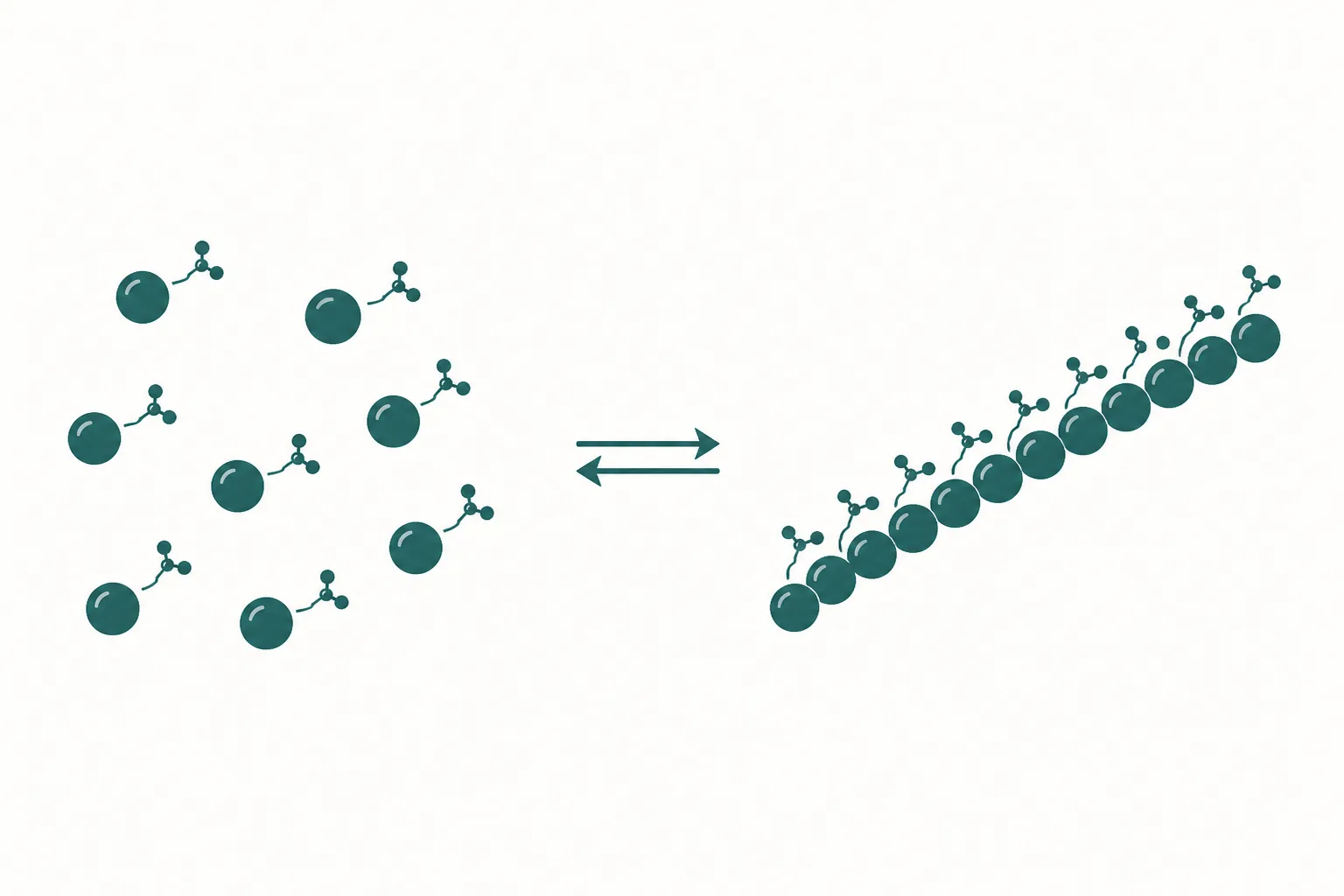
Actin exists in two interconverting forms. G-actin is the free monomer. F-actin is the polymerised filament that gives a cell its shape and generates the force for movement. A cell that needs to move, divide or close a wound must rapidly convert one to the other, and it therefore needs a large monomer reserve that will not spontaneously polymerise. Thymosin β4 maintains that reserve. It binds G-actin in a one-to-one complex and prevents its addition to a growing filament end 1.
This is a buffering role rather than a signalling one, and it has a specific consequence worth stating precisely: thymosin β4 does not drive polymerisation. It restrains it, and in doing so keeps polymerisation-competent material available. When local signalling calls for filament assembly, the sequestered pool is what supplies it. The peptide's abundance is what allows this to work — a low-abundance regulator could not buffer a pool of that size.
Why a buffering function produces motility effects
Directed cell migration depends on assembling filaments at the leading edge faster than they disassemble elsewhere. A larger available monomer pool raises the ceiling on how fast that can happen. This is the proposed link between an unglamorous biochemical function and the migration effects reported in culture: thymosin β4 was shown to stimulate directional migration of human umbilical vein endothelial cells, a standard in vitro assay for angiogenic potential 2. Endothelial migration is the first step in forming a new capillary, which is why the same peptide appears in the angiogenesis literature and the wound-healing literature simultaneously.
The LKKTETQ motif
The actin-binding activity does not require the whole 43-residue chain. It localises largely to a short internal sequence, LKKTETQ, at approximately residues 17 to 23. This motif is the reason shortened constructs exist at all: a seven-residue functional core is far cheaper to synthesise than a 43-residue peptide, and it retains the interaction that defines the parent molecule's principal function.
The important qualification is that thymosin β4's reported activities do not all map to the same region. Work dissecting the peptide into short sequences found that distinct biological activities localise to distinct sites, with anti-inflammatory effects separable from the actin-binding function 4. A construct built around LKKTETQ would therefore be expected to reproduce the actin-related activity and not necessarily the rest. Treating a fragment as equivalent to the parent across all reported effects is not supported by that work — it is contradicted by it.
| Reported activity | Principal evidence base | Maps to LKKTETQ? |
|---|---|---|
| G-actin sequestration | Biochemical, well established | Yes |
| Endothelial cell migration | In vitro, human cell lines | Partly |
| Angiogenesis | Rodent models, in vitro | Partly |
| Integrin-linked kinase activation | Mouse cardiac injury | Not established |
| Anti-inflammatory effects | Rodent, in vitro; separable sites | No |
| Antifibrotic effects | Rodent models | No — attributed to a different fragment |
The integrin-linked kinase result
The most cited single finding on this peptide is a 2004 report in Nature that thymosin β4 activates integrin-linked kinase, promotes cardiomyocyte migration and survival, and improves cardiac function in a mouse model of coronary artery ligation 3. The proposed route runs through integrin-linked kinase to Akt phosphorylation — a survival pathway — rather than through actin binding directly.
This finding is worth separating from the actin work for two reasons. First, it is a signalling claim, not a structural one, and it implies the peptide does something beyond buffering a monomer pool. Second, it is the result most responsible for the peptide's profile outside cell biology, and it is a single-model result: an induced infarct in a mouse heart. Cardiac repair in mice has a long history of not transferring to human clinical endpoints, and this result should be weighted accordingly.
Ac-SDKP and the antifibrotic arm
A separate line of work concerns Ac-SDKP, a four-residue peptide derived from the N-terminus of thymosin β4 by enzymatic cleavage. Ac-SDKP has its own literature, largely concerning antifibrotic and anti-inflammatory activity, and it is a distinct molecule with distinct pharmacology. Reviews of the animal work treat the parent peptide as multifunctional in part because its cleavage products are themselves active 5.
The practical consequence is that some effects attributed to thymosin β4 in vivo may be effects of a fragment released after administration. A synthetic construct that does not contain the N-terminal region cannot generate Ac-SDKP, and would not be expected to produce those effects at all.
What the evidence does not establish
The actin biology is settled. The therapeutic claims are not, and the gap between the two is wide. Reviews of the animal literature describe consistent effects across dermal, corneal and cardiac injury models in rodents 5. Consistency across models in one species is meaningful evidence. It is not evidence of a human effect.
- Controlled human trials of TB-500 as such do not exist in the published literature. The compound has not been through clinical development under that designation.
- Full-length thymosin β4 has been taken into human trials, but for ophthalmic surface indications — a delivery route and tissue context with little bearing on systemic musculoskeletal claims.
- The material sold as TB-500 is not sequence-standardised, so results obtained with one supplier's product do not necessarily describe another's.
- Angiogenic activity is not unconditionally desirable. A peptide that promotes vessel formation acts on a process that is also central to tumour growth, and long-term safety data addressing that does not exist.
- No human pharmacokinetic profile is published. Half-life, distribution and clearance in humans are unknown.
How to read this literature
Three checks resolve most confusion in this field. First, establish which molecule was tested — full-length thymosin β4, a defined fragment, or Ac-SDKP — because the three are not interchangeable and papers are usually explicit where summaries are not. Second, establish the model system, and treat rodent injury data as hypothesis-generating rather than confirmatory. Third, note that the actin-sequestering function and the tissue-repair claims rest on different bodies of evidence of very different maturity, and that a citation supporting the first does not support the second.
Thymosin β4 is a genuinely important molecule in cell biology, and the interest in it as a repair agent is not baseless. But the strength of the underlying cell biology is frequently borrowed to imply strength in the clinical claims, where almost nothing has been demonstrated in humans. That borrowing is the central error in how this compound is described.
References
- Thymosin beta4: actin-sequestering protein moonlights to repair injured tissues
- Thymosin beta4 stimulates directional migration of human umbilical vein endothelial cells
- Thymosin beta4 activates integrin-linked kinase and promotes cardiac cell migration, survival and cardiac repair
- Biological activities of thymosin beta4 defined by active sites in short peptide sequences
- Animal studies with thymosin beta4, a multifunctional tissue repair and regeneration peptide