Glp 1 outside metabolic disease
SURPASS-CVOT: Why Non-Inferiority Is Not Superiority
A hazard ratio of 0.92 with a confidence interval from 0.83 to 1.01 met one prespecified test and failed another. The trial is this site's worked example of how outcome trials are built and read.
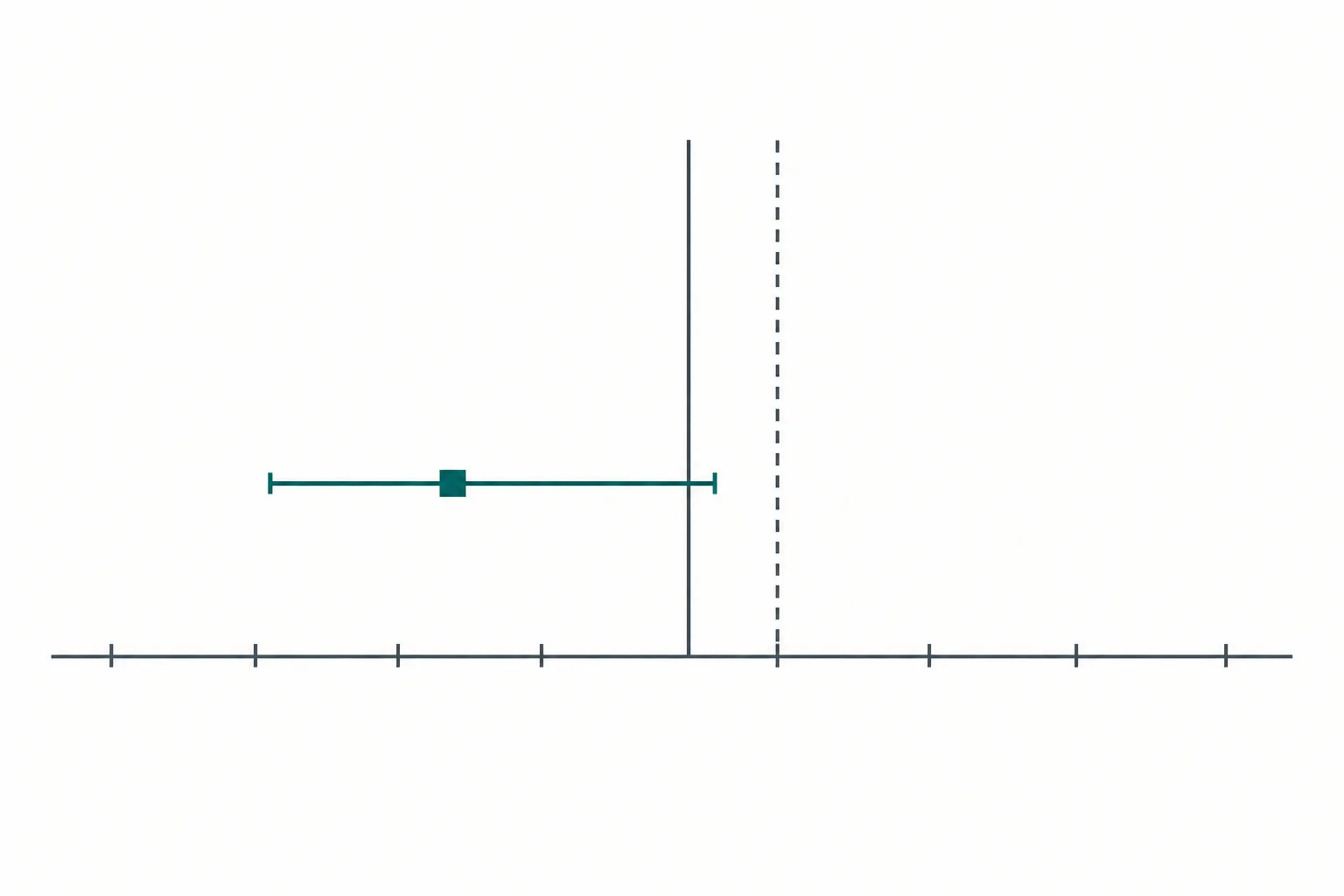
SURPASS-CVOT established that tirzepatide was non-inferior to dulaglutide on the composite of cardiovascular death, myocardial infarction and stroke in adults with type 2 diabetes and atherosclerotic cardiovascular disease: the hazard ratio was 0.92 with a 95.3% confidence interval of 0.83 to 1.01, the upper limit fell below the prespecified non-inferiority margin of 1.05, and the test for non-inferiority gave P = 0.003 1. It did not establish superiority, because the same upper limit did not fall below 1.00; the superiority test gave P = 0.09. Headlines that read 'confirms protection' and 'fails superiority' describe the same interval. Each is correct about one test and silent about the other.
This site covers tirzepatide's receptor pharmacology separately. Here the compound is the vehicle and the statistics are the subject: how a non-inferiority margin is set, why a 95.3% confidence interval rather than 95%, what a testing hierarchy does when one step fails, and why the mortality figure that followed is a hypothesis rather than a result. Each section states its evidence tier.
Why cardiovascular outcomes trials exist and what regulators required
Evidence tier: regulatory history. Cardiovascular outcomes trials in type 2 diabetes are a product of a December 2008 FDA guidance which asked sponsors to demonstrate that new glucose-lowering drugs did not produce an unacceptable increase in cardiovascular risk. Many such trials followed. In a March 2020 draft guidance withdrawing the 2008 document, the agency recorded that none of them had identified an increased risk of ischaemic events, that some had instead shown a reduced risk, and that it was moving to a broader safety-evaluation approach rather than a uniform cardiovascular requirement 5.
That history explains two features of SURPASS-CVOT. The trial was registered in February 2020 and began in May 2020, under the expectation of the old guidance that a new diabetes drug would carry an outcome trial 2. And because a placebo-controlled design would have withheld a drug class already shown to reduce events from people with established disease, the sponsor chose an active comparator from that class. Dulaglutide had reduced the same three-point composite against placebo in REWIND, with a hazard ratio of 0.88 (95% CI 0.79 to 0.99) over a median of 5.4 years in 9,901 participants 3. SURPASS-CVOT therefore asked whether tirzepatide was at least as good as a drug that already works.
Trial design: population, active comparator, follow-up
Evidence tier: human randomised trial, phase 3. SURPASS-CVOT was an active-comparator-controlled, double-blind, non-inferiority trial. Adults with type 2 diabetes and established atherosclerotic cardiovascular disease were randomised 1:1 to once-weekly subcutaneous tirzepatide, escalated to the highest tolerated of its maintenance steps, or to once-weekly dulaglutide at the dose used in REWIND 12. Randomisation ran from May 2020; the primary completion date was June 2025, and the registration specifies follow-up to week 259 2. Reports of the published paper give the median follow-up as about four years 6.
13,299 patients were randomised; 134 were later excluded for not meeting inclusion criteria, leaving a modified intention-to-treat population of 6,586 on tirzepatide and 6,579 on dulaglutide. Mean age was 64.1 years, 29.0% were women, mean body-mass index was 32.6, mean glycated haemoglobin was 8.4% and mean diabetes duration was 14.7 years 1. This is a population with long-standing diabetes and prior cardiovascular disease, which is what gives an event-driven trial enough events to reach a conclusion.
Three-point MACE: the composite and its components
The primary endpoint was the time to first occurrence of death from cardiovascular causes, myocardial infarction or stroke, adjudicated by a clinical endpoint committee 12. A composite exists to accumulate events. No single component occurs often enough, even in 13,000 high-risk people over four years, to power a trial on its own. The cost is that the composite weights each component equally. A non-fatal myocardial infarction counts as one event; so does a cardiovascular death. The hazard ratio describes the composite, not any component, and components are reported descriptively.
In SURPASS-CVOT a primary endpoint event occurred in 801 of 6,586 patients (12.2%) on tirzepatide and 862 of 6,579 (13.1%) on dulaglutide 1. Those are the numbers from which everything else follows: 61 fewer first events in the tirzepatide arm, in a trial where the comparator was itself an event-reducing drug.
Non-inferiority margins: what was prespecified and what was met
A non-inferiority trial does not ask whether the new drug is better. It asks whether the new drug is not unacceptably worse, and the trial has to say in advance how much worse would be unacceptable. SURPASS-CVOT set that margin at 1.05 for the upper limit of the 95.3% confidence interval of the hazard ratio 1. A confidence level of 95.3% rather than 95% is the conventional sign that part of the type-1 error was spent at an interim analysis, leaving slightly less for the final test. A margin of 1.05 is tight: it allows the new drug to be at most 5% worse than a comparator that had itself cut events by 12% against placebo 3.
The observed interval was 0.83 to 1.01. Its upper limit sits below 1.05, so non-inferiority was met, and the test returned P = 0.003 1. That P value is the probability of an interval this favourable if tirzepatide were truly 5% worse than dulaglutide; it is small, so that possibility is rejected. Note what the test does not say. It does not say tirzepatide is better; it says tirzepatide is not more than 5% worse. The margin, not the null line, is the reference.
| Test | Threshold for the upper limit of the 95.3% CI | Observed upper limit | Result | P value |
|---|---|---|---|---|
| Non-inferiority | Below 1.05 | 1.01 | Met | 0.003 |
| Superiority | Below 1.00 | 1.01 | Not met | 0.09 |
Why the superiority claim failed on the same data
Superiority was prespecified as an upper limit below 1.00 1. The observed upper limit was 1.01. The point estimate of 0.92 and the 12.2% against 13.1% event rates both favour tirzepatide, and the superiority P value of 0.09 says that a difference this large or larger would arise about 9% of the time if the drugs were truly equivalent. By the trial's own prespecified standard, that is not enough. The interval includes 1.00, so a true hazard ratio of exactly 1, no difference, remains compatible with the data.
Two points about reading this. First, failing superiority is not evidence of equivalence; the interval also includes 0.83, a 17% reduction. The data are consistent with tirzepatide being meaningfully better and with it being no different. Second, the result cannot be converted into a placebo comparison by multiplying hazard ratios. Indirect comparisons of that kind appear in secondary analyses and press material, but they inherit the assumptions of a cross-trial comparison between REWIND and SURPASS-CVOT, two trials in different populations a decade apart 37. The randomised evidence in SURPASS-CVOT is about tirzepatide against dulaglutide and nothing else.
Multiplicity control and the status of mortality and kidney endpoints
Evidence tier: randomised, but exploratory. Outcome trials control the overall false-positive rate by testing endpoints in a prespecified order and stopping formal inference when one fails. SURPASS-CVOT's hierarchy tested non-inferiority first, then superiority. Superiority failed. Everything downstream of it, however prespecified, is therefore exploratory in the formal sense: it was analysed and reported, but it was not tested at a controlled error rate 1.
That is the status of the mortality finding. Death from any cause was reported in 8.6% of the tirzepatide group and 10.2% of the dulaglutide group, hazard ratio 0.84 (95% CI 0.75 to 0.94); the principal investigator described the difference as driven by non-cardiovascular deaths 67. The sponsor's release states that this and the glycaemic, weight and kidney findings were not controlled for multiplicity-adjusted type-1 error 7. A reader should treat 0.84 as a hypothesis generated by the trial rather than a result established by it. The same applies to the kidney analyses, reported as a slower decline in estimated glomerular filtration rate on tirzepatide in a prespecified high-risk subgroup 7. The mortality and kidney figures in this paragraph are not in the primary report's abstract; they come from secondary reporting of the paper and should be read from the paper itself.
Gastrointestinal adverse events and discontinuation rates
The incidence of adverse events appeared similar in the two groups, with more gastrointestinal adverse events on tirzepatide 1. Reports of the paper give discontinuation for adverse events as 13.2% on tirzepatide and 10.1% on dulaglutide, described as largely driven by gastrointestinal effects 6. Mean body weight changed by −11.6% on tirzepatide and −4.5% on dulaglutide, and glycated haemoglobin by −1.66 and −0.88 percentage points 6. The tolerability difference is the price of a higher-exposure dual agonist against a fixed-dose comparator, and it is the reason the escalation in the tirzepatide arm was to the highest tolerated step rather than to a fixed one 2.
Reading this trial alongside the placebo-controlled outcome trials in the class
The class's placebo-controlled outcome trials are the context. REWIND, 9,901 participants with type 2 diabetes with or without prior cardiovascular disease, median 5.4 years: hazard ratio 0.88 (95% CI 0.79 to 0.99) for dulaglutide, with gastrointestinal adverse events in 47.4% against 34.1% on placebo 3. SELECT, 17,604 participants with overweight or obesity and established cardiovascular disease but no diabetes, mean follow-up 39.8 months: hazard ratio 0.80 (95% CI 0.72 to 0.90) for semaglutide, with 16.6% discontinuing for adverse events against 8.2% on placebo 4. Those trials establish that two GLP-1 receptor agonists reduce events against placebo in two different populations.
SURPASS-CVOT adds a different kind of fact. It shows that a dual GIP and GLP-1 receptor agonist, with larger effects on weight and glycaemia than its comparator, did not produce a detectably larger reduction in the three-point composite over four years against a GLP-1 receptor agonist that already reduces events 16. There are several readings. The event reduction in this class may be close to saturating at the exposure dulaglutide provides. The additional weight and glycaemic effects may act on events over a longer horizon than four years. Or the true difference may be real and modest, sitting inside the 0.83 to 1.01 interval. The trial does not choose among them.
What this means for a researcher reading the literature
SURPASS-CVOT is a clean illustration of a rule that applies well beyond this compound. A confidence interval is a single object; the claims drawn from it depend on which threshold it is held against, and those thresholds must be set before the data are seen. Against 1.05, the trial succeeded. Against 1.00, it did not. Against placebo, it was never tested. The mortality result that followed in the hierarchy is interesting and formally unproven 17.
For anyone reading a non-inferiority trial of any peptide, the checklist is short. Find the margin and ask whether it is justified by the comparator's own trial. Find the confidence level and ask why it is not 95%. Find the testing hierarchy and locate the point at which it stopped. Everything below that point is a hypothesis. SURPASS-CVOT reports all of these transparently, which is why it works as a worked example, and why two opposite headlines about it can both be accurate and both be incomplete.
References
- Cardiovascular Outcomes with Tirzepatide versus Dulaglutide in Type 2 Diabetes
- A Study of Tirzepatide (LY3298176) Compared With Dulaglutide on Major Cardiovascular Events in Participants With Type 2 Diabetes (NCT04255433)
- Dulaglutide and cardiovascular outcomes in type 2 diabetes (REWIND): a double-blind, randomised placebo-controlled trial
- Semaglutide and Cardiovascular Outcomes in Obesity without Diabetes
- Type 2 Diabetes Mellitus: Evaluating the Safety of New Drugs for Improving Glycemic Control (draft guidance for industry)
- SURPASS-CVOT Published: Large Trial Confirms CVD Efficacy of Tirzepatide
- SURPASS-CVOT: Tirzepatide Bests Dulaglutide for Cardiovascular Protection