Glp 1 outside metabolic disease
GLP-1 Agonists Outside Metabolic Disease: The Evidence
Liver, brain, heart, kidney and drinking behaviour have all been tested against GLP-1 receptor agonists in randomised trials. The results are not uniform, and the pattern they form is more informative than any single readout.
Three non-metabolic uses of GLP-1 receptor agonists rest on positive randomised human trials with a prespecified primary endpoint: liver histology in metabolic dysfunction-associated steatohepatitis, major cardiovascular events in people with established atherosclerotic disease, and kidney outcomes in diabetic kidney disease. Two further uses, Parkinson's disease and Alzheimer's disease, have been tested at phase 3 and returned null results. Alcohol use disorder has a single 48-participant phase 2 trial with a laboratory endpoint. The pattern of positive and null results tracks two variables: whether the tissue in question expresses the GLP-1 receptor, and whether the endpoint sits downstream of body weight and glycaemia 12.
This site covers receptor signalling separately. This article takes it as given and asks what happened when it was tested against organs other than the pancreas, organised by tier of evidence rather than by compound. Each section states its tier; companion articles carry the detail.
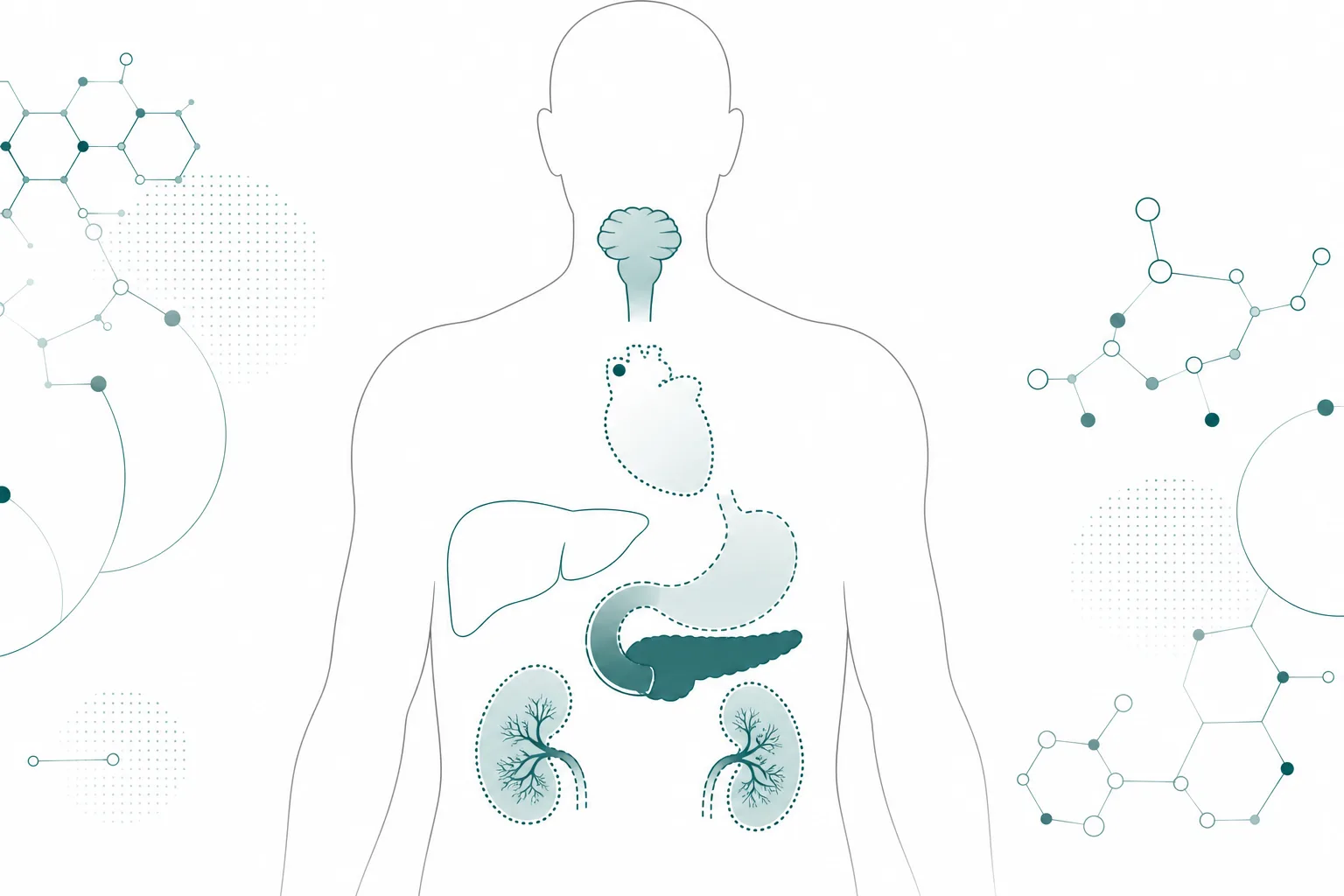
Where GLP-1 receptors are expressed outside the pancreas
Evidence tier: human and monkey tissue immunohistochemistry with ligand-binding confirmation; not clinical evidence. The most carefully validated map comes from a 2014 study using a monoclonal antibody checked against in situ binding of radiolabelled GLP-1 2. In the pancreas the receptor was concentrated in beta cells, with weaker expression in acinar cells and none in ductal epithelium. In kidney and lung it was confined to smooth muscle in the walls of arteries and arterioles. In the heart it was found in the myocytes of the sinoatrial node, consistent with the modest rise in heart rate the class produces. In the gut the highest expression was in the Brunner's glands of the duodenum, with lower expression in gastric parietal cells, gastric smooth muscle and myenteric plexus neurons throughout the tract 2.
Two absences matter. No receptor was detected in primate liver, and none in thyroid 2. Any histological change in steatohepatitis must therefore arise indirectly, through weight, insulin sensitivity, lipid flux or inflammation, not through receptor signalling in hepatocytes. The brain does express the receptor 1, which is why neurological indications were plausible enough to test. Expression says nothing about whether a peripherally administered molecule reaches those regions at a concentration that matters.
Three evidence tiers, and why they are not interchangeable
Every claim here sits in one of three tiers: the randomised controlled trial with a prespecified primary endpoint and blinded assessment; observational work, meaning retrospective cohorts, registers and post hoc analyses of trials designed for other questions; and preclinical work in rodents and in vitro.
Observational data in this class carry a specific hazard. Who receives a GLP-1 receptor agonist is not random: prescribing tracks obesity, diabetes duration and engagement with care, each of which also predicts the outcomes under study. A cohort in which treated patients fare better on dementia or alcohol endpoints is compatible with a drug effect and equally with selection. The evoke programme was launched on exactly such signals, and the randomised result did not confirm them 6.
Preclinical work has a different weakness. Rodent models of Parkinson's and Alzheimer's disease reproduce a lesion, not the disease, at exposures that may not correspond to anything achievable in humans. The LixiPark and Exenatide-PD3 investigators both cite animal neuroprotection as their starting point 45; the two trials then diverged in opposite directions.
| Indication | Highest evidence tier | Result | Molecule |
|---|---|---|---|
| Steatohepatitis with fibrosis stage 2 to 3 | Phase 3 RCT, histological co-primary endpoints | Both endpoints met at 72 weeks; clinical outcomes pending | Semaglutide |
| Major cardiovascular events, obesity without diabetes | Event-driven RCT versus placebo | Hazard ratio 0.80 | Semaglutide |
| Major cardiovascular events, type 2 diabetes with atherosclerotic disease | Event-driven RCT versus active comparator | Non-inferior; superiority not shown | Tirzepatide versus dulaglutide |
| Kidney outcomes, diabetic kidney disease | Event-driven RCT versus placebo | Hazard ratio 0.76 | Semaglutide |
| Heart failure with preserved ejection fraction | RCT, symptom-score primary endpoint | 7.8-point difference on KCCQ clinical summary score | Semaglutide |
| Heart failure with reduced ejection fraction | RCTs | No benefit; trend to more hospitalisations | Liraglutide |
| Obstructive sleep apnoea with obesity | RCT, apnoea-hypopnoea index | 20 to 23.8 fewer events per hour | Tirzepatide |
| Early Parkinson's disease | Phase 2 RCT; phase 3 RCT | Phase 2 positive at 12 months; phase 3 null at 96 weeks | Lixisenatide; exenatide |
| Early Alzheimer's disease | Two phase 3 RCTs | Null on CDR-SB at 104 weeks | Oral semaglutide |
| Alcohol use disorder | Phase 2 RCT, laboratory endpoint | Less self-administration; calendar-day drinking unchanged | Semaglutide |
| Hypertension | Post hoc trial substudy | Lower ambulatory blood pressure; no outcome trial | Tirzepatide |
Liver: the one indication with phase 3 histological endpoints
Evidence tier: human randomised trial, surrogate histological endpoint. ESSENCE randomised 1,197 adults with biopsy-defined steatohepatitis and fibrosis stage 2 or 3 in a 2:1 ratio to once-weekly semaglutide or placebo for 240 weeks. A planned 72-week interim analysis in the first 800 participants is part 1 3. The two primary endpoints were resolution of steatohepatitis without worsening of fibrosis, and improvement in fibrosis by at least one stage without worsening of steatohepatitis.
Both were met. Resolution without fibrosis worsening occurred in 62.9% of 534 participants on semaglutide and 34.3% of 266 on placebo, an estimated difference of 28.7 percentage points (95% CI 21.1 to 36.2). Fibrosis improvement without steatohepatitis worsening occurred in 36.8% against 22.4%, a difference of 14.4 points (95% CI 7.5 to 21.3). Mean body weight changed by −10.5% on semaglutide and −2.0% on placebo. Gastrointestinal adverse events were more frequent on semaglutide 3.
Two qualifications. Hepatocytes do not express the receptor 2, so the effect is indirect. And a one-stage fibrosis change is not fibrosis reversal; histology at 72 weeks is a surrogate. Whether it translates into fewer cases of cirrhosis, decompensation, transplant or liver-related death is the question part 2 was designed to answer, and part 2 has not reported 3.
Neurodegeneration: one positive phase 2, two null phase 3 programmes
Evidence tier: human randomised trials. Parkinson's disease has two results pointing in opposite directions. LixiPark randomised 156 people diagnosed within three years, on stable symptomatic treatment and without motor complications, to daily subcutaneous lixisenatide or placebo for 12 months. The primary endpoint, change in MDS-UPDRS part III on medication, moved by −0.04 points on lixisenatide and +3.04 on placebo, a difference of 3.08 points (95% CI 0.86 to 5.30; P = 0.007) 4.
Exenatide-PD3 randomised 194 people at six UK centres to once-weekly extended-release exenatide or placebo for 96 weeks, with the primary endpoint measured off medication. Scores worsened by 5.7 points on exenatide and 4.5 on placebo; the adjusted coefficient for exenatide was 0.92 points in the unfavourable direction (95% CI −1.56 to 3.39; p = 0.47). Serious adverse events occurred in 9% and 11% respectively 5. In June 2026 the journal attached an expression of concern to the report pending an institutional investigation at one site; the companion article covers it.
Alzheimer's disease has a cleaner answer. evoke and evoke+ randomised 3,808 people with amyloid-confirmed mild cognitive impairment or mild dementia to once-daily oral semaglutide or placebo. At week 104 the estimated difference on CDR-SB was −0.08 (95% CI −0.35 to 0.20; p = 0.57) in evoke and 0.10 (95% CI −0.17 to 0.38; p = 0.46) in evoke+. Treatment-emergent adverse events occurred in 91.2% on semaglutide and 84.8% on placebo 6. Two concordant trials of that size leave no room for a clinical effect of this molecule, at this exposure, in symptomatic disease. They say nothing about prevention or about molecules with greater brain penetration, where the Exenatide-PD3 authors also pointed 5.
Cardiovascular and renal outcomes: event-driven trials, not surrogates
Evidence tier: human randomised trials with adjudicated clinical events; every population was metabolic. SELECT enrolled more than 17,000 adults with overweight or obesity and established atherosclerotic disease but no diabetes, and reported a hazard ratio of 0.80 (95% CI 0.72 to 0.90) for the composite of cardiovascular death, myocardial infarction and stroke against placebo 1. FLOW, in type 2 diabetes with chronic kidney disease, reported a hazard ratio of 0.76 (95% CI 0.66 to 0.88) for a composite of kidney failure, a sustained halving of filtration rate, or kidney-related or cardiovascular death 1.
SURPASS-CVOT is the class's one large active-comparator outcome trial. It randomised 13,299 adults with type 2 diabetes and atherosclerotic disease to once-weekly tirzepatide, escalated to the highest tolerated of its maintenance steps, or to dulaglutide at the dose that had reduced events against placebo. The primary composite occurred in 12.2% against 13.1%, hazard ratio 0.92 (95.3% CI 0.83 to 1.01). Non-inferiority was met against a prespecified margin of 1.05 (P = 0.003); superiority was not (P = 0.09) 7.
Heart failure splits by phenotype. In preserved ejection fraction, semaglutide produced a 7.8-point difference (95% CI 4.8 to 10.9) on the Kansas City Cardiomyopathy Questionnaire clinical summary score, a symptom measure rather than an event count 1. In reduced ejection fraction, two liraglutide trials found no benefit, with a non-significant trend to more heart-failure hospitalisations and an arrhythmia signal in secondary analysis 1. Sinoatrial expression of the receptor 2 makes that signal coherent, and is a reason not to extrapolate between phenotypes.
Addiction and behavioural endpoints: small, mechanistic, early
Evidence tier: one human randomised trial with a laboratory endpoint. The trial randomised 48 non-treatment-seeking adults with alcohol use disorder to once-weekly semaglutide, escalated through three steps over nine weeks, or placebo. The primary outcome was alcohol self-administration in a laboratory session before and after treatment. Grams consumed fell relative to placebo (β −0.48; 95% CI −0.85 to −0.11; P = .01), as did peak breath alcohol (β −0.46; 95% CI −0.87 to −0.06; P = .03). Weekly craving and drinks per drinking day also fell. Drinks per calendar day and the number of drinking days did not 8.
The authors describe the result as initial prospective evidence justifying larger trials, resting on preclinical, observational and pharmacoepidemiological signals 8. A laboratory paradigm records what a participant does with alcohol in a controlled room on one afternoon: a mechanistic readout, not a clinical outcome, obtained in people not seeking treatment. No regulator has approved any GLP-1 receptor agonist for alcohol use disorder or any other addiction.
Indications resting on observational data alone
Evidence tier: observational. Several uses attributed to this class rest on cohorts or post hoc analyses and have never been tested in a randomised trial with a prespecified primary endpoint. Hypertension is one: the human data are a post hoc ambulatory blood-pressure substudy of an obesity trial, with no outcome trial 1. Dementia prevention is another. It derives from the same registry and pooled-trial signals that motivated evoke, and the one randomised test of the class against a cognitive endpoint, in symptomatic disease, was null 6. Prevention in cognitively unimpaired people has not been tested.
The structural problem is the same in each case. Retrospective comparisons inherit every difference in who gets prescribed what, and adjustment for recorded covariates does not remove differences in unrecorded ones. The class now includes a large, expensive demonstration that such signals can fail outright when randomised 6. That does not make every observational signal wrong. It makes each one a hypothesis.
What would have to be shown for any of these to count as established
- A randomised comparison against placebo or an active comparator, with blinded assessment.
- A single prespecified primary endpoint: a clinical event, or a surrogate a regulator has accepted, with its surrogate status stated.
- A sample sized for that endpoint, followed long enough for the disease process; 96 weeks showed little placebo progression in Parkinson's disease.
- Evidence of target engagement in the tissue of interest, so that a null result tests the hypothesis rather than the exposure.
- Replication, or two concordant trials, before a class effect is claimed; and molecule-by-molecule reporting until then.
- For surrogate-based approvals, a confirmatory outcome trial under way at the time of approval, as ESSENCE part 2 is.
What this means for a researcher reading the literature
The pattern is legible. Where the endpoint sits downstream of body weight, glycaemia and systemic inflammation, in liver histology, atherosclerotic events and kidney decline, randomised trials in metabolic populations have been positive, and the receptor's absence from hepatocytes shows that expression in the target organ is not required 23. Where the endpoint requires a direct effect in the brain, the results are mixed in Parkinson's disease and null in Alzheimer's disease, with brain exposure the unmeasured variable 456. Where the endpoint is behavioural, there is one small mechanistic trial and a stack of observational signals with a poor track record in this class 8.
The practical filter is three questions: which tier, which molecule, which endpoint. A hazard ratio, a histological score, a motor score in 156 people and an odds ratio from a prescription register are four different kinds of fact. Collapsing them into one sentence about what GLP-1 agonists do is the commonest error in this literature, and the one this cluster exists to correct.
References
- Beyond Diabetes: A Review of Emerging Indications for Glucagon-Like Peptide-1 Receptor Agonists
- GLP-1 receptor localization in monkey and human tissue: novel distribution revealed with extensively validated monoclonal antibody
- Phase 3 Trial of Semaglutide in Metabolic Dysfunction-Associated Steatohepatitis
- Trial of Lixisenatide in Early Parkinson's Disease
- Exenatide once a week versus placebo as a potential disease-modifying treatment for people with Parkinson's disease in the UK: a phase 3, multicentre, double-blind, parallel-group, randomised, placebo-controlled trial
- Efficacy and safety of oral semaglutide 14 mg (flexible dose) in early-stage symptomatic Alzheimer's disease (evoke and evoke+): two phase 3, randomised, placebo-controlled trials
- Cardiovascular Outcomes with Tirzepatide versus Dulaglutide in Type 2 Diabetes
- Once-Weekly Semaglutide in Adults With Alcohol Use Disorder: A Randomized Clinical Trial