Setmelanotide: MC4R Agonism in Monogenic Obesity
A melanocortin-4 receptor agonist licensed for a handful of named genetic conditions. The pharmacology explains why the indication is that narrow, and the trial designs explain how ten participants were enough.
Selective agonism at the melanocortin-4 receptor supplies a signal to the last step of a cascade whose earlier steps have failed, which is why setmelanotide has a licence written around named genetic defects rather than around obesity. The leptin-melanocortin pathway carries information about energy stores from adipose tissue to hypothalamic neurons that regulate food intake, and it does so through a series of discrete, individually breakable components. Setmelanotide acts at the receptor that sits below most of those components. Where the defect lies above it, the receptor is intact and unstimulated, and agonism restores the signal; where the defect lies at or below the receptor, it cannot 2.
That logic is unusually clean for a metabolic drug, and the trial programme that supported approval is unusual in a different way: the two pivotal studies were single-arm and open-label, enrolled ten and eleven participants respectively, and embedded a blinded placebo withdrawal sequence inside an otherwise uncontrolled design 3. Both the pharmacology and the methodology are worth taking slowly, because the second is a legitimate solution to a real problem and is routinely misread as a weak one.
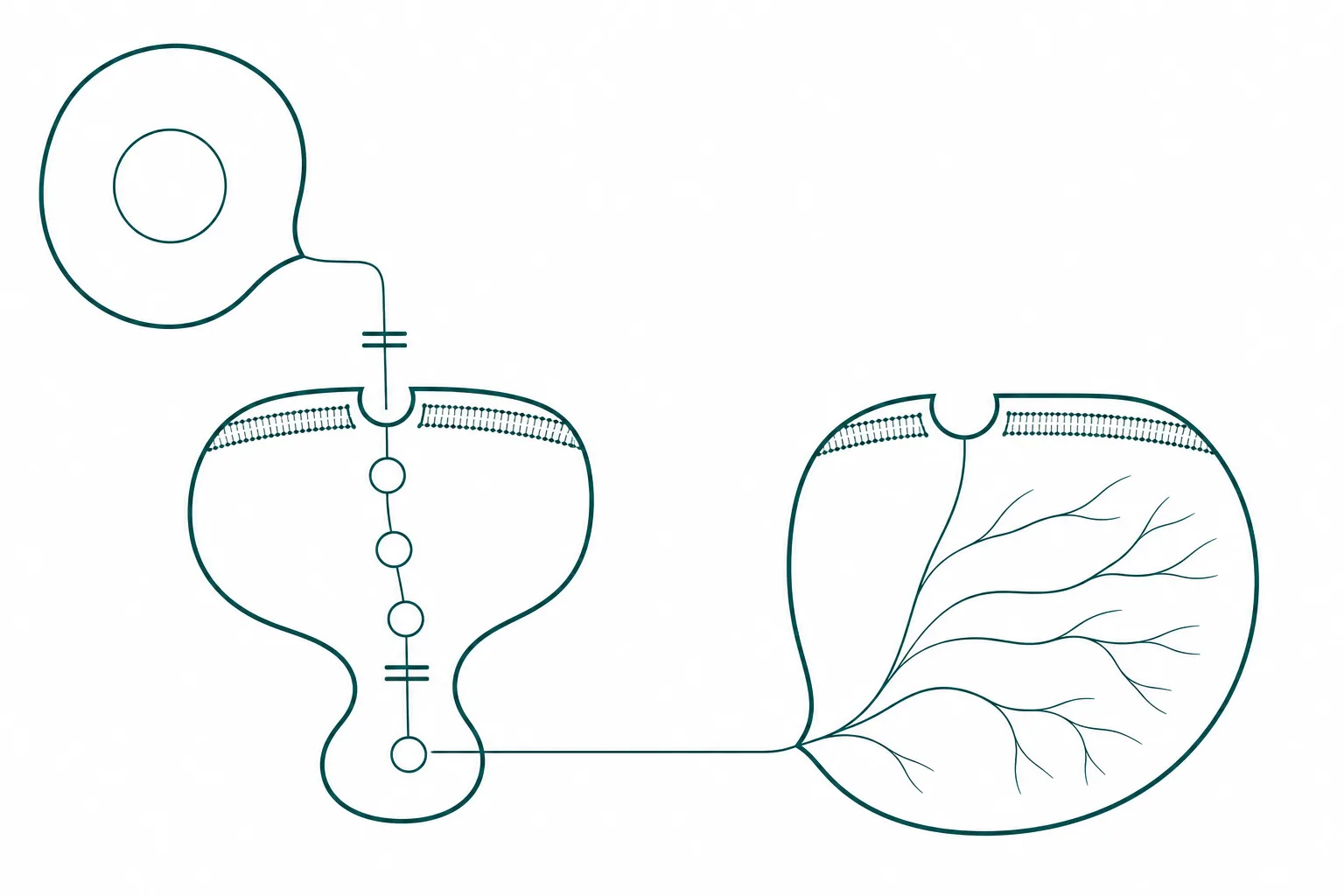
The pathway, component by component
Leptin is secreted by adipose tissue in rough proportion to fat mass and acts on the leptin receptor on pro-opiomelanocortin neurons in the arcuate nucleus of the hypothalamus. Those neurons translate the signal by processing the pro-opiomelanocortin precursor protein, which is cleaved by prohormone convertases into several active products, among them alpha-melanocyte-stimulating hormone and corticotropin. Alpha-MSH then acts on melanocortin-4 receptors on second-order neurons, and that engagement is the step associated with reduced food intake. The pathway is a relay, and a relay fails completely if any single stage fails.
Each stage is represented by a human genetic condition. Biallelic leptin receptor defects break the first step: leptin is present, often abundantly, and cannot be read. Biallelic pro-opiomelanocortin defects break the second: the receptor-bearing neurons are intact, but the ligand is never produced. Defects in the convertase PCSK1 break the processing step that generates the ligand from its precursor. Defects in MC4R itself break the receiving end. All produce severe early-onset obesity with hyperphagia, and they are not clinically interchangeable: pro-opiomelanocortin deficiency also produces hypopigmentation and hypocortisolism, because the same precursor supplies melanocyte-stimulating hormone and corticotropin, and the resulting adrenal insufficiency requires treatment with hydrocortisone from early life 1.
Potency at the receptor, and what the pigmentation reveals
In cell-based assays setmelanotide is significantly more potent at MC4R than alpha-MSH, the endogenous ligand it replaces, and it can disproportionately rescue signalling by a subset of severely impaired receptor mutants — a finding established alongside an annotation of the functional status of 369 published MC4R variants 2. Greater potency than the natural ligand is a meaningful property here rather than a marketing one: in a system where the native signal is absent, what matters is how much signalling the replacement can drive through whatever receptor is present.
The melanocortin receptor family has five subtypes, and selectivity across them is never absolute. The trials give a direct read on this: hyperpigmentation was reported in all ten participants in the pro-opiomelanocortin trial, alongside injection site reactions 3. Skin darkening is the signature of melanocortin-1 receptor engagement on melanocytes, so its occurrence in every participant indicates that the compound engages MC1R at the exposures used. It is reasonable to read the pigmentation as evidence that selectivity is relative, and worth noting the confounder in this particular population: these patients are hypopigmented at baseline because they lack melanocyte-stimulating hormone 1, so part of what is observed is restoration of a signal that was missing rather than a purely off-target effect.
The pivotal trials: single arm with a withdrawal sequence
The two phase 3 trials were single-arm, open-label and multicentre, run across ten hospitals in Canada, the United States, Belgium, France, Germany, the Netherlands and the United Kingdom, enrolling participants aged six years or older between February 2017 and September 2018. Ten participants were enrolled in the pro-opiomelanocortin trial and eleven in the leptin receptor trial. All received twelve weeks of open-label treatment. Those meeting a prespecified early weight-loss threshold then entered an eight-week placebo-controlled withdrawal sequence — four weeks of blinded active treatment and four weeks of blinded placebo — followed by a further 32 weeks of open-label treatment. The primary endpoint was the proportion of participants with at least 10% weight loss against baseline at approximately one year 3.
The withdrawal sequence is the methodological heart of the design and deserves to be named for what it is: a within-participant control embedded in an uncontrolled trial. Each participant who entered it served as their own comparator under blinding, which addresses the specific threat that an open-label single-arm result cannot otherwise address — that the change observed reflects expectation, attention or secular trend rather than the drug. It does not address everything a parallel-group trial would, because order is fixed and carry-over is possible, but it converts a before-and-after observation into something considerably stronger.
A second design concession is visible in the statistics. The key secondary hunger endpoint is reported with a 90% confidence interval rather than the conventional 95% 3. That is a deliberate widening of tolerance for uncertainty, appropriate to a sample of this size and worth noticing rather than passing over, because it means the interval quoted is not comparable to intervals from ordinary trials without adjustment.
Two genotypes, two response rates
Eight of ten participants in the pro-opiomelanocortin trial and five of eleven in the leptin receptor trial reached at least 10% weight loss at approximately one year 3. The divergence between 80% and 45% is the pharmacologically interesting result in the programme, and it is consistent with what the pathway predicts. Pro-opiomelanocortin deficiency removes the ligand immediately above the receptor; replacing it is close to a direct substitution. Leptin receptor deficiency breaks the pathway a stage earlier, and the neurons below that break are chronically deprived of input, so restoring signalling at the receptor is a less complete correction of a longer-standing disruption.
The same gradient had already appeared in earlier work. In a 28-day phase 1b study, participants with pro-opiomelanocortin defects upstream of the receptor lost significantly more weight on setmelanotide than participants with MC4R deficiency itself or than obese controls, and in rodent experiments MC4R knockout mice failed to respond at all while receptor-heterozygous mice responded less than wild type 2. Those are human and animal findings respectively, and they agree: response scales with how much intact receptor lies below the lesion.
| Defect | Position relative to MC4R | Observed response |
|---|---|---|
| Biallelic POMC deficiency | Upstream, ligand absent | 8 of 10 reached the primary endpoint at approximately one year |
| Biallelic LEPR deficiency | Further upstream, signal unread | 5 of 11 reached the primary endpoint at approximately one year |
| Heterozygous MC4R variants | At the receptor | Weight loss in a 28-day phase 1b study, less than in POMC defects |
| MC4R knockout, mouse | Receptor absent | No response (animal model) |
| Acquired hypothalamic injury | Upstream, circuit damaged | Randomised trial: BMI reduction against placebo at 52 weeks |
Hunger as an endpoint
The key secondary endpoint was the mean percentage change in the most-hunger score on an eleven-point Likert-type scale, assessed in participants aged twelve or older who had entered the withdrawal sequence. It fell by 27.1% in the pro-opiomelanocortin trial (n=7; 90% CI −40.6 to −15.0; p=0.0005) and by 43.7% in the leptin receptor trial (n=7; 90% CI −54.8 to −29.1; p<0.0001) 3.
A self-reported ordinal scale is a weaker instrument than a weight measurement, and three limitations follow from its structure. It requires a minimum age to administer, which is why these subgroups are smaller than the trials. It is subject to expectation, which is precisely what the blinded withdrawal weeks were there to test. And percentage change on an eleven-point scale is a ratio of ordinal quantities, which constrains how literally the figure can be read. Set against that, hyperphagia is the cardinal symptom of these conditions rather than an incidental one, and an endpoint that measures the symptom directly has a claim on attention that a weight endpoint does not.
The randomised trial, and the licensed indications
The programme's first conventional comparison came in acquired hypothalamic obesity — obesity following a hypothalamic tumour, lesion or injury, where the pathway is disrupted by damage rather than by inheritance. That phase 3 trial randomised participants in a 2:1 ratio to once-daily subcutaneous setmelanotide or placebo for 52 weeks after a dose-escalation period, enrolling from April 2023 to March 2025. Of 120 participants assigned, 81 received setmelanotide and 39 placebo; mean age was 19.9 ± 13.8 years with a range of 4 to 66. The least-squares mean change in body mass index at 52 weeks was −16.5% (95% CI −19.3 to −13.8) with setmelanotide against 3.3% (95% CI −0.6 to 7.2) with placebo 5.
Note what the placebo arm did: it drifted upward. That is the quantity a single-arm trial cannot observe, and it is the reason the earlier designs needed their withdrawal sequences. In a condition whose untreated course is progressive, the comparison against no treatment is not a comparison against stability.
The European public assessment report lists the authorised indications, and they are written by mechanism rather than by phenotype. The product is indicated for the treatment of obesity and the control of hunger associated with "genetically confirmed Bardet Biedl syndrome (BBS) in adults and children 2 years of age and above"; with "loss-of-function biallelic pro-opiomelanocortin (POMC), including PCSK1, deficiency or biallelic leptin receptor" deficiency in adults and children 2 years of age and above; and, with a higher age floor of 4 years, for acquired hypothalamic obesity due to hypothalamic injury or impairment. European marketing authorisation was granted on 16 July 2021 4. Indication wording and age limits are amended as new data arrive, and the entry for acquired hypothalamic obesity post-dates the original authorisation, so current wording should be read from the live assessment report rather than from any summary of it, including this one; the text above was checked against that page on 10 October 2026.
Why ten participants can suffice here and almost never does elsewhere
Four conditions have to hold together before a trial of ten people licenses an inference, and in biallelic pro-opiomelanocortin deficiency they do. The mechanism is specified in advance: the defect is identified at the gene, the drug acts at a named receptor below it, and the prediction is directional before anyone is enrolled. The expected effect is large relative to variation, so the signal does not need a large sample to clear the noise. The untreated course is known and unfavourable, which makes an external comparison interpretable. And the population is genuinely homogeneous, because it is defined genotypically rather than by a phenotype that many different causes can produce.
Remove any one of those and the inference collapses, which is why the same design would be worthless in common obesity. There the population is heterogeneous, the mechanism in any given participant is unknown, the placebo response on weight and appetite endpoints is substantial, and regression to the mean operates strongly on participants recruited at the extreme of a distribution. A single-arm result in that setting is uninterpretable no matter how many people it enrols. The methodological lesson is not that small trials are acceptable but that the acceptable ones are purchased with mechanistic specificity — and that when the sponsor moved to a population defined by acquired injury rather than genotype, the design moved with it, to randomisation and a placebo arm 5.
References
- Proopiomelanocortin Deficiency Treated with a Melanocortin-4 Receptor Agonist
- Evaluation of a melanocortin-4 receptor (MC4R) agonist (Setmelanotide) in MC4R deficiency
- Efficacy and safety of setmelanotide, an MC4R agonist, in individuals with severe obesity due to LEPR or POMC deficiency: single-arm, open-label, multicentre, phase 3 trials
- Imcivree (setmelanotide) — European public assessment report
- Setmelanotide for the Treatment of Acquired Hypothalamic Obesity