Afamelanotide: MC1R Agonism and Two Phase 3 Trials
Two amino acid substitutions turn alpha-MSH into a licensed medicine for one rare photodermatosis. The receptor mechanism is straightforward; the two pivotal trials produced numbers an order of magnitude apart.
Afamelanotide produces photoprotection indirectly: it is an agonist at the melanocortin-1 receptor on melanocytes, receptor activation shifts pigment synthesis toward eumelanin, and the eumelanin that accumulates in the epidermis attenuates light before it reaches the dermal compartment where the relevant photochemistry occurs 2. The drug itself has no optical properties of interest. It acts on the cell that makes the filter, and the filter does the work.
That mechanism was taken into two randomised, double-blind, placebo-controlled phase 3 trials in erythropoietic protoporphyria, a photodermatosis in which accumulated protoporphyrin absorbs light and produces acute phototoxicity with severe pain 3. Both trials used the same endpoint family and reached the same direction of effect. They also produced primary-endpoint medians roughly an order of magnitude apart, and reported the phototoxic-reaction outcome differently from one another. Both facts belong in any honest account of the evidence.
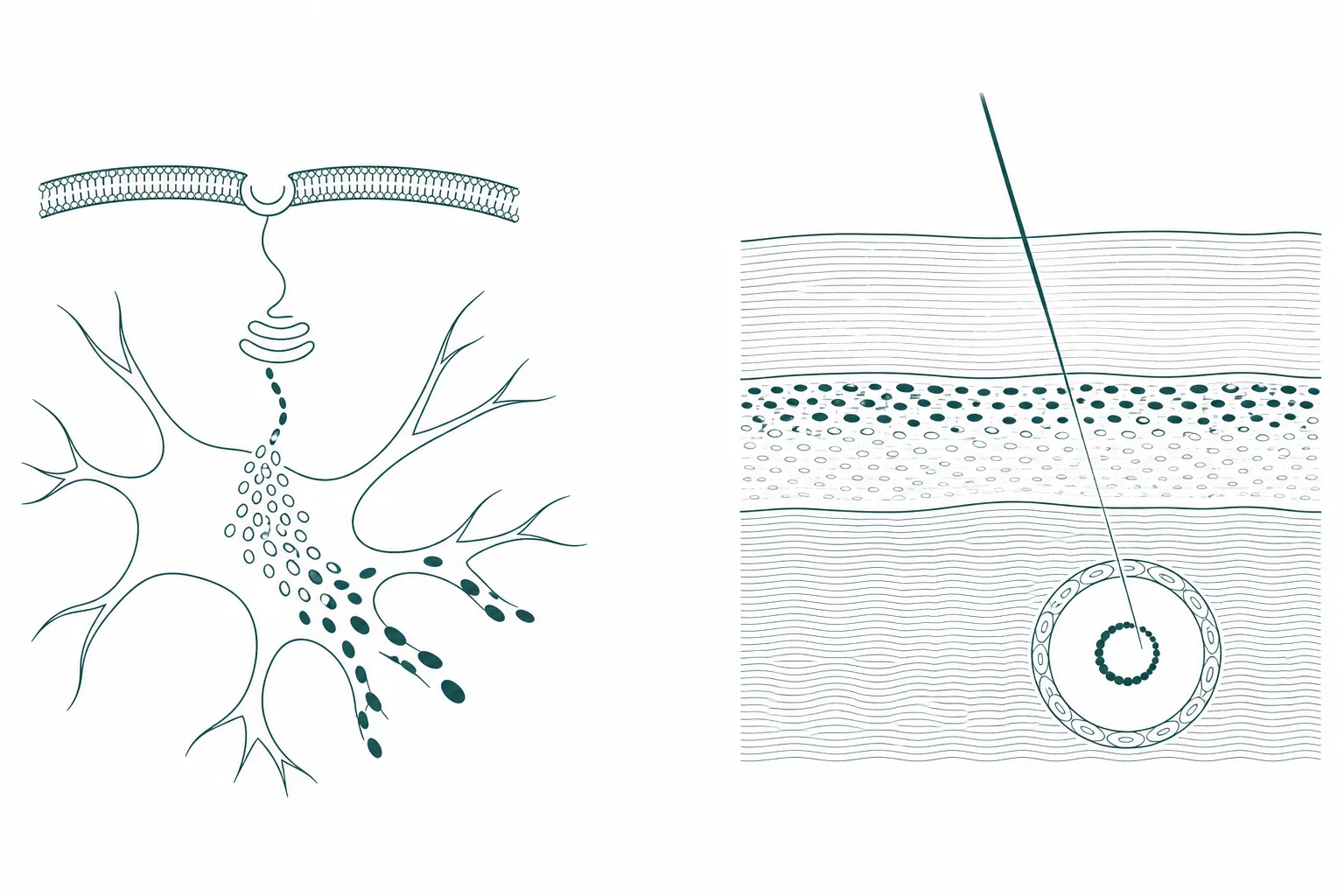
MC1R and the eumelanin switch
Melanocytes make two chemically distinct pigments. Eumelanin is the brown-black polymer that absorbs and scatters broadly across the visible and ultraviolet range; pheomelanin is the red-yellow sulfur-containing pigment, a considerably poorer absorber whose photochemistry can generate reactive species rather than quench them. Which one predominates is not fixed by the cell but regulated, and the melanocortin-1 receptor is the regulator: ligands at MC1R shift synthesis toward eumelanin and change visible pigmentation accordingly 2. The receptor is Gs-coupled, so agonism raises intracellular cyclic AMP, and the downstream consequence is increased transcription of the melanogenic enzymes and a greater proportion of eumelanin in the pigment that reaches the keratinocytes.
This is in vitro and cell-biological evidence, established in melanocyte systems rather than inferred from clinical outcome. It matters for reading the clinical literature because it specifies what the drug can and cannot be expected to do: it changes the quantity and type of pigment in the epidermis, which is an optical intervention upstream of the disease process, not an intervention in the disease process itself. The underlying enzyme defect is untouched, and so is the accumulated porphyrin.
Two substitutions, and what they buy
Afamelanotide is the analogue reported in 1980 as [Nle4, D-Phe7]-alpha-melanocyte-stimulating hormone, described at the time as a highly potent alpha-melanotropin with ultralong biological activity 1. Two positions in the native thirteen-residue hormone are altered. The methionine at position 4 is replaced by norleucine, which is close to isosteric but carries no sulfur and therefore cannot be oxidised at that position. The phenylalanine at position 7 is replaced by its D-enantiomer, inverting the stereochemistry of a single residue inside the conserved core region of the sequence.
The second substitution is the more instructive one. Proteases are stereospecific: they recognise L-amino acid backbones and cleave accordingly, so inserting a D-residue at or adjacent to a scissile bond removes the recognition without necessarily disturbing the conformation the receptor reads. The result is a molecule that engages the same receptor and survives considerably longer in vivo — which is the whole content of the phrase "ultralong biological activity" in the original report. Native alpha-MSH is cleared far too rapidly to be useful as a drug; the analogue is the same pharmacophore made durable.
Why light exposure is not required for the response
Ordinary sun-induced tanning is not a direct photochemical effect on melanocytes. Ultraviolet exposure damages keratinocyte DNA, the damage response raises pro-opiomelanocortin expression in those keratinocytes, and the alpha-MSH released acts on melanocortin-1 receptors on neighbouring melanocytes, which then increase eumelanin output. Light is the trigger for a signalling chain, and the receptor sits at the chain's far end.
An exogenous MC1R agonist enters that chain below the light-dependent step. The receptor cannot distinguish an agonist that arrived through the circulation from one released by an irradiated keratinocyte, so the pigmentary response proceeds without any ultraviolet exposure at all 2. For most purposes this is a pharmacological curiosity. In erythropoietic protoporphyria it is the entire point: these are patients for whom the light that would normally induce protective pigmentation is the exposure that causes the pain, so a protective response that can be induced in its absence is the only kind available.
Two trials, run differently
The pivotal programme consisted of two multicentre, randomised, double-blind, placebo-controlled trials of subcutaneous implants, reported together. Patients were randomised 1:1 and received an implant every 60 days. The United States trial enrolled 94 patients, delivered three implants, and ran over a 180-day period. The European Union trial enrolled 74 patients, delivered five implants, and ran over a 270-day period. The primary efficacy endpoint in both was the number of hours of direct exposure to sunlight without pain; the type and duration of sun exposure, the number and severity of phototoxic reactions and adverse events were recorded throughout, quality of life was assessed with validated questionnaires, and a subgroup of US patients underwent photoprovocation testing 3.
These are two separate trials sharing an endpoint definition, not one trial run in two places. The schedules differ, the observation periods differ, and the geography differs, which means latitude and season differ too. That design choice is defensible in a disease this rare — recruiting 168 patients with erythropoietic protoporphyria is itself an achievement — but it has a consequence for interpretation that is usually skipped over.
Where the trials agreed, and where they did not
In the US trial, median pain-free time after six months was 69.4 hours on afamelanotide against 40.8 hours on placebo (P=0.04). In the EU trial, median pain-free time after nine months was 6.0 hours against 0.8 hours (P=0.005). In the same EU trial the number of phototoxic reactions was lower on afamelanotide, 77 against 146 (P=0.04). Quality of life improved with afamelanotide in both trials, adverse events were mostly mild, and serious adverse events were not thought to be related to the study drug 3.
The direction of effect replicated. The magnitudes did not, and the gap is not subtle: a median of 69.4 hours in one trial against 6.0 hours in the other, with placebo medians of 40.8 and 0.8 hours respectively. A roughly tenfold difference in the placebo arms is the clearest evidence that the two trials were not measuring the same quantity on the same scale — the recording protocol, the length of the observation window and the available sunlight all differ. The reasonable conclusion is that the within-trial contrasts are interpretable and the between-trial comparison is not. Any secondary source that quotes one of these figures as "the" effect of the drug has discarded that distinction.
The phototoxic-reaction outcome is the second discordance. The reduction from 146 to 77 reactions is reported for the European trial; no corresponding significant reduction on that measure is reported for the United States trial 3. Reaction counts and pain-free hours are related but not equivalent endpoints — one counts adverse events, the other measures tolerated exposure — and a patient who responds to treatment by spending more time outdoors may accumulate reactions while being better off. Endpoints that move in opposite directions for the same underlying improvement are a known hazard of behaviourally mediated outcomes, and this programme illustrates it.
| United States trial | European Union trial | |
|---|---|---|
| Patients randomised | 94 | 74 |
| Implants delivered | Three, one every 60 days | Five, one every 60 days |
| Observation period | 180 days | 270 days |
| Primary endpoint | Hours of direct sunlight without pain | Hours of direct sunlight without pain |
| Median, active arm | 69.4 hours at six months | 6.0 hours at nine months |
| Median, placebo arm | 40.8 hours | 0.8 hours |
| P value, primary endpoint | 0.04 | 0.005 |
| Phototoxic reactions | No significant reduction reported | 77 against 146, P=0.04 |
The regulatory record, in two jurisdictions
The two approvals are worded differently, and the difference is substantive. The European Medicines Agency authorised the product on 22 December 2014 for the "prevention of phototoxicity in adult patients with erythropoietic protoporphyria (EPP)", and did so under exceptional circumstances — a designation applied because the applicant could not provide comprehensive efficacy and safety data under normal conditions of use, partly owing to the rarity of the disease 5. The United States approval, under NDA 210797, provides for use "to increase pain-free light exposure in adult patients with a history of phototoxic reactions from erythropoietic protoporphyria (EPP)" 4.
The European wording makes a claim about the disease process: prevention of phototoxicity. The American wording makes a claim about the trial endpoint: increased pain-free light exposure. The second is the more conservative construction, and it is the more faithful to what was actually measured, since the primary endpoint was hours of tolerated exposure rather than any index of the underlying photochemistry. It is also narrower in its population, specifying a history of phototoxic reactions rather than the diagnosis alone.
The US approval letter also records what the agency considered unresolved. The applicant was required to conduct a thorough QT study to characterise the compound's effect on cardiac repolarisation, and a prospective, longitudinal, registry-based observational exposure cohort study following patients for a minimum of eight years from the start of treatment, with skin cancer — melanomas and non-melanomas — and implant site reactions named as the primary adverse events of interest, and changes in pigmentary expression and pregnancy outcomes among the secondary ones. The application was not referred to an advisory committee, and the orphan drug designation exempted it from the paediatric assessment that would otherwise have been required 4. A compound whose mechanism is the stimulation of melanocytes, approved with an eight-year skin-cancer registry attached, is a reasonable summary of where the regulator placed the residual uncertainty.
Long-term follow-up, and the evidence it is
The longest published follow-up is observational. A study at two porphyria centres, in Rome and Zurich, reported longitudinal observations on 115 ambulatory patients treated with a total of 1,023 implants over a period of up to eight years. Uptake rose continuously from the treatment's first availability in 2006 until June 2014, by which point 66% of all patients with the condition known to those centres were being treated. Disease-specific quality-of-life scores stood at 31 ± 24% of maximum before treatment, rose to 74% after starting, and remained at that level across the observation period. Three patients considered that the treatment had not met their expectations for symptom improvement; 23% discontinued for other reasons, mostly compelling ones such as pregnancy or cost. Recorded adverse events attributable to the drug were minor, predominantly nausea 6.
This is human observational evidence and it should not be read as a trial. There is no control group, treatment was not allocated at random, and the patients who continued are by construction those who chose to. High continuation rates and sustained quality-of-life scores are consistent with benefit and are also consistent with selection; the design cannot separate the two. What the study does supply that the randomised trials cannot is duration and routine-practice conditions — eight years of exposure in unselected clinic populations, which is where rare adverse events would first become visible, and where none beyond the minor were recorded.
Where the evidence stops
The mechanism is well supported and mechanistically ordinary: a protease-resistant MC1R agonist drives eumelanin synthesis, and eumelanin attenuates light. The clinical evidence consists of two randomised trials totalling 168 patients that agree in direction and disagree substantially in magnitude, plus observational follow-up that is long but uncontrolled. Two licensing authorities read that package differently enough to write different indications, and one of them granted authorisation under exceptional circumstances on the explicit grounds that comprehensive data could not be obtained 45.
None of that is a criticism of the compound. It is what the evidence base for an ultra-rare disease looks like when it is reported accurately, and the honest reading is narrower than either enthusiasm or dismissal: a mechanism that is understood, an effect that replicated in direction across two trials, an effect size that cannot be stated as a single number, and a long-term safety question that the approving regulator considered open enough to require eight years of registry follow-up to answer 4.
References
- 4-Norleucine, 7-D-phenylalanine-alpha-melanocyte-stimulating hormone: a highly potent alpha-melanotropin with ultralong biological activity
- Regulation of eumelanin/pheomelanin synthesis and visible pigmentation in melanocytes by ligands of the melanocortin 1 receptor
- Afamelanotide for Erythropoietic Protoporphyria
- NDA 210797 approval letter, Scenesse (afamelanotide) implant
- Scenesse (afamelanotide) — European public assessment report
- Long-term observational study of afamelanotide in 115 patients with erythropoietic protoporphyria