Safety signals and pharmacovigilance
Semaglutide and NAION: What the Cohort Data Show
A disputed observational signal for optic neuropathy became a labelled very rare adverse effect. The relative risks vary several-fold between studies; the absolute excess is small and better behaved.
A signal that started as a single-centre registry comparison became a labelled adverse effect because several independent cohorts, run on different data, found an elevated risk when semaglutide was compared with an active comparator, and a regulator judged the weight of that evidence sufficient. In June 2025 the European Medicines Agency committee that reviews drug safety recommended that non-arteritic anterior ischaemic optic neuropathy (NAION) be listed as a side effect of semaglutide medicines with a frequency of very rare, meaning up to 1 in 10,000 people 7. The absolute excess in the best-designed cohorts is of the order of one to a few extra cases per 10,000 person-years 35.
The relative figures published along the way ranged from no association to a 7.6-fold hazard. This article reconciles them. Every study discussed is human observational, apart from a pooled analysis of randomised trials in the closing sections, and the evidence tier is stated again where it changes. Dated facts are given as of 10 October 2026.
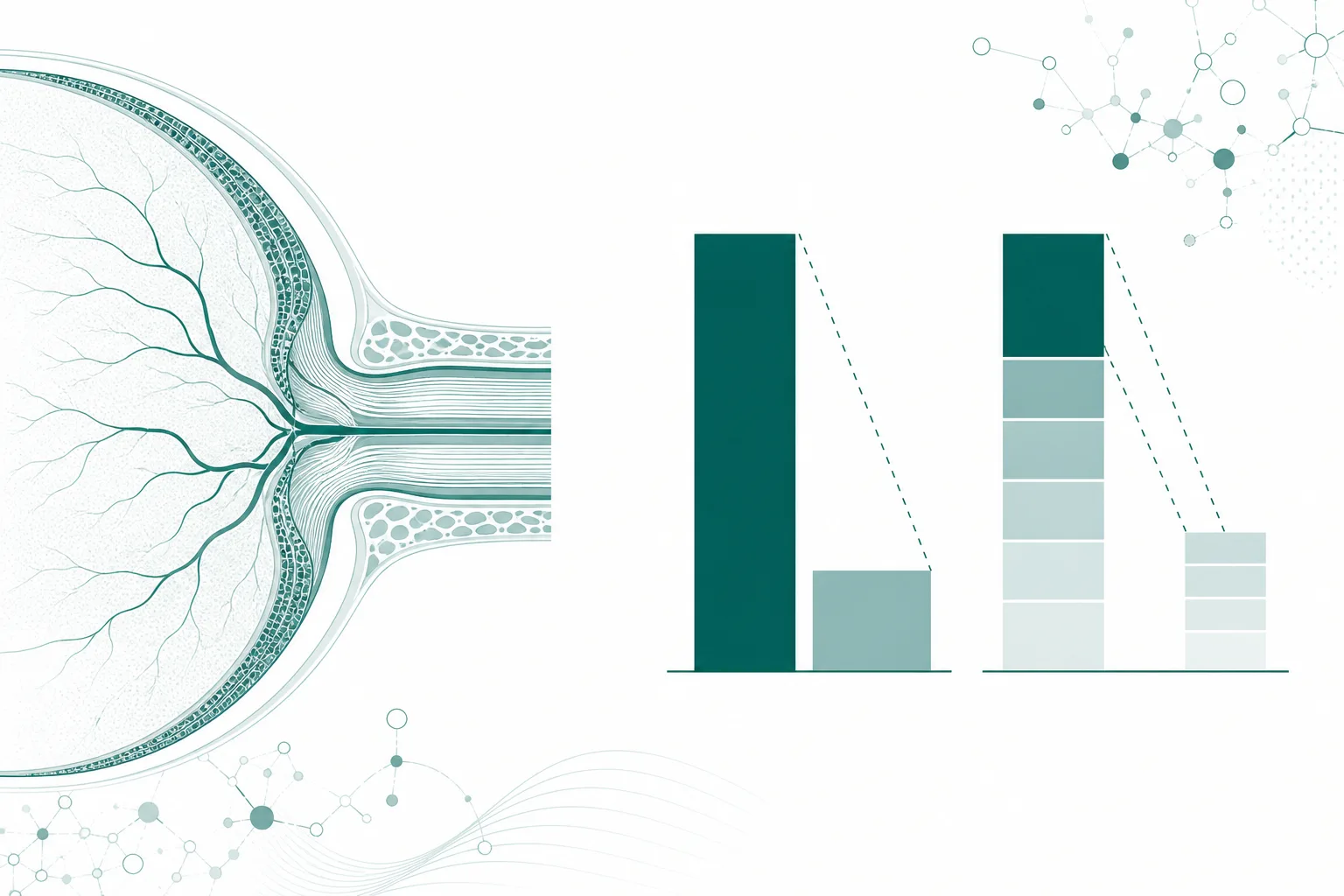
What NAION is and why its background incidence matters
NAION is an ischaemic injury of the optic nerve head. It presents as sudden visual loss in one eye, is generally irreversible, and has no effective treatment 8. It is not caused by arteritis, hence the name. Commonly cited associations include a small crowded optic disc, sleep apnoea, hypertension and diabetes, which matters here because the drug class is used by populations rich in those characteristics.
A relative risk is only interpretable against a baseline. The UK regulator's drug safety update lists published background incidence per 100,000 person-years as 11.4 to 82 in people with type 2 diabetes, 7.73 to 11.35 in the general population aged 40 and over, 10.2 at 50 and over, and 14.79 at 60 and over 8. The range in diabetes spans a factor of seven. Studies that identify the outcome differently, in populations of different age, will therefore report different baselines before any drug effect is considered.
The first signal: a matched cohort in one health system
The 2024 report came from a registry of patients evaluated by neuro-ophthalmologists at one academic institution between December 2017 and November 2023, comprising 16,827 patients with no prior NAION. Propensity matching was used within two groups. In the type 2 diabetes group, 194 patients were prescribed semaglutide and 516 a non-GLP-1 comparator; 17 NAION events occurred in the first group against 6 in the second. The 36-month cumulative incidence was 8.9% (95% CI 4.5 to 13.1) against 1.8% (0 to 3.5), and the hazard ratio was 4.28 (1.62 to 11.29). In the overweight and obesity group, 361 against 618 patients, there were 20 events against 3, a hazard ratio of 7.64 (2.21 to 26.36) 1.
The authors concluded that the finding suggests an association and that causality required further study 1. The cumulative incidences of 6.7% to 8.9% are not population risks. Everyone in the registry had been referred to a specialist service for an eye problem, so the denominator is enriched for exactly the people who develop optic neuropathies. That is a legitimate way to raise a signal and an unreliable way to size it. Evidence tier: human observational, single centre, referral population.
The Danish and Norwegian registry study and its two estimates
The 2025 Danish-Norwegian study compared people with type 2 diabetes who started semaglutide with those who started sodium-glucose cotransporter 2 inhibitors, using national registers: Denmark 2018 to 2024 and Norway 2018 to 2022. It included 44,517 semaglutide users in Denmark and 16,860 in Norway, with 32 NAION events 3. Unadjusted rates per 10,000 person-years were 2.19 against 1.18 in Denmark and 2.90 against 0.92 in Norway. The pooled adjusted hazard ratio was 2.81 (95% CI 1.67 to 4.75), the incidence rate difference was +1.41 (+0.53 to +2.29) per 10,000 person-years, and the country estimates were 2.17 (1.20 to 3.92) for Denmark and 7.25 (2.34 to 22.4) for Norway 3.
The Norwegian estimate is more than three times the Danish one, but its interval overlaps the Danish interval and is far wider, because the number of events is small. The authors describe the estimates as consistent across the countries and report a higher post hoc per-protocol hazard ratio of 6.35 (2.88 to 14.0) 3. A per-protocol analysis censors people who stop treatment, so it can exaggerate effects if those who stop differ from those who continue. Evidence tier: human observational, active comparator, registry data.
The studies that found less, and why design explains part of it
A multinational analysis of a global electronic-records network covered 160 health care organisations in 21 countries and used one-to-one propensity matching. Among 37,314 people with type 2 diabetes only, 129,690 with obesity only and 130,216 with both, it found no significant association. The three-year hazard ratios were 1.51 (95% CI 0.71 to 3.25), 0.72 (0.24 to 2.16) and 1.19 (0.78 to 1.82) 2.
These intervals are not narrow. The one-year estimate in the diabetes-only group was 2.32 (0.60 to 8.97), which cannot exclude a large effect. A statistically null result with wide intervals is compatible with both no effect and an effect as large as the Danish-Norwegian one. Differences in how the outcome is coded, how exposure is defined from electronic records and how long follow-up lasts all separate this design from the registry studies 23.
| Study | Population and design | Relative estimate | Absolute information |
|---|---|---|---|
| Single-centre registry | 16,827 specialist-referred patients, matched | HR 4.28 (diabetes); HR 7.64 (overweight or obesity) | Cumulative incidence 8.9% and 6.7%; referral population |
| Danish-Norwegian registers | Type 2 diabetes, against SGLT2 inhibitors | Pooled HR 2.81 (1.67 to 4.75) | +1.41 per 10,000 person-years (+0.53 to +2.29) |
| Multinational records network | 160 organisations, 21 countries, matched | Three-year HR 0.72 to 1.51, all intervals include 1 | Not the focus of the report |
| US veterans | 102,361 new users, target trial emulation | Overlap-weighted HR 2.33 (1.54 to 3.54) | 123 against 67 per 100,000 person-years |
Network-wide analyses and the self-controlled design
A network of 14 databases covering 37.1 million people with type 2 diabetes, 810,390 of them new semaglutide users, reported an NAION incidence of 14.5 per 100,000 person-years among users. Using a sensitive outcome definition, hazard ratios against empagliflozin, sitagliptin and glipizide were 1.44, 1.30 and 1.23, each with an interval spanning 1. With a restrictive definition, the ratio against empagliflozin was 2.27 (95% CI 1.16 to 4.46) 4. The outcome definition changed the answer, which is itself a finding about how fragile code-based ascertainment is.
The same study ran a self-controlled case series, in which each person is compared with themselves during exposed and unexposed time. Its pooled incidence rate ratio was 1.32 (1.14 to 1.54), described by the authors as a modest increase, smaller than previously reported 4. The Danish-Norwegian supplementary self-controlled analysis gave symmetry ratios of 1.14 (0.55 to 2.36) in Denmark and 2.67 (0.91 to 8.99) in Norway 3. Self-controlled designs remove confounding by fixed traits, but they assume the event does not change later exposure, and they carry their own assumptions about timing. A null there does not dissolve a positive cohort.
The regulatory review and the frequency category
The European committee met on 2 to 5 June 2025 and concluded its review of semaglutide medicines after concerns about a possible increased risk. After reviewing all available data, it recommended that the product information list NAION as a side effect with a frequency of very rare, which the agency defines as up to 1 in 10,000 people. It advised that patients with sudden vision loss or rapidly worsening eyesight contact a doctor without delay, and that treatment be stopped if the condition is confirmed 7. The announcement does not name the individual studies.
The UK regulator followed on 5 February 2026. Its drug safety update describes a European review finding an approximately two-fold increase in relative risk in adults with type 2 diabetes, equivalent to about one extra case per 10,000 patients treated per year. It records that an expert advisory group noted conflicting evidence in the literature but agreed with updating the product information, and that three spontaneous reports suggestive of NAION had reached its Yellow Card scheme between first authorisation in 2018 and 1 August 2025, against around 10.2 million packs dispensed in five years 8. The current text of each regulator's documents governs; the US label position was not verified for this article.
Relative risk against absolute excess
Take the Danish-Norwegian incidence rate difference of +1.41 per 10,000 person-years 3. Against the UK regulator's summary of about one extra case per 10,000 patients treated per year 8, the figures line up: the excess is roughly one to one and a half cases per 10,000 person-years. The US veterans cohort reports crude rates of 123 and 67 per 100,000 person-years, a difference of about 56 per 100,000 (a subtraction by the desk, not a reported result). Its overlap-weighted cumulative incidence was 0.29% against 0.13% over a median of 2.1 years, a difference of 0.16 percentage points 5. That cohort's absolute figure is several times higher than the Nordic one.
A pooled analysis of 8 randomised trials with 31,174 patients and 8 observational studies with 1,611,278 patients adds the evidence tier that has been missing. For diabetes, observational studies gave a pooled hazard ratio of 1.85 (95% CI 1.20 to 2.85), while randomised trials recorded 5 ischaemic optic neuropathy events on semaglutide against 1 on control, a risk ratio of 1.76 (0.43 to 7.25). For weight management, the observational ratio was 1.57 (0.69 to 3.59) and the trials showed 4 events against 1 6. The trials were not designed to detect events this rare, so their intervals are consistent with a harmful effect and with none.
Residual confounding, surveillance bias and what would settle it
Three explanations compete for the elevated cohort estimates. The first is a real causal effect. The second is residual confounding: people prescribed semaglutide may differ from users of sodium-glucose cotransporter 2 inhibitors in disease duration, retinopathy status, rapid glycaemic improvement or sleep apnoea in ways measured poorly or not at all. The third is surveillance bias: once the signal was public, ophthalmologists and patients looked harder, and diagnosis codes appeared more often among exposed people.
The 2025 and 2026 analyses address part of this with active comparators and new-user designs, and the target-trial emulation in the veterans cohort adds explicit time zero and eligibility rules 5. None eliminates unmeasured confounding. What would settle the matter is a prospective study with adjudicated outcomes, standardised ophthalmic examination, pre-registered analyses and a large enough population to observe events, ideally with a randomised component. Until then, the defensible statement is the regulators': a very rare adverse effect, possibly causal, with a relative risk near two and an absolute excess near one extra case per 10,000 person-years.
References
- Risk of Nonarteritic Anterior Ischemic Optic Neuropathy in Patients Prescribed Semaglutide
- Association between Semaglutide and Nonarteritic Anterior Ischemic Optic Neuropathy: A Multinational Population-Based Study
- Use of semaglutide and risk of non-arteritic anterior ischemic optic neuropathy: A Danish-Norwegian cohort study
- Semaglutide and Nonarteritic Anterior Ischemic Optic Neuropathy
- New-Onset Nonarteritic Anterior Ischemic Optic Neuropathy and Initiators of Semaglutide in US Veterans With Type 2 Diabetes
- Rate and Risk of Nonarteritic Anterior Ischemic Optic Neuropathy with Semaglutide Use for Diabetes and Weight Loss: A Systematic Review and Meta-Analysis
- Meeting highlights from the Pharmacovigilance Risk Assessment Committee (PRAC) 2-5 June 2025
- Semaglutide (Wegovy, Ozempic and Rybelsus): risk of Non-arteritic Anterior Ischemic Optic Neuropathy (NAION)