peptide pharmacokinetics
Renal Filtration: The Size Threshold That Clears Most Peptides in Minutes
The kidney is a size filter that offers a typical peptide no resistance at all, and then a second system that destroys almost everything the filter lets through. This is the renal half of clearance, examined on its own.
Peptide clearance has two engines — peptidases that cut the chain and the kidney that filters it — and the half-life article on this site treats them together, because that is how they act. This article takes the kidney alone, in detail, because the renal route has internal structure that gets flattened when it is summarised as one word. Filtration is not a single event. It is a size-selective barrier that a typical peptide crosses without resistance, followed by a reabsorption and degradation system in the proximal tubule that destroys most of what the barrier let through, followed by whatever small remainder appears in urine. Each step is measurable, and each behaves differently.
The threshold that matters is stated easily. The glomerular barrier passes solutes below roughly five kilodaltons essentially unrestricted, becomes progressively more selective through the tens of kilodaltons, and retains albumin — a little over sixty-six kilodaltons — almost completely 2. Peptides of pharmacological interest weigh between about one and five kilodaltons. From the kidney's point of view they are not macromolecules at all; they are small solutes, and they leave the plasma at close to the rate at which plasma water is filtered.
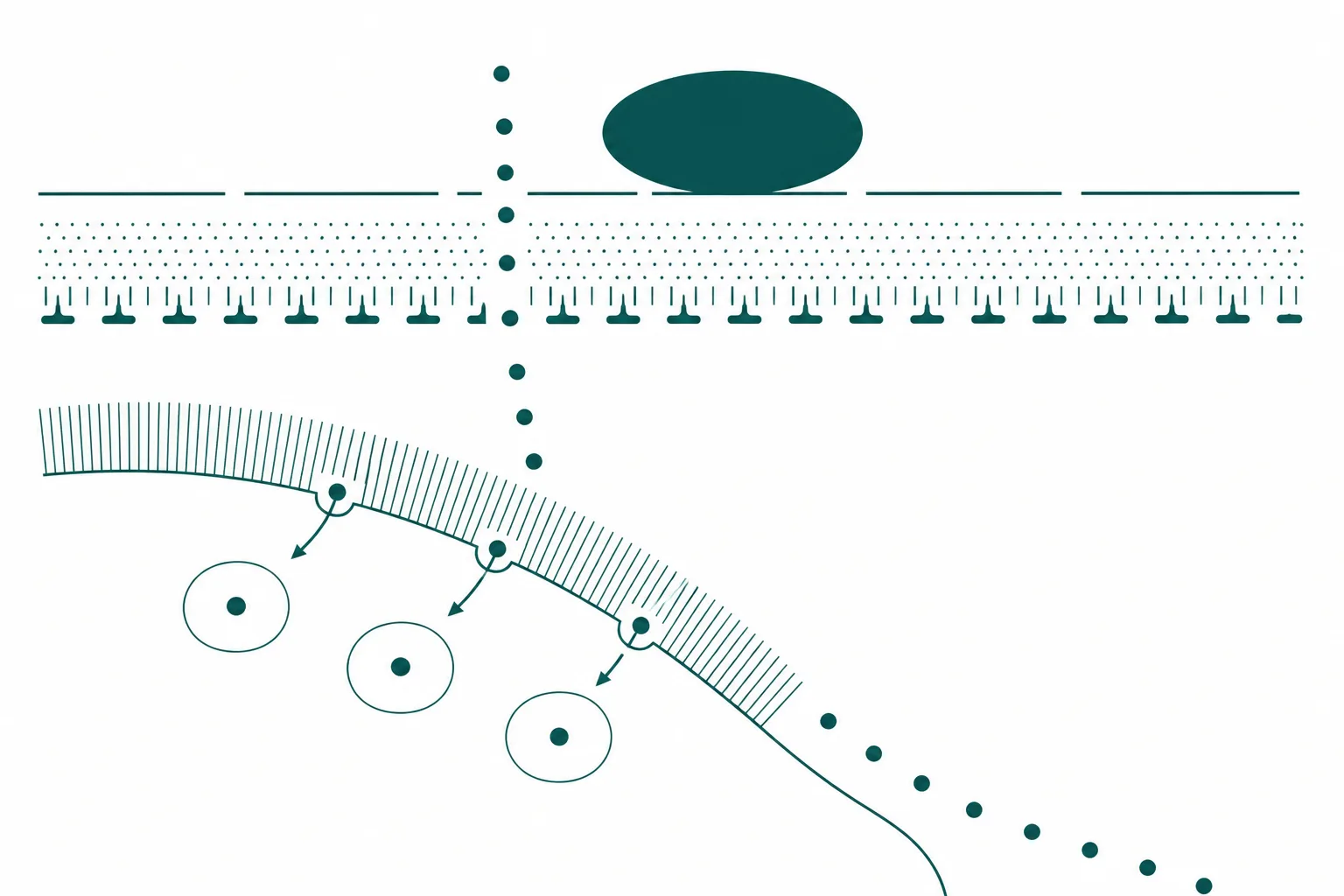
What the glomerulus is, and what it selects on
The filtration barrier has three layers in series, and selectivity is a property of the assembly rather than of any one of them. First comes a fenestrated endothelium carrying a thick, negatively charged surface layer of glycocalyx and adsorbed proteins. Then the glomerular basement membrane, a hydrated mesh of collagen IV, laminin and heparan sulphate proteoglycans. Then the podocyte layer, whose interdigitating foot processes are bridged by slit diaphragms of defined width. Restriction is by size, by charge and by molecular shape, with negatively charged macromolecules hindered relative to neutral ones of equal size 2.
For large molecules this architecture is decisive. For a peptide it is almost irrelevant. The useful quantity is the sieving coefficient, the ratio of a solute's concentration in filtrate to its concentration in plasma water; a value of one means the barrier does not discriminate against the molecule at all. Small peptides sit at or near one. The older physiological literature on low-molecular-weight proteins made this point with proteins an order of magnitude heavier than a peptide and still found substantial filtration, which is why peptides were never in question 1.
The rate consequence is what makes renal clearance formidable. The kidneys produce on the order of a hundred and eighty litres of filtrate a day from a circulating plasma volume of about three litres, which means the entire plasma pool is presented to the filter many times over in a single day. For a molecule with a sieving coefficient near one and no reabsorption back into blood, that arrangement removes the compound from the circulation on close to the first pass. Nothing has to be induced and nothing saturates.
Megalin, cubilin and the proximal tubule
The apical brush border of the proximal tubule carries two large endocytic receptors that between them recognise an extraordinary range of filtered ligands. Megalin is a very large single-pass receptor of the low-density-lipoprotein receptor family; cubilin is a peripheral membrane protein with no transmembrane domain of its own, which depends on megalin and on amnionless for internalisation and recycling. They function as a tandem system: ligands bind at the brush border, are internalised into endosomes, and are delivered to lysosomes, while the receptors return to the surface 3.
The ligand list includes carrier proteins, vitamin-binding proteins, enzymes and, directly relevant here, peptide hormones. Reabsorption is therefore not a leak but a physiological recovery system: the kidney filters small proteins and peptides freely, then retrieves them, breaks them down to amino acids and returns those to the body. The design makes sense for an organ that must filter aggressively to clear waste while not squandering nitrogen. Human disease evidence and knockout models agree on the consequence of losing it — impaired receptor function produces urinary loss of low-molecular-weight proteins that are normally reclaimed 4.
The clearest demonstration that this route is receptor-mediated comes from a peptide. In mice lacking megalin in the kidney, renal uptake of a radiolabelled octapeptide somatostatin analogue was drastically reduced compared with animals expressing the receptor normally, establishing megalin as the route by which the analogue is taken up into tubular cells 5. That result is also the mechanistic basis of a well-known problem in radionuclide therapy: the kidney concentrates filtered peptide inside its own tubular cells, which is precisely where the radiation is not wanted.
Alongside receptor-mediated uptake runs straightforward luminal hydrolysis. The brush border presents a dense array of membrane peptidases, and short peptides are cleaved there directly, with the fragments handled by amino acid and peptide transporters. For very small peptides this is the dominant intrarenal fate; for larger ones, endocytosis and lysosomal degradation matter more 1. Both routes end in the same place, which is why intact peptide in urine is the exception.
| Step | Mechanism | Effect on the peptide | Visible in urine? |
|---|---|---|---|
| Glomerular filtration | Size, charge and shape selectivity across three layers | Passes essentially unrestricted below about five kilodaltons | Not yet |
| Brush-border hydrolysis | Membrane-bound peptidases in the tubular lumen | Cleaved to fragments and amino acids | No |
| Receptor-mediated endocytosis | Megalin and cubilin, with lysosomal delivery | Internalised and degraded inside tubular cells | No |
| Residual excretion | Whatever escapes both retrieval routes | Excreted intact | Yes, usually a small fraction |
When the kidney is the whole story, and when it is not
Peptides differ in how much of their clearance the kidney accounts for, and the cleanest illustration is a direct comparison in one species. In anaesthetised pigs, exendin-4 was cleared exclusively by glomerular filtration, whereas glucagon-like peptide-1 was not: the native peptide is destroyed enzymatically in the circulation so quickly that renal filtration is only part of its disposal, while the more enzyme-resistant analogue survives long enough for the kidney to become the sole exit 6.
That pairing captures a general rule. Protease resistance does not extend half-life on its own; it promotes the kidney to sole responsibility. A molecule engineered against peptidases and left at three kilodaltons has closed one exit and left the larger one open, which is why single-modification strategies disappoint. The renal capacity was never the bottleneck being addressed.
The corollary is the design principle behind every long-acting peptide in current use. To escape the kidney a molecule must stop being small, either in fact or in effect. Attaching a hydrated polymer raises the hydrodynamic radius until the barrier resists it. Fusing to an antibody fragment or to albumin puts the conjugate far above the threshold outright. Acylation with a fatty acid takes the cheapest route: the peptide binds albumin reversibly, and since only the unbound fraction is available for filtration, a binding level above ninety-nine percent reduces the filtered flux by about the same factor 7. The peptide is still small. It is simply not free.
Read that way, the acylation strategy is a renal strategy specifically. It does nothing about proteolysis, which is why acylated analogues also carry separate protease-blocking substitutions, and it works only because the association with albumin is fast and reversible enough to keep regenerating free peptide at the receptor while keeping the free fraction small 7.
Why renal function is a pharmacokinetic variable
For a compound cleared predominantly by the kidney, clearance is not a fixed property of the molecule. It tracks glomerular filtration rate, which varies with age, hydration, cardiac output and disease, and can fall substantially without any symptom. Two people given the same amount of the same peptide can therefore experience quite different exposure, and the difference is a property of them rather than of the compound.
Disease alters both renal steps, not only the first. Proteinuria means the barrier is passing more protein, which loads the reabsorptive machinery and puts filtered peptides in competition with albumin and other ligands for the same receptors 24. Reduced receptor expression shifts the balance the other way, towards urinary loss of material that would normally be retrieved. The consequence for interpretation is that a renal clearance figure describes the kidneys of the population in which it was measured.
Reading a renal clearance claim
Three habits keep this straight. First, distinguish filtered from excreted: low urinary recovery of intact peptide is the expected finding even when the kidney is doing all the clearing, so an argument that a peptide is not renally cleared because little appears in urine is not an argument at all 13. Second, ask what fraction was free. For an albumin-bound molecule the filtered flux is set by the unbound concentration, so a total-drug measurement and a filtration estimate are not commensurable 7. Third, check the species and the anaesthetic state, since both affect filtration rate and therefore any clearance number derived from it 6.
The larger point is that the kidney is not a passive sieve attached to the end of the circulation. It is a filter with a sharp size dependence, backed by a retrieval system with its own receptors, its own saturability and its own pathology. For most peptides it is the single largest route out of the body, and the reason nearly every successful half-life extension in this class amounts to an argument with the glomerulus.
References
- Renal filtration, transport, and metabolism of low-molecular-weight proteins: a review
- Properties of the glomerular barrier and mechanisms of proteinuria
- Megalin and cubilin: multifunctional endocytic receptors
- Megalin and cubilin in proximal tubule protein reabsorption: from experimental models to human disease
- Megalin is essential for renal proximal tubule reabsorption of 111In-DTPA-octreotide
- Exendin-4, but not glucagon-like peptide-1, is cleared exclusively by glomerular filtration in anaesthetised pigs
- The Discovery and Development of Liraglutide and Semaglutide