OASIS 4: The First Oral GLP-1 Approved for Obesity
A 307-participant registration trial converted an absorption-enhancer formulation into an approved product. Two effect figures circulate for the same trial, and the difference between them is an estimand, not an error.
OASIS 4 established that a once-daily tablet of an acylated GLP-1 receptor agonist, co-formulated with an absorption enhancer, produced a placebo-subtracted weight reduction of 11.4 percentage points at week 64 in adults without diabetes who had overweight or obesity, in a double-blind randomised trial of 307 participants 1. The reported effect sizes differ between analyses because they answer different questions. One is a treatment-policy estimand, which counts everyone as randomised; the other is a trial-product estimand, which estimates the effect had everyone adhered to treatment 14.
Both figures are correct. Trade coverage tends to quote whichever is larger, and the difference between them is the most commonly misreported feature of the result. This article sets out the design, the endpoints, the two estimands and the pharmacokinetic ceiling of the oral route. The formulation chemistry is summarised once and cross-referenced to the site's separate piece on absorption enhancers. Evidence tier is human randomised controlled trial throughout, except where stated.
Why an oral peptide needed its own registration programme
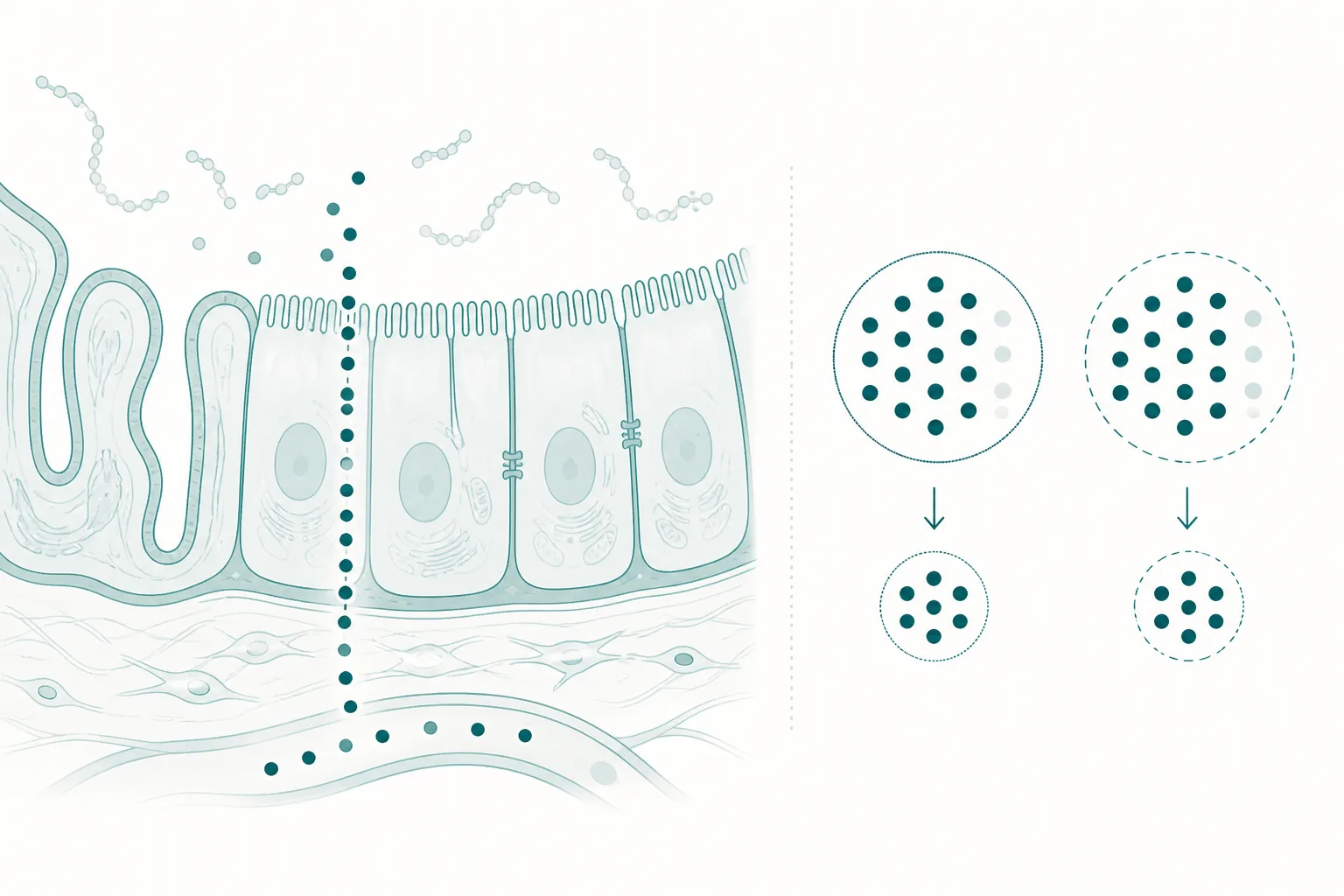
A regulator cannot approve a new route of administration by analogy with an existing one. The oral product delivers the same active peptide as the injectable, but with an absorption enhancer, and exposure depends on the formulation. In the mechanistic work that underpinned the programme, absorption took place in the stomach, was confined to an area close to the tablet surface, and required co-formulation with salcaprozate sodium (SNAC), which protects against enzymatic degradation through local buffering and only transiently enhances absorption. The mechanism was transcellular, with no evidence of an effect on tight junctions 3.
That is the formulation science in one paragraph; the detail sits in the site's article on oral GLP-1 absorption and permeation enhancers. The point for this article is that a formulation with a distinctive absorption site needed its own trial in the population for which approval was sought. Evidence tier for the absorption study: human and dog experiments.
Trial design: sites, duration, randomisation and exclusions
OASIS 4 was a 71-week, double-blind, placebo-controlled phase 3 trial, run at 22 sites in four countries according to the paper 1. The registry lists locations in the United States, Canada, Germany and Poland, with the sponsor being the manufacturer 2. Participants were randomised 2:1, and 205 received the oral agent while 102 received placebo, both with lifestyle interventions 1.
Eligibility required a body-mass index of 30 or more, or 27 or more with at least one obesity-related complication, and a history of at least one unsuccessful dietary attempt. The registry lists exclusion of people with glycated haemoglobin of 6.5% or more at screening, and of those reporting a body-weight change above 5 kg in the preceding 90 days 2. A published summary reports that 79% of participants were women, 92% were White and the mean age was 48 years, with a 12-week escalation phase, 64 weeks of treatment and a 7-week follow-up off treatment 7. The trial therefore says nothing about people with diabetes, a much older or younger group, or a more diverse population.
The co-primary and confirmatory secondary endpoints
The co-primary endpoints at week 64 were the percent change in body weight and the proportion with a reduction of 5% or more. Confirmatory secondary endpoints were reductions of 10% or more, 15% or more and 20% or more, and the change in the physical function score of an obesity-specific quality-of-life instrument 1. In the paper’s reported analysis, all of these favoured the oral agent, with a P value below 0.001 1.
A hierarchy of confirmatory endpoints protects against false positives from multiple testing: later endpoints are interpreted only if earlier ones succeed. The published summary reports that 30% of the oral group and 3% of the placebo group achieved a reduction of 20% or more, and that the physical function score rose by 16 points against 8 7. The percentages for the 5%, 10% and 15% thresholds should be read from the paper's tables.
Estimands: trial product against treatment policy
An estimand is a precise statement of the treatment effect a trial aims to estimate. It specifies the population, the outcome, the treatment conditions and, critically, how events after randomisation are handled. Those events include stopping treatment, starting a rescue therapy and dying. Under a treatment-policy estimand, those events are ignored, so participants count as randomised whether or not they kept taking the drug. This is the effect of prescribing the drug, which includes the cost of people who do not tolerate or continue it.
Under a trial-product estimand, the effect is estimated as if everyone had stayed on the assigned treatment. It describes the pharmacological effect in people who keep taking it. The company announcement reports a mean loss of 16.6% under this estimand and says that one in three participants achieved 20% or more 4. The journal abstract reports -13.6% against -2.2% as the estimated mean change; it does not name the estimand, and this article treats that all-randomised figure as the treatment-policy one 1. The gap in the oral arm, 3.0 percentage points, is the contribution of non-adherence and treatment discontinuation to the diluted figure.
| Feature | Treatment-policy estimand | Trial-product estimand |
|---|---|---|
| Question answered | What happens to people assigned to the drug, adherent or not | What happens to people who take the drug as assigned |
| Mean weight change, oral arm | -13.6% (placebo -2.2%) | 16.6% loss, as reported by the sponsor |
| Treatment effect | -11.4 percentage points (95% CI -13.9 to -9.0) | Read from the paper's supplementary tables |
| Primary use | Pragmatic expectation for a treated group | Pharmacological potency in adherers |
Gastrointestinal adverse events and discontinuation
Gastrointestinal adverse events were more common with the oral agent than with placebo, at 74.0% against 42.2% 1. The published summary describes most as mild to moderate and transient, and reports discontinuation for adverse events at 7% on the oral agent against 6% on placebo 7. The sponsor describes the safety profile as consistent with earlier trials of the same active substance in weight management 4.
The two numbers should be read together. Frequent gastrointestinal events with low discontinuation suggest events that are common but mostly tolerable within a trial, where participants receive structured escalation and support. They do not show that the same pattern would hold outside it. The gap between trial-product and treatment-policy figures above is partly the effect of the people who did stop.
What the cardiovascular outcomes evidence contributed
OASIS 4 was a weight trial. It was not large enough, or long enough, to test cardiovascular events. The company announcement of 22 December 2025 states that the United States regulator approved the product for reducing excess body weight and maintaining the reduction, and for reducing the risk of major adverse cardiovascular events. It attributes the approval to the OASIS programme of four phase 3 trials with about 1,300 adults and to a cardiovascular outcomes trial of the injectable formulation, supported by data from two further programmes 4.
A separate event-driven trial of oral semaglutide in 9,650 people with type 2 diabetes and established cardiovascular or kidney disease reported a hazard ratio of 0.86 (95% CI 0.77 to 0.96) for major adverse cardiovascular events over a median 49.5 months 6. That trial used a different formulation strength and population, and the announcement does not cite it 4. It is therefore supporting context for the class, not the evidence for the obesity indication. Evidence tier: randomised controlled trial in a different population. Regulatory status elsewhere, including the European submission pending at the time of the announcement, should be read from the regulator's current pages.
Bioavailability and the pharmacokinetic ceiling
The tablet's prescribing information gives a population-pharmacokinetic estimate of absolute oral bioavailability of about 0.4% to 1%. It states that absorption occurs predominantly in the stomach, that maximum concentration is reached about 1 hour after dosing, that steady state takes 4 to 5 weeks, and that the elimination half-life is about 1 week, with binding to plasma albumin above 99% 5. Those figures come from the label of the original tablet developed for type 2 diabetes; the obesity product’s exposure profile should be read from its own documents.
A bioavailability below 1% has two consequences. First, a small proportional change in the fraction absorbed produces a large proportional change in the exposure that reaches the circulation, so variability is built into the route. The desk draws this inference from the arithmetic, and the label does not state it as such. Second, low absorption means most of the administered peptide is not used, which is an economic constraint and not a safety finding.
What this establishes for oral peptide delivery, and what it does not
It establishes that a peptide of this class can be delivered orally at a pharmacologically useful exposure, in a controlled trial, with a weight effect that the sponsor describes as similar to the injectable version 4; any such comparison is cross-trial. It establishes a regulatory template: a distinct programme for a distinct route. It does not establish that the SNAC mechanism generalises. The original absorption work found the mechanism to be compound specific 3, so success for this molecule predicts little about others.
A researcher reading OASIS 4 coverage should check which estimand a number comes from, whether a quoted comparison with the injectable is cross-trial, and whether the trial population resembles the population in the claim. The first question resolves the most common confusion, and it takes seconds: the estimand is stated in the methods.
References
- Oral Semaglutide at a Dose of 25 mg in Adults with Overweight or Obesity
- Efficacy and Safety of Oral Semaglutide 25 mg Once Daily in Adults With Overweight or Obesity (OASIS 4, NCT05564117)
- Transcellular stomach absorption of a derivatized glucagon-like peptide-1 receptor agonist
- Wegovy pill approved in the US as first oral GLP-1 for weight management (company announcement)
- Rybelsus (semaglutide) tablets: prescribing information
- Oral Semaglutide and Cardiovascular Outcomes in High-Risk Type 2 Diabetes
- OASIS 4: Significant Weight Loss With Oral Semaglutide Comparable With High-Dose, SC Versions