MK-677: An Oral Secretagogue With Two-Year Trial Data
A non-peptide agonist at the ghrelin receptor with an unusual distinction: multi-year randomised human data. They show a hormone that rises reliably and functional endpoints that did not follow.
Randomised trials of MK-677, also called ibutamoren, established that an orally active, non-peptide agonist at the ghrelin receptor raises growth hormone and insulin-like growth factor I reliably in older adults, that it increased fat-free mass in a two-year trial, and that none of this was accompanied by a demonstrable change in strength or function. Few compounds in this class have randomised data of that length. The data are also a case study in the gap between a hormone level and an outcome.
The drug was developed for sarcopenia and for recovery after hip fracture. It was not approved for either. Everything below is the record of what was measured in those trials, in the populations they enrolled, and nothing here is guidance for any other group of people.
The receptor, and what a non-peptide agonist changes
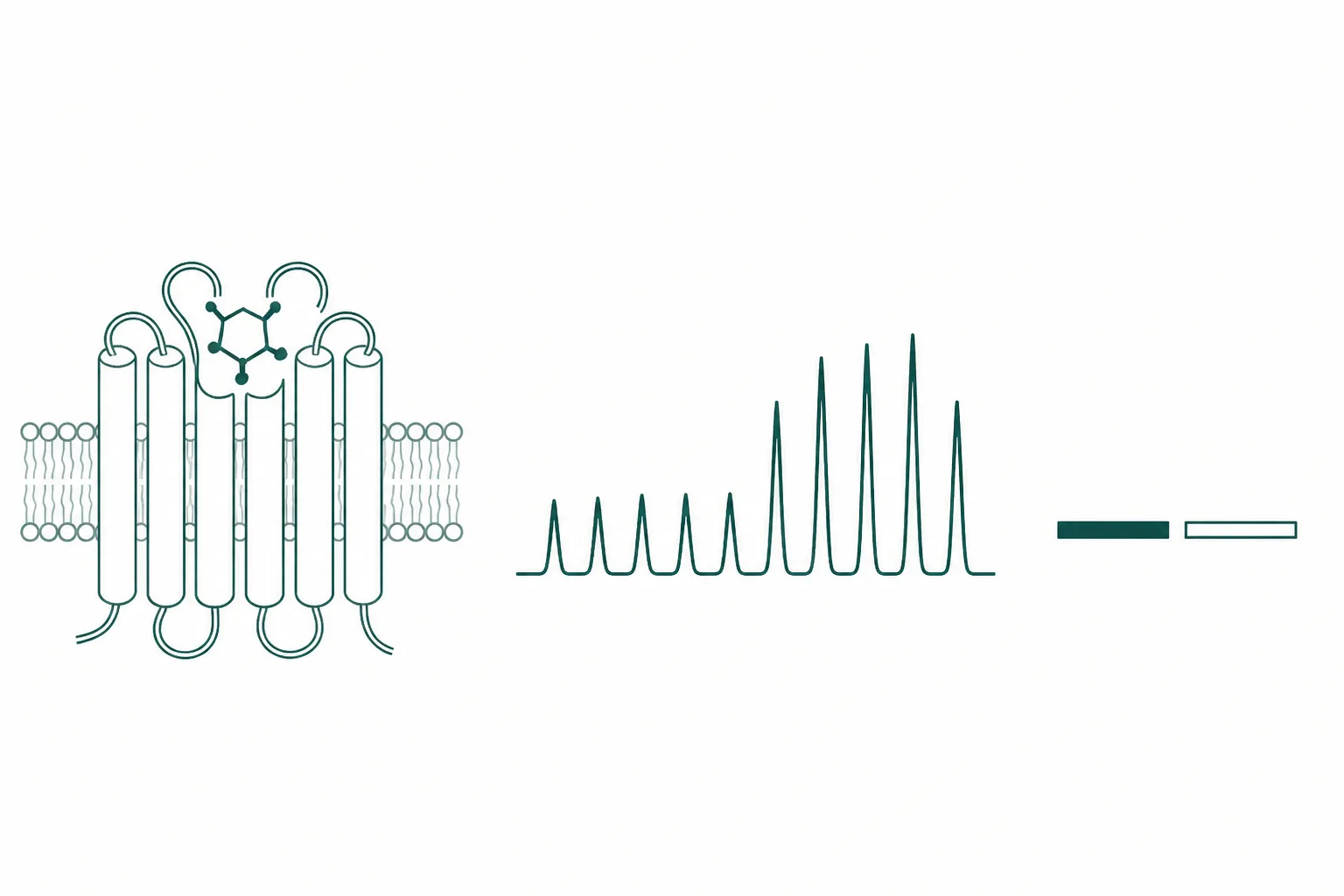
The growth hormone secretagogue receptor was cloned in 1996 from pituitary and hypothalamus of swine and humans, and shown to be the target of a class of small synthetic molecules that amplify pulsatile growth hormone release 2. The authors reasoned that these molecules mimic an undiscovered natural hormone. That hormone was later identified as ghrelin. A receptor characterised through synthetic ligands before its endogenous ligand was known is a historical oddity worth remembering when reading older papers, which use the term secretagogue and not ghrelin mimetic.
MK-677 was reported in 1995 as a potent, orally active member of a newer structural class. In rat pituitary cells in culture it released growth hormone with an EC50 of 1.3 nM and was mechanistically indistinguishable from the peptide GHRP-6 and from an earlier non-peptide secretagogue, while being clearly distinguishable from growth hormone releasing hormone itself. In dogs it raised growth hormone by mouth, without significant effect on aldosterone, luteinising hormone, thyroxine or prolactin; only modest increases in cortisol were seen 1. Those are in vitro and animal findings, and the paper selected the compound for clinical study on their basis.
The structural difference from the peptide agonists matters for one reason above others. A peptide of this kind is degraded in the gut and generally cannot be given by mouth. A small molecule avoids that problem, and oral activity is the property that separates this compound from ipamorelin and the other peptide secretagogues acting at the same receptor.
Hormone levels in the two-year trial
The central trial was a two-year, double-blind, randomised, placebo-controlled, modified-crossover study in 65 healthy adults aged 60 to 81: men, women receiving hormone replacement therapy, and women not receiving it. Fat-free mass and abdominal visceral fat were the primary endpoints, assessed after one year of treatment. Secondary measures included body weight, fat mass, insulin sensitivity, lipids, cortisol, bone mineral density, limb lean and fat mass, isokinetic strength, function and quality of life. Everything was assessed at baseline and every six months 4.
Daily administration significantly increased growth hormone and IGF-I to the levels of healthy young adults, without serious adverse effects 4. This is the endpoint on which the compound performed as intended, and it is the one on which every trial reported success. It is also the weakest evidence of clinical relevance, for reasons covered below.
Fat-free mass against strength and function
Mean fat-free mass fell by 0.5 kg (95% CI −1.1 to 0.2) in the placebo group and rose by 1.1 kg (95% CI 0.7 to 1.5) in the MK-677 group (P < 0.001). Body cell mass, estimated from intracellular water, followed the same direction (−1.0 kg against +0.8 kg; P = 0.021). Neither abdominal visceral fat nor total fat mass differed significantly, but limb fat rose more in the treated group (1.1 kg against 0.24 kg; P = 0.001), and body weight rose by 2.7 kg against 0.8 kg (P = 0.003) 4.
Read together, those numbers qualify the fat-free mass result. Fat-free mass includes water, and the most frequent adverse effects in the trial were transient, mild lower-extremity oedema and muscle pain, alongside an increase in appetite that subsided over a few months. A rise in a compartment that includes water, accompanied by oedema, is not equivalent to a rise in contractile tissue. The authors' own conclusion on the functional question is stated plainly: the increased fat-free mass did not result in changes in strength or function 4.
| Endpoint | Placebo | MK-677 | Reported significance |
|---|---|---|---|
| Fat-free mass change | −0.5 kg | +1.1 kg | P < 0.001 |
| Body weight change | +0.8 kg | +2.7 kg | P = 0.003 |
| Limb fat change | +0.24 kg | +1.1 kg | P = 0.001 |
| Abdominal visceral fat; total fat mass | Reference | No significant difference | Primary endpoint missed (visceral fat) |
| Strength and function | Reference | No change reported | Underpowered by the authors' account |
| Fasting glucose | Reference | +0.3 mmol/L on average | P = 0.015 |
Metabolic effects reported
The same trial recorded effects the programme was not designed to produce. Fasting blood glucose rose by an average of 0.3 mmol/L (5 mg/dL; P = 0.015) in the MK-677 group, and insulin sensitivity decreased. LDL cholesterol fell relative to baseline (−0.14 mmol/L; P = 0.026), with no between-group difference in total or HDL cholesterol. Cortisol rose by 47 nmol/L (P = 0.020), and bone mineral density changes were consistent with increased bone remodelling 4.
None of these is surprising in light of what growth hormone does to glucose handling, and it is useful that the trial measured them. They are also a reminder that a pathway-level hormone rise is not a targeted intervention. The compound raises a hormone that acts on many tissues, and the effects on those tissues arrive together.
The hip-fracture programme
Two further randomised trials tested the compound in people recovering from hip fracture, a setting in which functional decline is common and a functional endpoint is the clinically meaningful one. The first enrolled 161 patients at thirteen centres in seven countries, aged 65 or older and ambulatory before the fracture, who were randomised to six months of daily treatment or placebo and followed for six months after. The primary measure was the change in a panel of functional performance measures from week 6 to week 26. IGF-I rose by 84% (95% CI 63 to 107) on treatment against 17% (95% CI 8 to 28) on placebo. There were no significant differences in functional performance measures or in the overall Sickness Impact Profile score. Three of four lower-extremity functional measures, the physical domain of the profile and the ability to live independently favoured treatment, but none of the differences was statistically significant 3.
The second was a randomised, double-blind phase IIb study of 123 patients, with 62 assigned to the drug and 61 to placebo. Primary outcomes were a rank analysis of change in objective functional performance and IGF-1. At 24 weeks, gait speed increased by a 0.7-point difference in mean scores (95% CI 0.17 to 1.28; p = 0.011). Stair-climbing power did not differ significantly (12.5 W; 95% CI −10.95 to 35.88; p = 0.292), and several other functional measures showed no improvement. The group on treatment had fewer falls (p = 0.096, not significant at the conventional threshold). IGF-1 was higher by 51.4 ng/ml (p < 0.001). The trial was terminated early because of a safety signal of congestive heart failure in a limited number of patients, and the authors concluded that the profile in this population was unfavourable 5.
One functional endpoint of several reached significance in the later trial. A gait-speed result in isolation, from a trial stopped early for a safety signal, carries limited weight. The consistent finding across both trials is the one the authors state: an increase in IGF-1 was not paralleled by improvement in most functional measures.
Why an increase in a hormone level is not an outcome
This is a surrogate endpoint problem in its textbook form. A surrogate is a measurement used in place of an outcome because it is quicker or easier to obtain, and its validity depends on whether changing it changes the outcome. IGF-I is a biomarker of growth hormone action. Raising it demonstrates that the drug engaged the receptor and the axis responded. It does not demonstrate that a person will lift, walk or climb any better, and in these trials they did not.
The premise that raising the axis would affect function in older adults was a reasonable hypothesis. The trials were the test of that premise, and on the functional question they did not support it.
What was never tested, and where the programme stopped
The longest trial lasted two years and enrolled 65 people. No trial tested hard clinical outcomes such as fracture, hospitalisation, disability or mortality. None was large enough to assess rare adverse events beyond the congestive heart failure signal that ended one programme. None tested the compound in young healthy adults or in athletes, the populations in which it is most often discussed online, and the data from older adults cannot be carried across to them.
The development history ended without a marketing authorisation. What remains is a small set of well-conducted randomised trials with a consistent message: the receptor responds, the hormone rises, the body composition measure moves and the functional endpoints stay put. For a researcher reading the literature, that consistency is the most useful thing it offers, and it is the opposite of what secondary accounts usually report.
References
- Design and biological activities of L-163,191 (MK-0677): a potent, orally active growth hormone secretagogue
- A receptor in pituitary and hypothalamus that functions in growth hormone release
- The effects of MK-0677, an oral growth hormone secretagogue, in patients with hip fracture
- Effects of an oral ghrelin mimetic on body composition and clinical outcomes in healthy older adults: a randomized trial
- MK-0677 (ibutamoren mesylate) for the treatment of patients recovering from hip fracture: a multicenter, randomized, placebo-controlled phase IIb study