ARA-290: The Innate Repair Receptor and Phase 2 Data
An eleven-residue peptide cut from the structure of erythropoietin was designed to engage a tissue-protective receptor and skip the blood-forming one. Its human record is two small trials in one disease, with a nerve-imaging surrogate as the primary endpoint.
The innate repair receptor is a proposed tissue-protective receptor complex, built from the erythropoietin receptor subunit and the beta common receptor subunit (CD131), that is distinct from the receptor pair that governs red blood cell production 12. ARA-290, also called cibinetide, is an 11-residue peptide designed to engage it. Its two phase 2 trial programmes, both in sarcoidosis with small nerve fibre loss, measured symptom questionnaires and, in the larger one, the area of corneal nerve fibres as a primary endpoint 45.
Evidence tier for this article is stated per section. The receptor concept rests on in vitro and rodent work. The human record is two small phase 2 trials in a single disease, run with sponsor-affiliated authors, with no phase 3 trial cited in the sources reviewed. Development status is reported below as fact, not as a verdict on the compound.
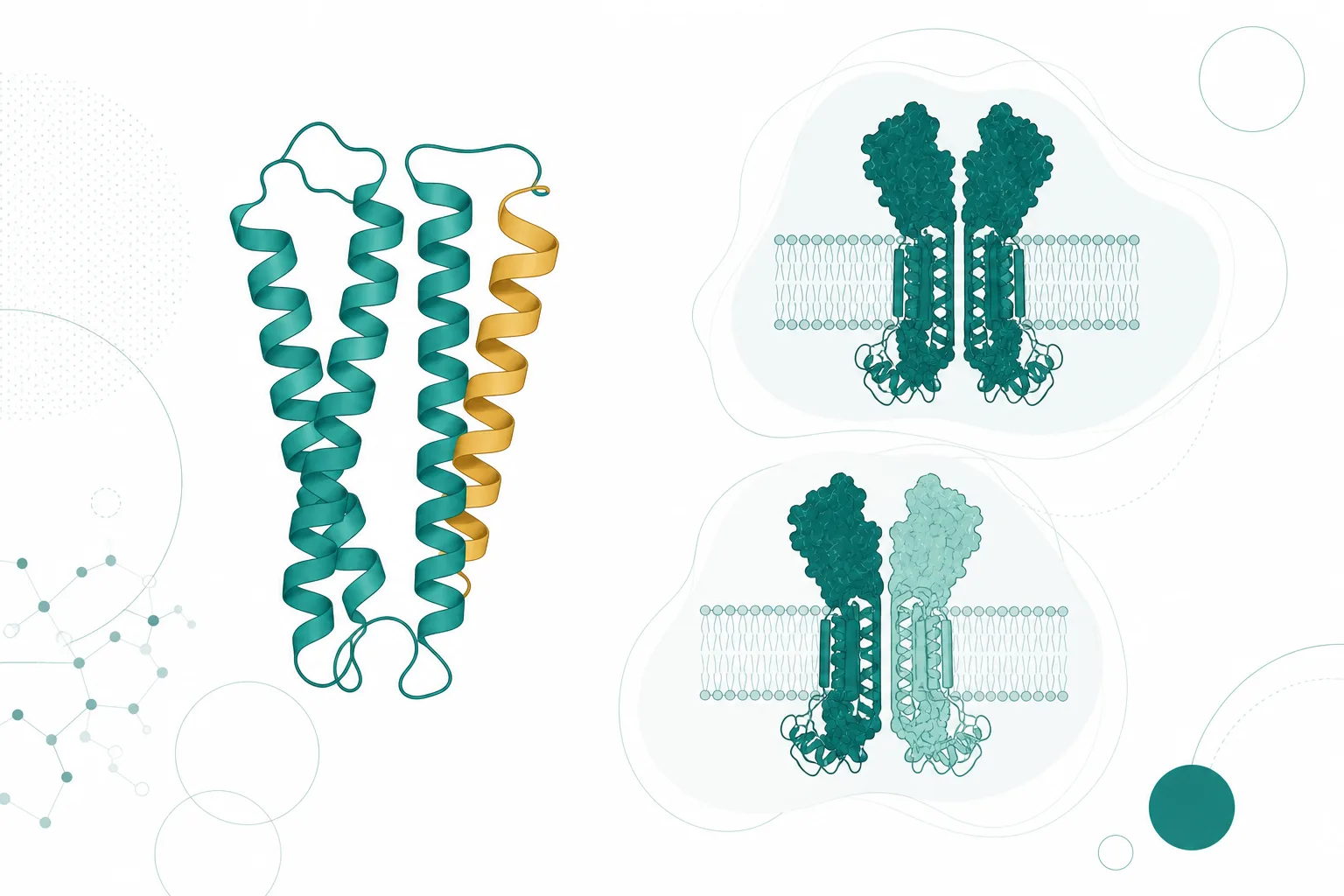
Erythropoietin's two activities
Evidence tier for this section: in vitro and animal pharmacology, with review-level synthesis. Erythropoietin plays a hormonal role in regulating red blood cell production and a paracrine and autocrine role in which locally produced hormone protects tissues from injury. These functions are mediated by distinct receptors: blood formation through the erythropoietin receptor homodimer, and tissue protection through a heterocomplex of the erythropoietin receptor with CD131, the beta common receptor 1.
The tissue-protective receptor is described as generally not expressed by normal tissue and as becoming functional after injury, with its expression raised by inflammation and hypoxia 2. That is the rationale for the engineering goal. Giving full-length erythropoietin to activate the protective receptor also activates the blood-forming one, with its attendant effects on haematocrit and clotting. A ligand that engaged only the heterocomplex would, in principle, separate the two.
The helix B surface peptide: structure and derivation
Evidence tier for this section: in vitro and rodent. The 2008 derivation work delimited tissue-protective domains in erythropoietin to short peptide sequences. Helix B, residues 58 to 82, faces the aqueous medium when erythropoietin is bound to the receptor homodimer. It was neuroprotective in vitro and tissue protective in vivo in rodent models including ischaemic stroke, diabetes-induced retinal oedema and peripheral nerve trauma 1.
An 11-residue peptide composed of adjacent amino acids forming the aqueous face of helix B was also tissue protective in the reported models of ischaemic stroke and renal ischaemia-reperfusion. It was further reported to accelerate wound healing and to augment cognitive function in rodents 1. The European Medicines Agency lists the substance as a pyroglutamyl-initiated eleven-residue sequence named cibinetide 7. Everything in this paragraph is animal data.
Why the peptide is not erythropoietic
Evidence tier for this section: in vitro and rodent, plus a structural argument. The structural argument is that the face of helix B used to build the peptide is not the face that contacts the receptor homodimer. The experimental result is that neither helix B nor the 11-residue peptide was erythropoietic in vitro or in vivo 1. The result is observed. The structural explanation for it is an inference from where the segment sits on the folded protein.
| Property | Erythropoietic receptor | Innate repair (tissue-protective) receptor |
|---|---|---|
| Composition | Homodimer of the erythropoietin receptor subunit | Erythropoietin receptor subunit with CD131, the beta common receptor |
| Role | Red blood cell production | Limiting injury and inflammation, tissue protection |
| Expression | Haematopoietic tissue | Generally low in normal tissue, raised by inflammation and hypoxia |
| ARA-290-type peptide activity | Not erythropoietic in vitro or in vivo | Designed to engage; reported tissue-protective in rodents |
Direct binding or signalling data for the heterocomplex in human tissue are not among the sources reviewed here. Review-level work adds that the vascular endothelial growth factor receptor also appears to be a component of the tissue-protective receptor in some tissues, such as the endothelium 2. The receptor is therefore best described as a working model with variable composition.
Preclinical models and what they tested
Evidence tier for this section: rodent. The models listed above test whether a peptide limits injury after an insult delivered by the experimenter: occlusion of a cerebral vessel, renal ischaemia and reperfusion, nerve trauma, a wound. The common design is that an injury is imposed, the compound is administered, and a tissue outcome is compared with vehicle. That tests tissue protection in an animal in which the injury is acute, sharply timed and otherwise healthy.
Sarcoidosis is a different situation. It is a chronic, immune-mediated condition in which small nerve fibre loss is hypothesised to arise from immune dysregulation acting on the peripheral and central nervous systems 4. The step from an acute rodent injury to a chronic human inflammatory neuropathy is a large inferential gap, and it is the gap the phase 2 trials were designed to start crossing.
The sarcoidosis phase 2 programme
Evidence tier for this section: human randomised double-blind trials, small, sponsor-affiliated. The first was a pilot in 22 patients with sarcoidosis and symptoms of small fibre neuropathy, randomised to the peptide (12) or placebo (10) with intravenous dosing three times weekly for four weeks. The Small Fibre Neuropathy Screening List score changed more in the peptide group than in placebo at week 4, and the pain and physical functioning dimensions of the SF-36 changed from baseline in that group 3. The mean Brief Pain Inventory and Fatigue Assessment Scale scores improved significantly but equivalently in both groups. No safety concerns were raised by clinical or laboratory assessments.
A second blinded placebo-controlled trial used 28 days of daily subcutaneous administration in patients with documented small nerve fibre loss. Its authors reported changes in neuropathic symptoms, in corneal small nerve fibre density, in cutaneous temperature sensitivity and in exercise capacity on the six-minute walk test 4. Several of its authors are affiliated with the sponsoring company. The registry record of the dose-ranging trial that followed lists the same sponsor 6.
The dose-ranging trial and which arm reached significance
Evidence tier for this section: human randomised, quadruple-masked phase 2b, 64 participants. The registered primary outcome was the change in corneal nerve fibre area between baseline and day 28 6. Participants were randomised to low, middle and high daily arms, or placebo, for 28 consecutive days, in two countries. The placebo-corrected mean changes in corneal nerve fibre area were 109 square micrometres (95% confidence interval −429 to 647) in the low arm, 697 (159 to 1,236; P = 0.012) in the middle arm and 431 (−130 to 992) in the high arm 5.
Only the middle arm excluded zero. The low and high arms did not, and the high arm's point estimate was lower than the middle arm's. A non-monotonic dose-response in a trial of 64 people with four arms is compatible with a real inverted-U relationship, and equally with chance. The trial cannot tell the two apart. Intraepidermal fibres expressing the regeneration marker GAP-43 increased in the middle arm (P = 0.035). Pain scores improved significantly in all groups, and the subgroup with moderate to severe pain who received the middle arm showed a placebo-corrected decrease in pain intensity that the authors called clinically meaningful but that did not reach significance (P = 0.157) 5.
Corneal nerve fibre imaging: what it proxies
Evidence tier for this section: human, surrogate endpoint. Corneal confocal microscopy images the small nerve fibres of the cornea in living patients without a biopsy. In sarcoidosis the registry describes nerve fibre area as reduced compared with normal humans, a measurement of small fibre loss 6. The authors of the phase 2b trial propose the area measure as a surrogate endpoint for disease modification, supported by correlations between its change and the change in regenerating skin fibres (ρ = 0.575) and in the six-minute walk test (ρ = 0.645) 5.
A surrogate is only as good as its link to the outcome that matters to patients. Here the correlations were measured within a 64-person trial by its own investigators, and the surrogate's validity as a predictor of clinical benefit is argued by the authors and not established by independent replication in the sources reviewed. A change in imaged fibre area over 28 days is an observation about tissue. It is not a clinical outcome.
Development status and what an orphan designation means
Evidence tier for this section: regulatory record. The European Medicines Agency lists orphan designation EU/3/13/1191, granted on 7 October 2013, for cibinetide for the treatment of sarcoidosis, with the sponsorship later transferred to a company in Ireland in April 2019 7. The agency's own text states that an orphan designation is not a marketing authorisation, and that a product must show quality, safety and efficacy before it can be authorised. A US designation is reported in secondary sources, which this article has not verified against the regulator's database.
No phase 3 trial of ARA-290 appears in the sources reviewed, and the published programme the sources describe ends at phase 2. The sources do not explain why. Reports about the sponsor's corporate status come from commercial pages and were not corroborated, so this article does not state them. The accurate summary is that the compound has a designation, a mechanism hypothesis and two small trials, and that no larger confirmatory result has been published in the literature reviewed.
Where the evidence stops
Established in rodents and in vitro: a short peptide derived from helix B is not erythropoietic and is tissue protective in acute injury models 1. Reported in humans: small changes in symptom questionnaires in a 22-patient pilot, in which two of the measured scales improved equally in the placebo group, and a change in a nerve-imaging surrogate in a 64-patient trial in which one of three active arms reached significance 35. Not established: the structure of the human receptor complex in injured tissue, a dose-response relationship, durability beyond the follow-up period, or any clinical outcome in a confirmatory trial.
A researcher reading this literature should treat the receptor model as a working hypothesis, the imaging endpoint as a surrogate argued by the sponsor's investigators, and the trial record as hypothesis-generating. Each of those statements is consistent with the compound being an interesting molecule, and none of them requires any conclusion about whether it works.
References
- Nonerythropoietic, tissue-protective peptides derived from the tertiary structure of erythropoietin
- The receptor that tames the innate immune response
- Safety and efficacy of ARA 290 in sarcoidosis patients with symptoms of small fiber neuropathy: a randomized, double-blind pilot study
- ARA 290 improves symptoms in patients with sarcoidosis-associated small nerve fiber loss and increases corneal nerve fiber density
- Cibinetide Improves Corneal Nerve Fiber Abundance in Patients With Sarcoidosis-Associated Small Nerve Fiber Loss and Neuropathic Pain
- A Double Blind, Placebo Controlled Phase 2 Dose Ranging Study of the Effects of ARA 290 on Corneal Nerve Fiber Density and Neuropathic Symptoms of Subjects With Sarcoidosis (NCT02039687)
- EU/3/13/1191: orphan designation for treatment of sarcoidosis