Antibody-Peptide Conjugates: A Half-Life by Design
Lipidation tethers a peptide to albumin and PEGylation adds bulk. The third strategy borrows the longest-lived protein in plasma and makes it pharmacologically active in its own right.
Attaching a peptide to a monoclonal antibody extends its half-life from minutes to weeks because the conjugate inherits the antibody's recycling by the neonatal Fc receptor, and it differs from lipidation and PEGylation in one respect that matters more than the half-life: the carrier is not inert. In the best-characterised example, the antibody is itself an antagonist of one receptor and carries agonist peptides for another, so one 150 kDa molecule delivers two opposing pharmacologies at once 4.
This article treats the conjugate as a molecular design problem. The example is a GIPR-antagonist antibody bearing two GLP-1 analogue peptides, known in the literature as AMG 133 and now as maridebart cafraglutide. What is set out below is the architecture, the pharmacokinetics measured at each stage of development, and the points at which the design creates new analytical and immunological questions. It is not an account of any product's use.
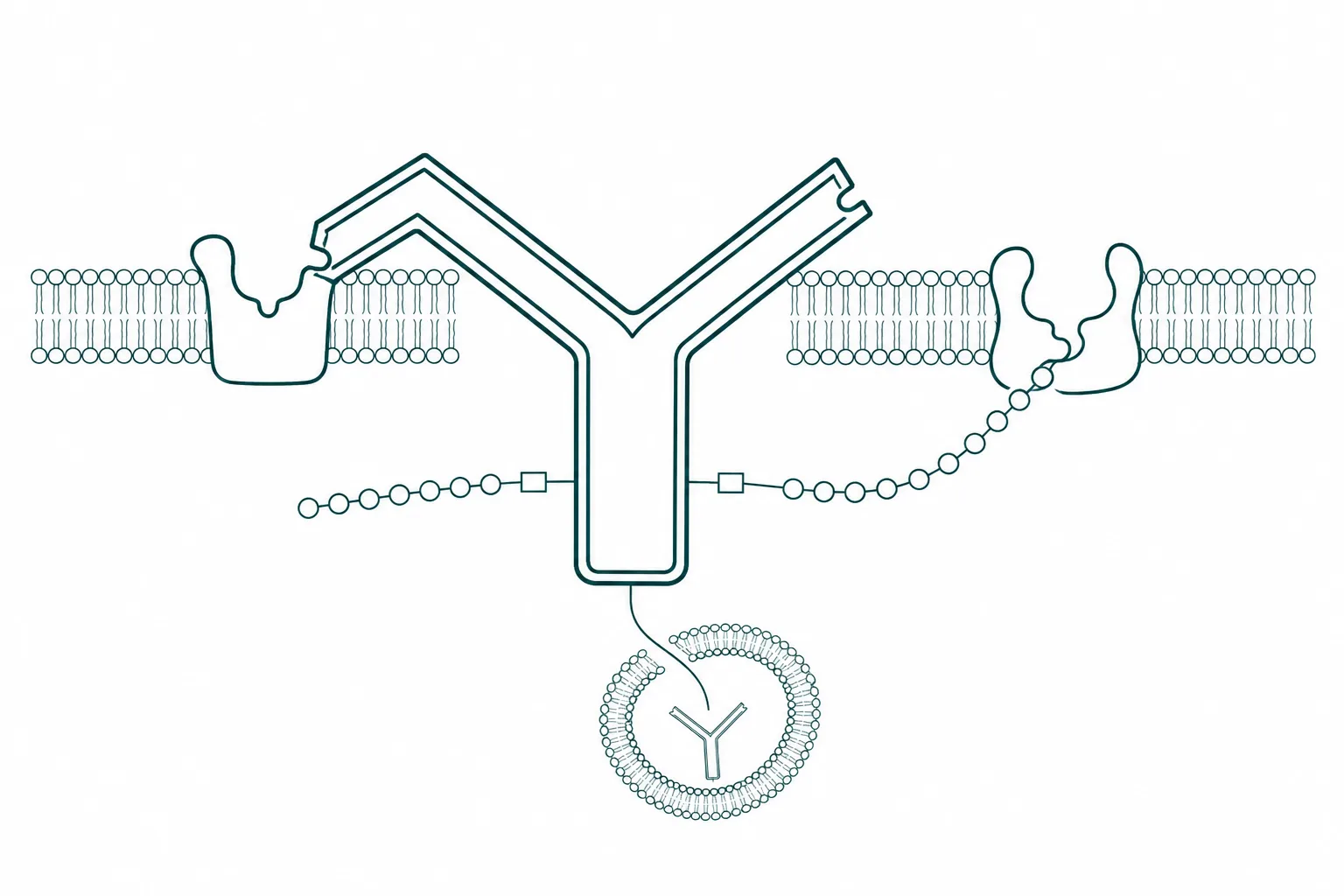
Three ways to extend a peptide, and what each costs
Native GLP-1 is cleared within minutes by dipeptidyl peptidase-4 cleavage and renal filtration. The established engineering response has two branches. Acylation attaches a fatty acid to a lysine so that the peptide binds albumin reversibly, as in liraglutide and semaglutide, whose development history is well documented 2. PEGylation adds a hydrophilic polymer that increases hydrodynamic size past the renal filtration threshold. Each buys persistence and each charges for it, in receptor potency, in manufacturing complexity or in characterisation burden.
Antibody conjugation is the third branch. Its cost structure differs from the other two. The carrier is far larger, roughly 150 kDa against a peptide of three to four kDa, so tissue distribution changes and so does the practical meaning of receptor access. But the carrier is also a binding molecule with its own specificity, which turns what would elsewhere be a passive extension element into a second pharmacological component. That is a design choice rather than a by-product, and it explains why the approach is discussed as a strategy of its own.
| Strategy | Mechanism of persistence | Carrier pharmacology | Principal cost |
|---|---|---|---|
| Lipidation | Reversible albumin binding slows filtration | Inert | Potency loss from albumin occupancy; spacer and chain tuning |
| PEGylation | Increased hydrodynamic size past the filtration threshold | Inert | Heterogeneous products; polymer clearance and anti-polymer antibodies |
| Antibody conjugation | FcRn-mediated recycling of the antibody scaffold | Active, if the antibody has a target | Large size; complex characterisation; anti-drug antibody risk across two components |
FcRn recycling: why antibodies persist and peptides do not
A common intuition holds that antibodies last because they resist degradation. They do not. Immunoglobulin G is taken up continuously by cells through fluid-phase pinocytosis and delivered to endosomes. There, at acidic pH, the neonatal Fc receptor binds the Fc region and diverts the antibody from the lysosomal route; it is returned to the cell surface, where the neutral pH of plasma releases it. Immunoglobulin that fails to bind is degraded. The result is a salvage pathway that gives IgG a circulating half-life of roughly three weeks in humans 1.
The consequence for conjugate design is that persistence is a property of the Fc region and of the interaction at endosomal pH, not of the whole molecule. A peptide attached to an intact antibody rides the salvage pathway because it is physically attached to the thing being salvaged. This is a different mechanism from albumin binding, though albumin is also recycled by FcRn. Here the half-life is conferred by a much larger protein with an established pharmacokinetic profile, and the engineering burden shifts from tuning the peptide to preserving the scaffold's FcRn behaviour after chemical modification.
Conjugate architecture
The reference molecule is a fully human monoclonal antibody against the human GIP receptor, conjugated at engineered cysteine positions at residue 384 to a GLP-1 agonist peptide analogue through a linker, giving two peptides per antibody. Its average molecular weight is 153,514 Da 4. The peptide carries an alpha-aminoisobutyric acid at position 2, the standard defence against dipeptidyl peptidase-4 cleavage, and a flexible glycine-serine spacer, (GGGGS) repeated three times, between the pharmacophore and the attachment point, which ends in a bromoacetylated lysine for coupling to the antibody cysteine 4.
Three architectural decisions are visible in that description. Site-specific cysteine engineering fixes valency at exactly two peptides per antibody, which avoids the heterogeneous mixture produced by random lysine coupling. The long flexible spacer lets the peptide reach its receptor without being sterically blocked by the antibody. And the choice of a bromoacetyl handle yields a stable thioether bond. The earlier series of such molecules was reported in obese mice and monkeys, where conjugates of an antagonist antibody with GLP-1 peptide reduced body weight more than the antibody alone or a control antibody conjugate, suggesting a combined effect 3.
When the carrier has its own pharmacology
Most extension strategies aim for a carrier that does nothing. Here the antibody antagonises GIPR while the peptide agonises the GLP-1 receptor. In cells expressing both receptors, simultaneous binding and rapid receptor internalisation were reported to amplify endosomal cyclic AMP production, which the authors of the earlier study offered as a possible explanation for the efficacy of the bispecific format 3. That is an in vitro observation, and it should be read as a hypothesis about mechanism, not as an established account of what happens in a person.
Preclinical pharmacokinetics
Pharmacokinetics were measured with two assays: one for intact conjugate (antibody with at least one peptide attached) and one for total antibody, with or without peptide. After a single intravenous administration in mice, both followed biphasic clearance with a gradual divergence over two weeks. Mean terminal half-life was 118 hours for the intact conjugate and 206 hours for total antibody 4. After subcutaneous administration in female cynomolgus monkeys the corresponding values were 207 and 292 hours. In obese male monkeys, half-life ranged from 189 to 222 hours by the intact assay and 231 to 284 hours by the total assay 4.
The gap between the two assays carries information. Total antibody outlasts intact conjugate, which means the peptide payload is lost or degraded faster than the scaffold is cleared. A conjugate's effective pharmacology therefore decays faster than its antibody concentration would suggest. This is a feature of the design, not a flaw in the measurement, and it is why any claim about half-life in a conjugate has to say which analyte was measured.
What the phase 1 study measured
The phase 1 study was randomised, double-blind and placebo-controlled in adults with obesity. Forty-nine participants were enrolled in seven single-ascending-dose cohorts and followed for up to 150 days; 26 participants were enrolled in three multiple-dose cohorts, dosed every four weeks for three administrations and followed until day 207. Safety and tolerability were the primary endpoints; pharmacokinetics and immunogenicity were secondary and weight was exploratory 4.
Maximum plasma concentrations were reached by day 4 to 6, with a mean half-life of 14 to 24 days across intact and total assays, around 21 days. In the highest multiple-dose cohort, body weight was still reduced by 11.2% relative to baseline 150 days after the final administration 4. The common adverse events were gastrointestinal, mostly mild, appearing 8 to 12 hours after the first administration and lasting around 72 hours, and no severe or serious events were reported. The cohorts were small, the weight measure was exploratory, and the study was not designed to estimate effect size. What it shows is that exposure and a pharmacodynamic signal persist for months after a single administration, a pharmacokinetic fact that follows directly from the architecture.
A phase 3 programme followed. The registry record for one study, in adults with type 2 diabetes and obesity or overweight, lists a randomised, double-blind, placebo-controlled design with 1,105 participants enrolled and an estimated primary completion in January 2027 5. Registry entries are statements of intent and status, and they should be read from the live record.
Immunogenicity and analytical consequences
A conjugate has more antigenic surface than either component alone. Anti-drug antibodies can arise against the antibody, against the peptide, against the linker region, or against the neoepitope created where they join. A response against the peptide is particularly consequential because it can cross-react with the endogenous hormone. Immunogenicity was a secondary endpoint in the phase 1 study 4, but the paper text consulted for this article does not report an anti-drug antibody frequency, so no rate is stated here.
Analytical characterisation changes in kind. A 3 kDa peptide is characterised by reversed-phase chromatography and mass spectrometry against a defined sequence. A 150 kDa conjugate needs intact-mass analysis, peptide mapping, assessment of drug-to-antibody ratio and a check that the conjugation site is the intended one. The pharmacokinetic work above is itself a demonstration: it required separate immunoassays, one capturing the antibody Fc and detecting the peptide, another detecting any Fc-containing species 4.
In one sentence
Antibody conjugation gives a peptide the half-life of the scaffold, about 21 days in the one human dataset available, and in exchange adds size, a second pharmacology, a second analytical problem and a second immunological one 4.
References
- FcRn: the neonatal Fc receptor comes of age
- The Discovery and Development of Liraglutide and Semaglutide
- GIPR antagonist antibodies conjugated to GLP-1 peptide are bispecific molecules that decrease weight in obese mice and monkeys
- A GIPR antagonist conjugated to GLP-1 analogues promotes weight loss with improved metabolic parameters in preclinical and phase 1 settings
- Efficacy and Safety of Maridebart Cafraglutide in Adult Participants With Type 2 Diabetes Mellitus Who Have Obesity or Are Overweight (MARITIME-2)