SYNCHRONIZE-1: Survodutide's First Phase 3 Readout
The phase 2 programme left open whether glucagon-receptor agonism would show up anywhere other than the scale. The first phase 3 trial ran for 76 weeks, carried a prespecified imaging substudy, and reported two sets of numbers from two estimands.
The first phase 3 readout established that the two-receptor pairing holds up across 76 weeks in a large randomised population, and that the compartment-level question the phase 2 programme had raised could only be addressed by a substudy of 25 participants per arm. SYNCHRONIZE-1 randomised 725 adults with obesity and without diabetes, in equal proportions, to one of two survodutide dose-escalation arms or to placebo. The two primary endpoints were the percent change in body weight and the proportion reaching a reduction of at least 5% from baseline, both at week 76 1. Evidence tier for the trial's own findings throughout this article: human randomised controlled trial. Evidence tier for the mechanistic rationale that motivated it: rodent models and human phase 2.
The phase 2 trial had left three things genuinely open. Whether the effect survived a longer exposure than 46 weeks. Whether the glucagon arm's energy-expenditure rationale would register in specific tissue compartments rather than only in total body mass. And what proportion of participants would complete escalation 3. The phase 3 trial addressed the first and third directly. The second it addressed through a prespecified imaging substudy, and the limits of that substudy are the most important thing to understand about this readout.
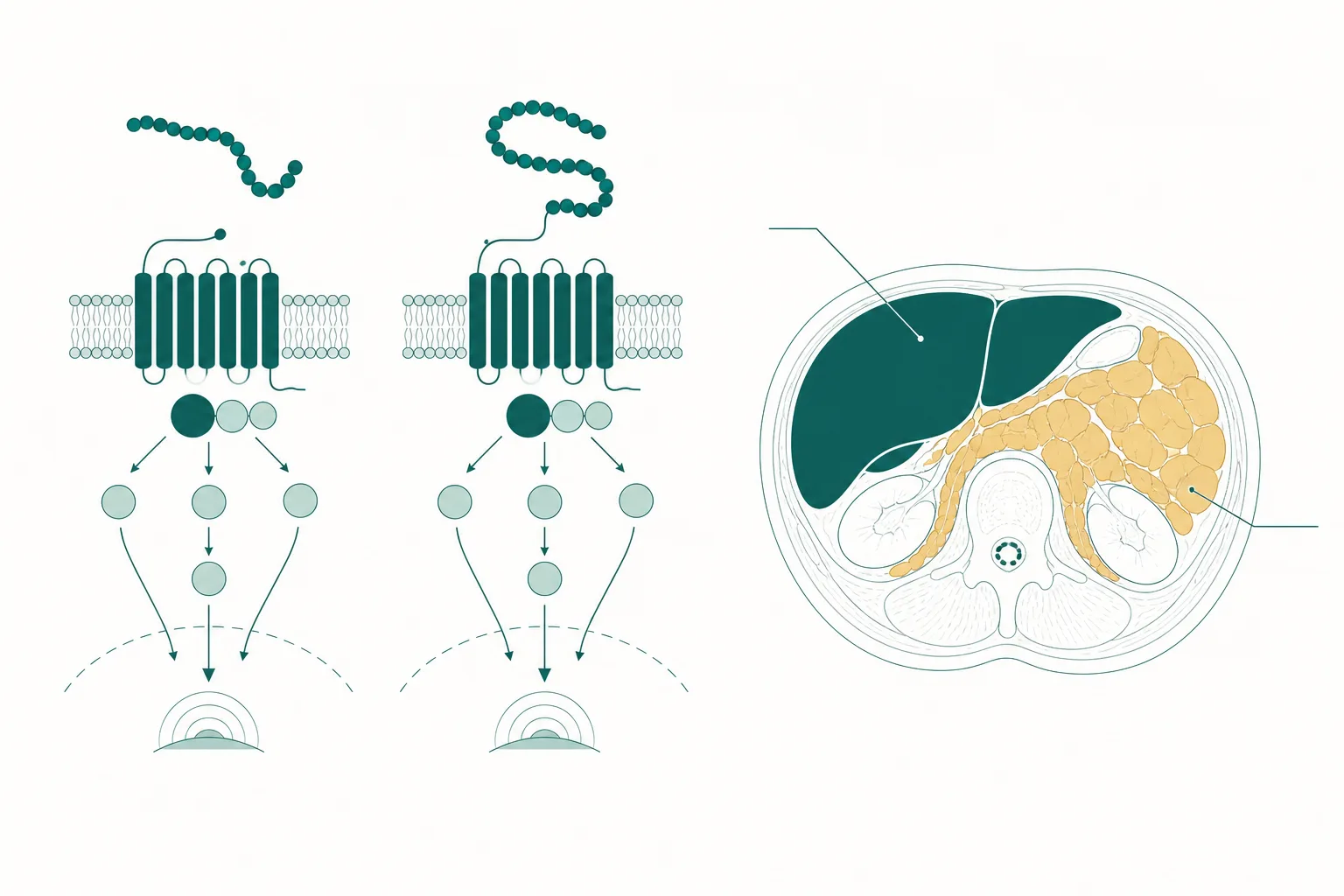
What adding glucagon-receptor agonism is meant to do
Evidence tier for this section: rodent models, plus inference from human phase 2. The rationale for pairing a glucagon receptor agonist with a GLP-1 receptor agonist is that the two act on different sides of the energy balance equation. GLP-1 receptor agonism reduces intake. Glucagon receptor agonism is proposed to raise energy expenditure and to act directly on hepatic lipid handling. The second limb is the contested one, because glucagon receptor agonism also raises blood glucose, which is why the ratio between the two activities in a single molecule is a design parameter rather than an afterthought.
If that rationale is correct, the consequence is testable and specific: the compound should alter the visceral and hepatic compartments more than a change in total body mass alone would predict. This is why the trial registry lists relative change in visceral fat volume, subcutaneous fat volume, lean body volume and liver fat content among the secondary endpoints, alongside the conventional anthropometric and metabolic measures 2. The hypothesis was built into the endpoint list before the trial read out.
Trial design: population, duration, blinding
Evidence tier for this section: human randomised controlled trial, registered design. Eligibility required a body-mass index of 30 or higher, or 27 or higher with at least one obesity-related complication; participants with diabetes were excluded 1. Randomisation was 1:1:1 to the lower-dose arm, the higher-dose arm, or placebo, with quadruple masking. All participants received counselling on lifestyle modification. Both active arms escalated to their assigned level rather than starting there, which matters for how the adverse-event data should be read.
The registered record gives 118 sites across 14 countries, with the trial running from November 2023 to February 2026 2. Mean age at baseline was 47.1 years; 40.6% of participants were men; mean body-mass index was 37.9 and mean body weight 108.8 kg 1. Nearly 70% of the population carried at least one obesity-related complication, most commonly hypertension and dyslipidaemia 6. This is a conventionally designed registration trial, and nothing about its structure is unusual. The interpretive difficulties lie entirely in the analysis and in the substudy.
Two estimands, two sets of figures
Evidence tier for this section: human randomised controlled trial, prespecified analysis. An estimand is a formal statement of what quantity a trial is estimating, including how it handles participants who stop treatment or take something else. The primary analysis used the treatment-regimen estimand, which incorporates early discontinuation, use of protocol-prohibited obesity medications, and a prolonged escalation period 1. That is the conservative framing: it asks what happened to people assigned to a strategy, not what happened to people who stayed on it.
| Measure | Lower-dose arm | Higher-dose arm | Placebo |
|---|---|---|---|
| Participants randomised | 241 | 242 | 242 |
| Mean change in body weight from baseline | −12.2% (95% CI −13.6 to −10.8) | −13.0% (95% CI −14.4 to −11.6) | −5.4% (95% CI −6.9 to −4.0) |
| Proportion with a reduction of at least 5% | 72.6% | 71.9% | 46.3% |
| Gastrointestinal adverse events | 80.9% | 89.7% | 47.9% |
Conference coverage of the same trial reports an efficacy estimand alongside the primary one, giving −15.3% in the lower-dose arm, −16.6% in the higher-dose arm and −3.2% in placebo 6. The gap between the two analyses is the entire substance of most reporting disagreements about this trial. Neither figure is wrong. They answer different questions, and the efficacy estimand produces the larger separation because it discounts the discontinuations and the prohibited-medication use that the treatment-regimen estimand absorbs.
The imaging substudy, and how far it reaches
Evidence tier for this section: human randomised controlled trial, prespecified substudy, small sample, figures currently available through conference reporting rather than the primary publication. The substudy enrolled 25 participants per arm with magnetic resonance imaging at baseline and at the end of the trial. Reported relative changes at week 76 in the higher-dose arm were −63.1% for liver fat against −24.5% in placebo, and −34.0% for visceral fat against −11.8% in placebo 6. Lean volume fell by around a tenth, and the derived share of total tissue change attributable to fat exceeded 89%.
Three qualifications apply. The substudy is small, so its confidence intervals are wide relative to the headline figures and the "up to" phrasing used in trade coverage refers to the highest arm rather than an average effect. Compartment-level imaging change is a mechanistic observation and not an outcome in itself. And the per-arm figures above come from conference reporting; a researcher relying on them should read them from the publication's supplementary material rather than from secondary coverage. The one claim the substudy does support is the directional one the glucagon rationale predicted: the visceral and hepatic compartments moved further, proportionally, than total body mass.
Adverse events during escalation, and discontinuation
Evidence tier for this section: human randomised controlled trial. Gastrointestinal symptoms were the most common adverse events, typically mild to moderate, and occurred in 80.9% of the lower-dose arm, 89.7% of the higher-dose arm and 47.9% of placebo 1. No deaths were reported. Conference coverage puts discontinuation attributed to gastrointestinal events at 17.8%, 20.2% and 2.9% respectively, with premature discontinuation across the trial for any reason discussed at the 35% to 40% level 6. The ACC summary records the authors' own listed limitations: no active comparator, a substantial proportion of participants discontinuing the regimen, and exclusion of participants with uncontrolled hypertension 4.
Those numbers are a dose-dependent gradient, and the gradient is the informative part. Both active arms escalated over an extended period and the higher arm recorded both more symptoms and more discontinuation, which is the pattern expected if tolerability rather than potency sets the practical ceiling for this receptor pairing. It also explains why the two active arms differ so little on the primary endpoint: participants assigned to the higher arm did not uniformly reach or remain at it.
What a placebo-controlled trial cannot settle
Evidence tier for this section: methodological. SYNCHRONIZE-1 had no active comparator 4. It therefore cannot establish where this compound sits relative to any other molecule in its class, and cross-trial comparison does not repair that gap: populations, escalation schedules, trial durations, placebo-arm behaviour and estimand choice all differ between programmes. A difference in reported percentages between two trials is not evidence of a difference between two compounds.
The trial also cannot isolate the glucagon contribution. A dual agonist tested against placebo shows the effect of the molecule, not the effect of one of its two activities. Isolating that would require comparison against a matched GLP-1-only agonist, or a design that varies the ratio between the two activities. Neither is what this trial did. The imaging substudy is compatible with a glucagon-specific hepatic effect, and compatible with a non-specific consequence of a larger change in body mass.
The programme still outstanding
Evidence tier for this section: one further human randomised controlled trial reported, one ongoing. The hepatic question has since been addressed by a separate phase 3 trial in 216 adults with obesity and at-risk metabolic dysfunction-associated steatotic liver disease, randomised 2:1 to the higher-dose arm or placebo for 48 weeks, with co-primary endpoints of a relative reduction of at least 30% in imaging-assessed liver fat content and percent change in body weight 5. Its authors list a short duration and recruitment confined to two countries among its limitations.
What remains outstanding is the harder evidence. A cardiovascular outcomes trial in this programme has a published rationale and design but no reported result 7. Biopsy-assessed hepatic histology, rather than imaging-assessed fat content, has not been reported at phase 3 scale. Both of those are the endpoints that would convert a compartment-level observation into a clinical one, and neither has read out.
What this means for a researcher reading the literature
Three reading rules follow from this readout. First, check which estimand a quoted figure comes from before comparing it with anything; the same trial supports two sets of numbers that differ by roughly three percentage points in the active arms and two in placebo 16. Second, check whether a compartment figure comes from the full randomised population or from the 25-per-arm imaging substudy, because almost all the visceral and hepatic numbers in circulation come from the latter. Third, treat the placebo arm as data: a control group changing by more than 5% from baseline tells you something about how trials in this area now behave.
The phase 2 trial had demonstrated that the pairing was tolerated and that its effect scaled with the assigned level 3. The phase 3 trial added duration, a much larger population, prespecified compartment imaging, and an honest accounting of how many participants stopped. What it did not add was a comparison against another molecule, a separation of the glucagon limb from the GLP-1 limb, or a hard clinical endpoint. Those are three distinct gaps, and none of them is closed by a larger trial of the same design.
References
- Survodutide Once Weekly for the Treatment of Adults with Obesity
- A Phase 3, Randomised, Double-blind, Parallel-group, 76-week, Efficacy and Safety Study of BI 456906 Administered Subcutaneously Compared With Placebo in Participants With Overweight or Obesity Without Type 2 Diabetes (NCT06066515)
- Glucagon and GLP-1 receptor dual agonist survodutide for obesity: a randomised, double-blind, placebo-controlled, dose-finding phase 2 trial
- SYNCHRONIZE-1: Survodutide Led to Significant Weight Loss in Adults With Obesity (journal scan)
- Survodutide in adults with obesity and metabolic dysfunction-associated steatotic liver disease: SYNCHRONIZE-MASLD, a randomized, double-blind, placebo-controlled phase 3 trial
- Survodutide Phase 3 Data Signal Metabolic Gains Beyond Weight Loss
- Survodutide for the Treatment of Obesity: Rationale and Design of the SYNCHRONIZE Cardiovascular Outcomes Trial