evidence base
Epitalon and Telomerase: An Assessment of the Evidence Base
The claims made for epitalon are specific, mechanistic and testable. The evidence behind them is small, concentrated in a single research programme, and largely unreplicated. That combination is the finding.
There is not, at present, evidence of a quality that can support that claim. Epitalon — also written epithalon — is a synthetic tetrapeptide, alanyl-glutamyl-aspartyl-glycine (Ala-Glu-Asp-Gly), presented as a peptide bioregulator modelled on epithalamin, a preparation extracted from the pineal gland. The proposition that it induces telomerase rests principally on one in vitro report in cultured human somatic cells 1. The surrounding claims — a reduced incidence of spontaneous tumours in transgenic mice 3, and reduced mortality in a human cohort followed over years 2 — originate largely from the same research programme, and the human work is observational rather than a controlled trial. This article is about the structure of that evidence base rather than about the compound's plausibility. The two questions are separate, and only the first can currently be answered.
What epitalon is, and where the claims come from
Epitalon is a four-residue peptide: alanine, glutamic acid, aspartic acid, glycine. Four residues is very short for a signalling molecule, and the activity proposed for it is correspondingly unusual. It is described not as a conventional receptor ligand but as a peptide bioregulator, a category defined within Russian gerontology as short peptides that act on gene expression directly. The compound was developed as the synthetic, defined-sequence successor to epithalamin, a polypeptide preparation extracted from bovine pineal glands, which had been studied in the Soviet Union from the 1970s onward.
The research programme behind both compounds is centred on the St Petersburg Institute of Bioregulation and Gerontology and associated laboratories, and it has run continuously from the 1980s to the present. It is a substantial body of work by volume. Its distinguishing feature, for the purpose of appraising it, is that the great majority of the primary reports on epitalon share authorship, institutional affiliation and methodological approach. The findings did not arise independently in several laboratories and then converge on the same conclusion. They were produced by one programme, and they have largely stayed there.
That is an observation, not an accusation. Single-laboratory origin is the normal starting condition for any new compound; every drug begins somewhere. It becomes a problem only when decades pass and the finding is still confined to the place it started. The central in vitro result was published in 2003 1, and the international literature does not contain a substantial independent replication of it. Twenty-three years is long enough that the absence itself carries information.
What telomeres and telomerase actually do
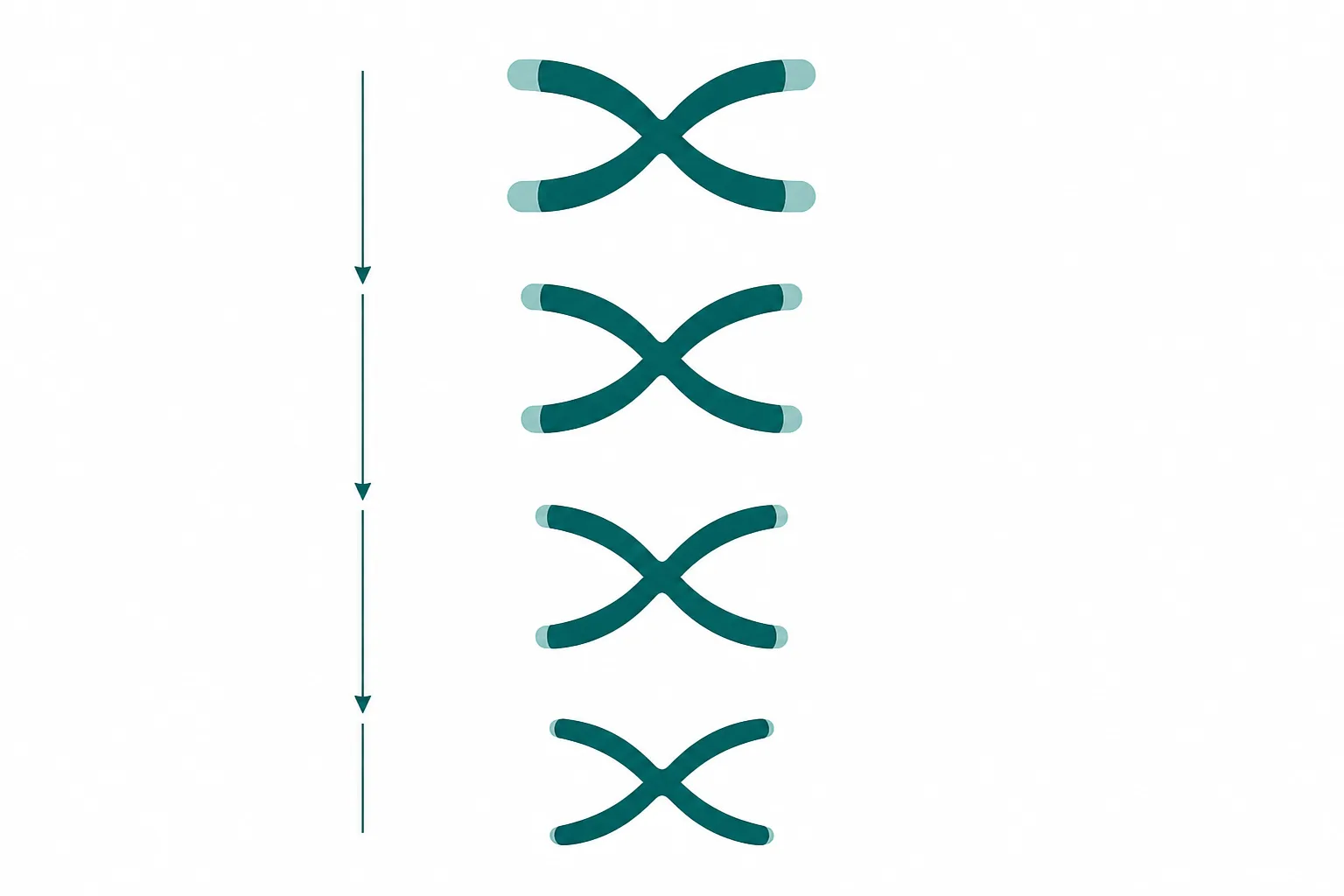
Telomeres are repetitive DNA sequences that cap the ends of linear chromosomes. In humans the repeat unit is TTAGGG, tandemly repeated for several kilobases and bound by a protein complex that stops the chromosome end being read by the cell as a double-strand break. Because DNA polymerase cannot fully replicate the lagging strand to the very end of a linear template, a small amount of terminal sequence is lost at every round of replication. Telomeres therefore shorten as somatic cells divide, and once they become critically short the cell enters replicative senescence or dies 4.
Telomerase is the enzyme that counteracts this. It is a ribonucleoprotein reverse transcriptase: a catalytic protein subunit, TERT, paired with an RNA component that supplies the template for adding telomeric repeats back onto the chromosome end. It is active in germ cells, in stem cell compartments and in some rapidly renewing tissues. In the large majority of human somatic cells it is transcriptionally repressed 4.
The point most often lost in popular accounts is why that repression exists. It is not a design flaw that evolution failed to correct. Limited replicative capacity is a barrier to malignant transformation: a cell lineage accumulating oncogenic mutations will usually run out of telomere before it can accumulate enough of them to become a tumour. Telomere shortening is a tumour-suppressive mechanism as much as it is an aging phenotype, and the two roles cannot be separated by preference. Human telomere biology is correspondingly bidirectional in its disease associations — both short and long telomeres carry risk, and the relationship with mortality is not a simple monotonic one 5.
The three claims, and what supports each
The claims made for epitalon fall into three groups, and they rest on evidence of very different types. Keeping them separate is essential, because the strongest-sounding claim rests on the weakest design.
| Claim | Evidence type | Model system | Independently replicated? |
|---|---|---|---|
| Induces telomerase activity | In vitro assay | Cultured human somatic cells | Not substantially |
| Elongates telomeres | In vitro measurement | Cultured human somatic cells | Not substantially |
| Reduces spontaneous tumour incidence | Controlled animal experiment | HER-2/neu transgenic mice | Not substantially |
| Reduces mortality | Observational cohort follow-up | Human, non-randomised | No |
| Extends human lifespan | Inference drawn from the above | Mixed | No |
The 2003 in vitro report is the origin of the telomerase claim: cultured human somatic cells exposed to the peptide were reported to show induced telomerase activity and lengthened telomeres 1. Taken at face value that would be a significant result, because inducing telomerase in a normal human somatic cell is not a trivial thing for a four-residue peptide to accomplish. Which is precisely why it needs replication. The more mechanistically surprising a claim is, the more independent confirmation it requires, and this one has not received it in the international literature.
The animal claim is better designed than the human one. Spontaneous mammary tumour development in HER-2/neu transgenic mice is a defined, quantifiable endpoint, and a reported reduction in tumour incidence in that model is a controlled experiment with a control group and a countable outcome 3. It is also, worth noting, the opposite of what a telomerase activator might naively be expected to produce — a point returned to below. It remains a rodent finding in one transgenic strain, and it has not been reproduced elsewhere.
The human claim is the most cited and the least able to carry the weight placed on it. It comes from long-term follow-up of a cohort of older adults given pineal and thymic peptide preparations, reported as showing reduced mortality relative to an untreated group over a period of years 2. That is an observational design. Participants were not randomised in any adequately described manner, allocation and blinding are not reported to a contemporary standard, and the comparison group is not a matched control arm in the sense a trial would require.
Why the design of the human study is decisive
An observational cohort compares people who received something with people who did not, and those two groups differ in every respect that produced the difference in the first place. Older adults who enrol in and remain within a long-running peptide programme are, on average, more engaged with their own health, more medically supervised, more mobile and more likely to survive for reasons entirely unrelated to what they were given. This is confounding by indication, and in geriatric cohorts it is not a technicality: it is comfortably large enough to manufacture mortality differences of the magnitude reported.
Randomisation exists to sever that link, which is why its absence is decisive rather than merely regrettable. Nor is the problem repaired by duration. A longer follow-up of a confounded cohort yields a more precisely estimated confounded result; the precision improves and the bias does not. A mortality claim is among the strongest claims medicine makes, and it demands among the strongest designs. This evidence does not have one.
Reporting standards in the source publications
Separately from design, the source publications are difficult to appraise. Some of this is a matter of era — much of the foundational work predates the reporting checklists now expected of clinical and preclinical research — and some of it is a matter of venue. The practical consequence is the same either way.
- Sample sizes are small, and formal power calculations are generally not presented.
- Methodological detail — assay conditions, blinding, handling of losses to follow-up — is frequently reported too briefly to allow independent reconstruction of the experiment.
- Allocation in the human work is not described in a way that lets a reader determine how the groups were actually formed.
- Effect sizes are often given without confidence intervals, so the precision of the estimate cannot be judged.
- Much of the foundational material appeared in Russian-language journals and is available internationally only as abstracts or translations, which limits the scrutiny it can receive.
- Because the same programme reports across many compounds and many endpoints, the total number of comparisons performed is not recoverable, so the likelihood of chance findings cannot be assessed.
None of these observations shows any particular result to be wrong. They show that the results cannot be independently checked from what has been published, which for an evidence base this concentrated is the more relevant limitation. Where an entire claim rests on one programme's reports, the appraisability of those reports is doing all of the work.
The telomerase counterweight
The mechanism proposed for epitalon deserves to be taken seriously in both directions, and the second direction is almost always omitted from summaries of this compound.
Telomerase reactivation is one of the defining molecular features of human cancer. The large majority of human tumours — the figure commonly cited is around 85 to 90 per cent — reactivate telomerase, and most of the remainder reach the same end through an alternative lengthening mechanism 4. Unlimited replicative potential is a requirement for malignancy, and telomerase is how most cancers obtain it. This is not a peripheral association. It is among the most consistent findings in the molecular biology of cancer, and it is why telomerase has been pursued as a therapeutic target for inhibition 5.
A compound whose headline mechanism is telomerase induction in human somatic cells is therefore proposing to activate the single most common route by which cancer cells acquire unlimited division. That does not make the compound carcinogenic, and it should not be read as though it did. Systemic telomerase activation has been investigated deliberately as a therapeutic strategy by serious groups, and telomerase induction alone is not sufficient to transform a normal cell — transformation requires additional oncogenic events, and an immortalised cell is not a malignant one. The proposition is not absurd on its face.
What it does mean is that the absence of long-term controlled safety data weighs more heavily here than it would for a compound with a benign proposed mechanism. For most compounds, missing long-term safety data is an ordinary gap of the kind that exists everywhere in early research. For one that claims to lift a tumour-suppressive constraint in human somatic cells, the gap sits exactly where the theoretical risk is located. The reported reduction in mammary tumour incidence in transgenic mice does not close it 3: that is a different species, one specific transgenic model, one tumour type, and an observation window bounded by a mouse lifespan. Rodent tumour incidence over roughly two years is not a long-term human carcinogenicity assessment, and it was never designed to serve as one.
What would change the assessment
The gap here is specific, which means the remedy is specific too. This is a compound whose claims could be settled. They are not unfalsifiable, merely untested by anyone other than the people who made them.
- Independent in vitro replication: a laboratory with no connection to the original programme measuring telomerase activity and telomere length in cultured human somatic cells, with assay conditions reported in full.
- Pre-registered animal work with defined endpoints conducted elsewhere, including long-term tumour incidence in wild-type strains rather than only the transgenic mammary model.
- A randomised, blinded, placebo-controlled human trial with a registered primary endpoint — the design element the existing human evidence lacks entirely.
- Pharmacokinetic characterisation. A four-residue peptide raises immediate questions about stability, distribution and cellular entry that the existing literature does not answer adequately.
- Long-term human safety follow-up with cancer incidence as a pre-specified outcome, which the proposed mechanism makes a requirement rather than a courtesy.
None of that is exotic. It is the ordinary requirement placed on any compound making claims of this magnitude, and it is what separates a hypothesis from a finding.
The fair summary
The honest position is narrow, and it should stay narrow. Epitalon is a real, defined molecule with a real research literature behind it, produced by researchers working on a coherent hypothesis over several decades. The claims made for it are internally consistent and, in principle, entirely testable. But the in vitro telomerase result is unreplicated 1, the animal result is a rodent result in one transgenic strain 3, and the human result is observational 2. None of the three can support the conclusion drawn from it. Nor do the three together compensate for one another, because they share the limitation that matters most: they come from the same place.
That is a statement about the evidence, not a verdict on the compound. A finding produced by a single group can be correct, and some are. It simply cannot be known to be correct until somebody else finds it too.
References
- Epithalon peptide induces telomerase activity and telomere elongation in human somatic cells
- Peptides of pineal gland and thymus prolong human life
- Inhibitory effect of the peptide epitalon on the development of spontaneous mammary tumors in HER-2/neu transgenic mice
- Telomeres and telomerase: three decades of progress
- Human telomere biology: A contributory and interactive factor in aging, disease risks, and protection