evidence base
AOD9604: A Compound That Worked in Mice and Failed in People
The rodent data were strong, the mechanism was coherent, and the human trials did not replicate it. AOD9604 is the most instructive failure in the peptide literature, and it is rarely described as one.
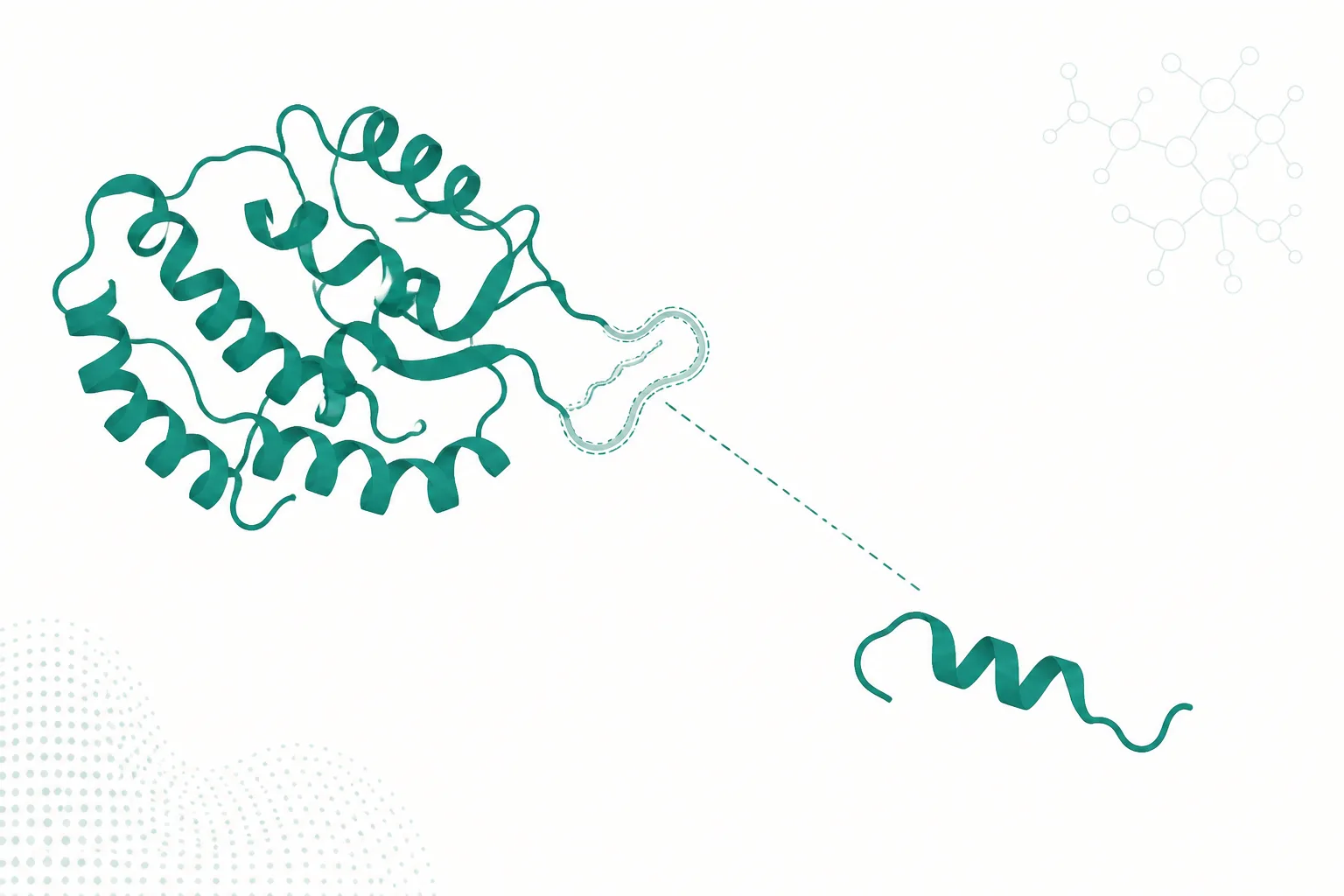
In humans, the controlled evidence does not show that AOD9604 produces fat loss. The compound is a 16-residue synthetic peptide corresponding to the C-terminal region of human growth hormone, developed on the hypothesis that growth hormone's fat-mobilising activity could be separated from its growth-promoting activity and given on its own. In obese mice the hypothesis held: the fragment reduced body fat and increased fat oxidation without raising insulin-like growth factor 1 23. Taken into human clinical trials for obesity, it was well tolerated but did not produce weight loss that separated convincingly from placebo, and development for that indication was discontinued 5. The gap between those two sentences is the reason this compound is worth studying.
The idea: splitting a hormone in two
Human growth hormone does two broadly separable things. It promotes growth, largely through hepatic IGF-1 production, and it alters substrate metabolism, shifting the body toward fat oxidation. The second effect is desirable in the context of obesity. The first is not, because chronic growth hormone excess causes insulin resistance, soft tissue overgrowth and a raised burden of other harms. Growth hormone itself was therefore never a tractable obesity treatment.
Work through the 1980s and 1990s mapped the lipolytic activity to the C-terminal portion of the molecule, and synthetic fragments of that region were shown to retain metabolic activity 1. AOD9604 was the optimised product of that line: the 177–191 sequence with an N-terminal tyrosine added for stability. If the mapping was correct, the fragment should mobilise fat without touching the growth axis. That is a clean, testable structure-function hypothesis, and it is a good one.
What the rodent studies showed
The animal data were consistent and, on their face, convincing. Chronic administration to genetically obese mice reduced body weight and fat mass and increased whole-body fat oxidation, with effects comparable in direction to growth hormone itself 2. Critically, IGF-1 did not rise, which is the result the design predicted and the one that distinguished the fragment from the parent hormone. Metabolic activity was also reported after oral administration, unusual for a peptide of this size and a finding that made the development programme considerably more attractive 4.
| Finding | Model | Reproduced in humans? |
|---|---|---|
| Reduced fat mass | Obese mice | No |
| Increased fat oxidation | Obese mice | Not demonstrated |
| No rise in IGF-1 | Obese mice | Yes — consistent |
| No adverse glucose effect | Obese mice | Yes — consistent |
| Activity after oral administration | Rodent | Not established |
| Good tolerability | Rodent | Yes — confirmed |
Note the pattern in that table. Everything relating to safety and to the absence of growth-axis effects carried across to humans. The efficacy did not. This is a common shape for translational failure and a more informative one than a compound that simply proves toxic: the molecule did what it was designed to avoid doing, and failed at what it was designed to do.
The β3-adrenergic receptor question
One rodent experiment deserves particular attention, because it turned out to matter more than it appeared to at the time. The fragment's metabolic effects were examined in mice lacking the β3-adrenergic receptor, a receptor central to lipolysis and thermogenesis in rodent adipose tissue, and effects were reported that did not depend on it being present 3. The intent was to characterise the mechanism as β3-independent.
The β3-adrenergic receptor is also one of the best-known points of divergence between rodent and human energy metabolism. Rodents have abundant, metabolically active brown adipose tissue under β3 control; adult humans have far less, and the pharmacology of the human receptor differs. An entire generation of β3 agonists produced striking thermogenic effects in rodents and negligible weight effects in humans for precisely this reason. A compound whose metabolic effects were characterised in that system was being characterised in a system with a documented history of not predicting human outcomes.
What happened in humans
AOD9604 was taken into clinical development for obesity by an Australian pharmaceutical company and progressed through human trials. The published safety record is favourable: the hexadecapeptide was assessed as safe and well tolerated across the clinical programme, without the glucose and IGF-1 effects that would be expected of growth hormone 5. On the efficacy endpoint the programme did not succeed. Weight loss in the larger controlled trials did not separate from placebo in the way the earlier data had indicated, and development for obesity was discontinued.
It is worth being precise about what that means and what it does not. It does not mean the compound is inert — it means that at the doses and durations tested, in the populations enrolled, it did not produce a weight effect distinguishable from placebo. That is the finding. It is also, in practical terms, the finding that matters, because it is the one that would have supported the intended use.
Why the gap opened
- Species differences in adipose regulation. Rodent lipolysis is governed substantially through the β3-adrenergic receptor and brown adipose tissue, both of which are far less prominent in adult humans.
- Model differences. Genetically obese mice are a specific, extreme metabolic phenotype, not a scale model of human obesity, and interventions frequently work in them and nowhere else.
- Effect size. A change detectable against the tight variance of an inbred mouse colony can vanish in the variance of a free-living human population.
- Compensation. Human energy balance is defended by behavioural and metabolic feedback over months. A trial long enough to measure meaningful weight change is long enough for that compensation to operate.
- Publication asymmetry. The positive rodent findings are indexed and easy to find. The negative human efficacy result is the harder thing to locate, which is exactly why secondary summaries of this compound tend to describe only the first half of the story.
What happened afterwards
After the obesity programme ended, the compound was investigated for other indications, cartilage and osteoarthritis among them, on the basis of separate preclinical signals. None has produced an approved product. Regulators have separately declined to accept AOD9604 as a permissible dietary supplement ingredient, and the peptide is prohibited in competitive sport under World Anti-Doping Agency rules as a growth hormone fragment.
The favourable human safety data are sometimes cited as though they were evidence of efficacy. They are not. A compound can be entirely safe and entirely ineffective, and demonstrating the first says nothing whatever about the second. Conflating tolerability with activity is among the more common misreadings in this literature, and AOD9604 is the compound where it happens most.
How to establish what happened to a development programme
Because negative results are systematically harder to find than positive ones, it is worth setting out how the outcome of a clinical programme can actually be checked. This is a general method, not specific to this compound, and it resolves most questions of the form "whatever happened to X?".
- Search the trial registries. ClinicalTrials.gov and the Australian New Zealand Clinical Trials Registry record sponsor, phase, enrolment, primary endpoint and status. A registration is created before a trial starts, so it exists regardless of whether results were ever published.
- Compare registered endpoints against any published paper. A trial that reported a secondary endpoint prominently while the registered primary endpoint goes unmentioned is a recognisable pattern.
- Check the sponsor's disclosures. A publicly listed company must disclose materially significant trial outcomes to its exchange, and those announcements are archived. For discontinued programmes this is usually the most direct primary record.
- Look for the indication changing. A compound that moves quietly from its original indication to an unrelated one has usually failed at the first, and the redirection is often documented where the failure is not.
- Check regulator correspondence. Decisions on supplement status, import alerts and approval refusals are public records in most jurisdictions.
Applied to AOD9604, this method yields a coherent account: an obesity programme that reached clinical trials, a published human safety assessment 5, no corresponding publication demonstrating efficacy on the weight endpoint, discontinuation of the obesity indication, and subsequent repositioning toward unrelated musculoskeletal applications. Each element is individually checkable. None of it is visible from the rodent literature alone, which remains the most accessible and most cited part of the record 12.
One caution applies to this reasoning. The absence of a publication is not itself proof of a negative result — trials go unpublished for funding, commercial and administrative reasons that have nothing to do with their findings. What supports the inference here is the combination: a completed clinical programme, no efficacy publication, and abandonment of the indication the programme existed to serve. Any one of those alone would be weak evidence. Together they are not.
What this case is good for
AOD9604 is the most useful compound in this field for calibrating how much weight rodent data can bear, because the full sequence is documented: a coherent mechanism, a well-designed fragment, consistent animal results, orderly clinical development, and a negative efficacy outcome. Nothing went wrong procedurally. The hypothesis was tested properly and it did not hold in humans.
Every compound described elsewhere on this site with promising rodent data and no human trials is, at present, at the stage AOD9604 occupied in 2001 — when everything looked convincing and the question had not yet been asked in people. That is the correct comparison, and it is the reason the model system is worth checking before the conclusion.
References
- Metabolic studies of a synthetic lipolytic domain (AOD9604) of human growth hormone
- Increase of fat oxidation and weight loss in obese mice caused by chronic treatment with human growth hormone or a modified C-terminal fragment
- The effects of human GH and its lipolytic fragment (AOD9604) on lipid metabolism following chronic treatment in obese mice and beta3-AR knock-out mice
- Effects of oral administration of a synthetic fragment of human growth hormone on lipid metabolism
- Safety and Tolerability of the Hexadecapeptide AOD9604 in Humans